Red line plans for licensed areas
Create a red line plan to show which areas of your venue or location you want licensed.
On this page
- What is a red line plan?
- Why you need it
- General requirements
- Licence-specific requirements
- Download your plan
- Change your plan
- Example red line plans
What is a red line plan?
A red line plan is a map of your venue or location with a red line drawn around the areas where:
- you will sell, serve or supply alcohol
- your customers will drink alcohol
- anywhere else they may go with a drink, such as bathrooms.
This is called your licensed area.
We must approve your red line plan when you apply:
- for a licence or permit
- to change your red line plan.
Pre-retail licences do not need a red line plan.
Why you need it
You need your red line plan to:
- meet the legal requirements of your licence or permit
- upload when you apply for a licence or apply to change your red line plan
- keep at your venue or location at all times
- show liquor inspectors or Victoria Police if they ask for it.
As the licence or permit holder, you are responsible at all times for what happens within the red line plan.
General requirements
You can create your red line plan by hand or using a computer.
The red line plan must:
- be at least A4 size
- be neat and easy to read (no wobbly lines)
- outline the licensed area in a continuous red line – if drawing by hand, use pen or ink (not pencil or highlighter)
- show a compass arrow pointing north
- include the address and surrounding street names (or an arrow to the closest street if none nearby)
- show and label key areas, such as bars or registers (point of sale), dining areas, kitchens, toilets, dance floors
- include the measurements of your licensed venue or location
- include the total floor space of your licensed area in square metres
- describe how you will mark the boundaries of your licensed area (for example, walls, barriers, ropes).
Do not use a satellite image to create your plan. It does not show us the internal layout of your venue or location.
Red line plans are public information. Do not include the location of safes in your red line plan.
Licence-specific requirements
Check what extra details you need to provide, depending on your licence or permit type.
Example A and B in this information refers to the red line plan examples.
Open all
- BYO permit
BYO permit (club, restaurant or cafe)
If your BYO permit is for a club, restaurant or cafe, include in your red line plan:
- any areas where customers can drink alcohol at your venue
- toilets and bathrooms. The licensed area cannot include any public areas, such as laneways or footpaths.
Use Example A as a guide. Do not include the footpath or kerbside area shown as AA on the example.
BYO permit (commercial party bus)
If your BYO permit is for a commercial party bus, you do not need a red line plan.
- Full club licence
Include in your red line plan:
- any area where you will sell alcohol, such as bars or registers
- any area where your customers can drink alcohol, including any outdoor areas (for example, a privately-owned courtyard)
- toilets and bathrooms. Do not include storage rooms, unless customers will be able to access them.
You cannot include any public areas in your red line plan, such as laneways or footpaths.
Do not use a satellite image to create your plan. It does not show us the internal layout of your venue.
Use Example A as a guide. Do not include the footpath or kerbside area shown as AA on the example.
- General (including late night) licence
Include in your red line plan:
- any area where you will sell alcohol, such as your bar and register
- any area where your customers can drink alcohol, including any outdoor areas (for example, rear courtyards or beer gardens)
- toilets and bathrooms. Do not include storage rooms, unless customers will be able to access them.
Do not include any kerbside, footpath or laneway areas in your red line plan, even if council has given you permission to use them. If you have council permission, you can do table service or allow customers to drink in those areas up until 11 pm.
Use Example A as a guide. Do not include the footpath or kerbside area shown as AA on the example.
- Major event licence
Include in your red line plan:
- any area where you will sell alcohol
- any area where your customers can drink alcohol, including any outdoor areas
- the layout of your event and all the important areas
- toilets and bathrooms. Do not use a satellite image of the site as the basis for your red line plan.
For larger events, you may need several red line plans that show the areas of activity. If so, you must also provide a larger site plan where we can see the whole event.
Use Example A as a guide but do not include the AA area.
- On-premises (including late night) licence
Include in your red line plan:
- any area where you will sell alcohol, such as your bar and register
- any area where your customers can drink alcohol, including any outdoor areas
- toilets and bathrooms
- any kerbside, footpath or laneway areas that your council has given you permission to use. Label them as AA (authorised area). You do not need to include storage rooms, unless customers will be able to access them.
Use Example A as a guide.
- Packaged liquor (including late night) licence
Include in your red line plan:
- any area where you will sell alcohol, such as your register or checkout
- any area where customers can browse your stock, including cool rooms, storage bays and shelving areas
- toilets and bathrooms (only if they are open to customers). Do not include any areas that your customers cannot access, such as loading docks or back-of-house storerooms.
Use Example B as a guide.
- Producer’s licence
If you have a cellar door (customers visit your location)
Include in your red line plan:
-
any area where you will sell alcohol
-
toilets and bathrooms. Do not include in your plan:
-
areas where you distil, produce or store alcohol, unless you intend to let customers browse, drink or buy alcohol from these areas. Be aware your annual licence renewal fees(opens in a new window) are based on the square metres of your licensed area.
Consider including your gardens or vineyards in your plan if you:
-
frequently serve alcohol directly to customers in these areas (for example, from a bar or kiosk)
-
have events in those areas more than 6 times a year (for example, weddings or other functions). Do not include gardens or vineyards in your plan if:
-
your customers collect a picnic basket (with alcohol), or a bottle of alcohol from inside your red line plan, and then wander your grounds and drink it in your gardens or vineyards
-
you only have a few events a year that use your gardens or vineyards. If you hold events in your gardens or vineyards occasionally (less than 6 times a year) and they are not licensed, you need to apply for a temporary limited licence. This gives permission to extend your licensed area for these events.
Use Example A as a guide. Do not include the footpath or kerbside area shown as AA on the example.
If you do not have a cellar door (customers do not visit)
Include in your red line plan any areas where you:
- distil, produce and store your alcohol (if you produce it yourself)
- store and fulfil orders, if relevant (for example, if you pay someone else to make alcohol under your direction but you store and prepare orders at your location). Use Example B as a guide.
- Remote seller’s licence
Your red line plan must include the area where you will pack the orders ready for delivery.
If you have multiple locations or addresses where you fulfil orders, you must provide a red line plan for each location.
You do not need to include:
- toilets and bathrooms
- storage areas. Use Example B as a guide.
- Renewable limited licence
Your red line plan depends on how you supply alcohol.
If you:
- serve alcohol at your venue (with or without packaged alcohol), follow the on-premises licence requirements.
- only sell packaged alcohol, follow the packaged liquor licence requirements.
- Restaurant and cafe licence
Include in your red line plan:
- any area where you will sell alcohol, for example your till or cash register
- any area where your customers can drink alcohol, including any outdoor areas
- kitchens, toilets and bathrooms
- any kerbside, footpath or laneway areas that your council has given you permission to use. Label them as AA (authorised area). You do not need to include storage rooms, unless customers will be able to access them.
Use Example A as a guide.
- Restricted club licence
Include in your red line plan:
-
any area where you will sell alcohol, such as bars or registers
-
any semi-permanent or temporary structure that you will sell alcohol from during sporting events, such as a canteen
-
any area where your customers can drink alcohol, including any outdoor areas (for example, a privately-owned courtyard)
-
toilets and bathrooms. Do not include in your red line plan:
-
sports fields, ovals or any of the field areas where people are playing sport
-
storage rooms, unless customers will be able to access them
-
any public areas, such as laneways or footpaths. Do not use a satellite image to create your plan. It does not show us the internal layout of your venue.
Use Example A as a guide. Do not include the footpath or kerbside area shown as AA on the example.
If your venue is at a sporting ground
We recommend you do not include the seating next to the sports field in your red line plan. If you do, you will be legally responsible for all alcohol supplied or consumed in that area at all times, even when you’re not there. This includes potential penalties for unaccompanied minors in these areas.
If you want to sell alcohol during sporting events, you need to apply for this as a condition on your licence. This is called adding ‘point of sale’ conditions.
To get point of sale conditions, if you:
- do not have a licence yet, ask for these conditions when you apply
- already have a licence, ask for these conditions by applying to make changes to your existing licence conditions.
- Temporary limited licence
Include in your red line plan:
- the event layout with all the key areas – do not use a satellite image
- show a compass arrow pointing north
- the event address and surrounding street names (or an arrow to the closest street if there are none nearby)
- areas where you will sell alcohol – point of sale, such as a bar or register
- areas where customers can drink alcohol, including outdoor areas
- show and label key areas such as kitchens, toilets and individual stallholders
- include the total floor space of your licensed area in square metres
- describe how you will mark the boundaries of your licensed area (for example, walls, barriers, ropes). Do not include sporting activity areas in your red line plan, such as ovals or bowling greens.
For larger events, you may need several red line plans that show multiple areas of activity. If so, you must also provide a larger site plan where we can see the whole event.
Use Example A as a guide. Do not include areas marked as AA in the example. If you will operate more like a bottle shop, use Example B as a guide instead.
Download your plan
When we approve your red line plan we:
- make it available in the Liquor Portal (all licence types except events)
- email it to you (if you applied for a major event licence or temporary limited licence)
- make it publicly available.
You need to keep a copy at your location or event, ready at all times to show a liquor inspector or Victoria Police if they ask to see it.
To download a copy:
- Log into your Liquor Portal account.
- On the left navigation, click eLicence.
- Find your licence in the list. If it’s not there, you will need to associate your licence first. Go to ‘Associate licences’ and follow the prompts. You need your PIN, which is on your renewal notice or grant email.
- Click on the Action button.
- Choose View plan.
Only the licence or permit holder, or someone with written permission, can access the plan.
Change your plan
You must apply to make changes to your licence or permit (make a variation) if you want to change your red line plan’s:
- size (measured in square metres)
- perimeter (boundary of the licensed area).
If your internal layout changes (for example, you add a stage or move a bar) but the size or perimeter stays the same, you do not need to do this.
However, if the internal change affects your maximum patron capacity, or other licence conditions, you must apply to change these conditions.
If you’re not sure if your changes need a licence or permit variation, email us at contact@liquor.vic.gov.au and include:
- your licence number
- description of what’s changing
- a copy of your new red line plan.
We’ll review your information and advise if you need to make a variation.
Example red line plans
For a venue or event supplying alcohol for people to drink at the event or location only.
Example A
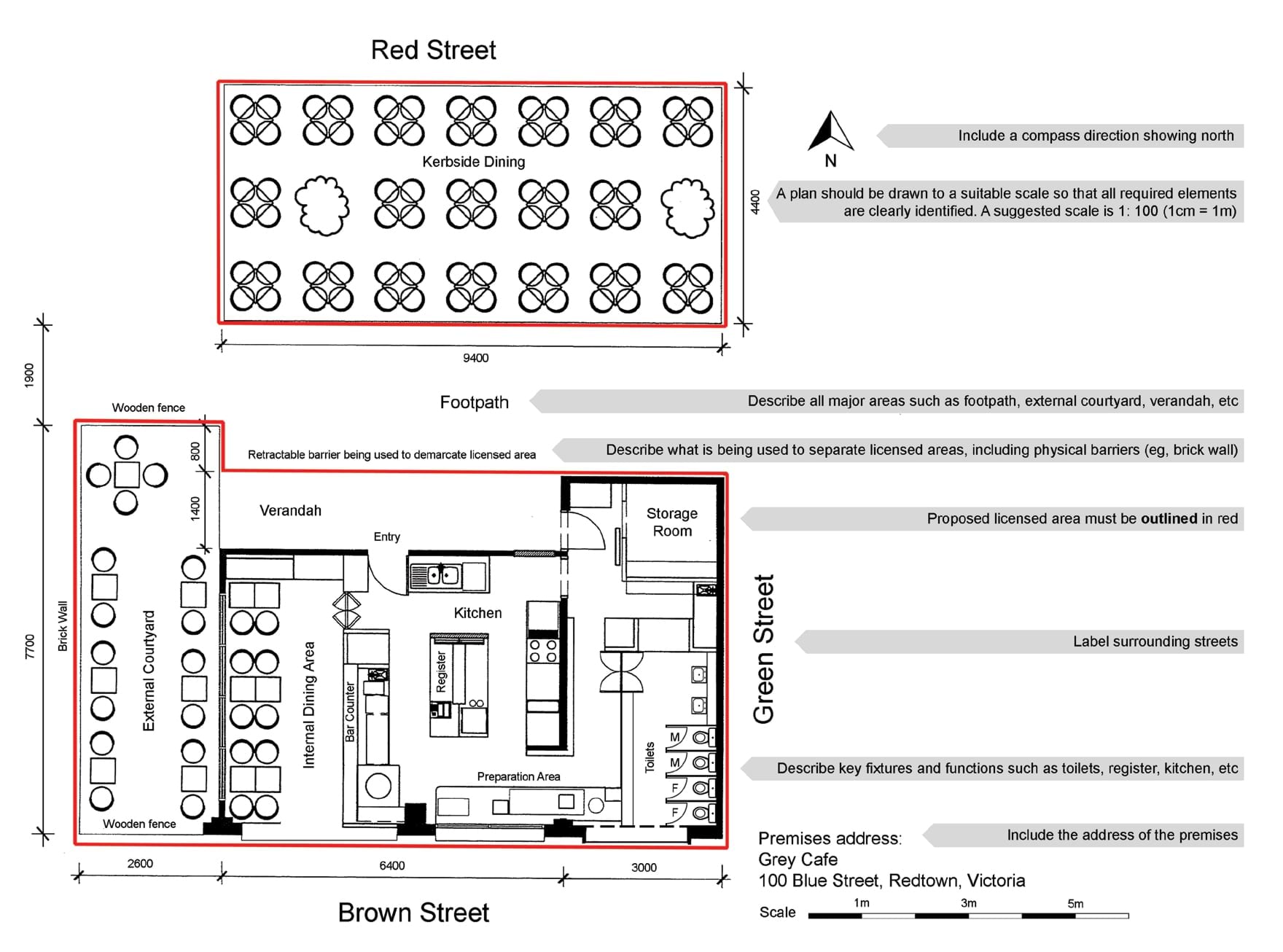
For a venue or event supplying alcohol for people to drink at the event or location only.
Example B
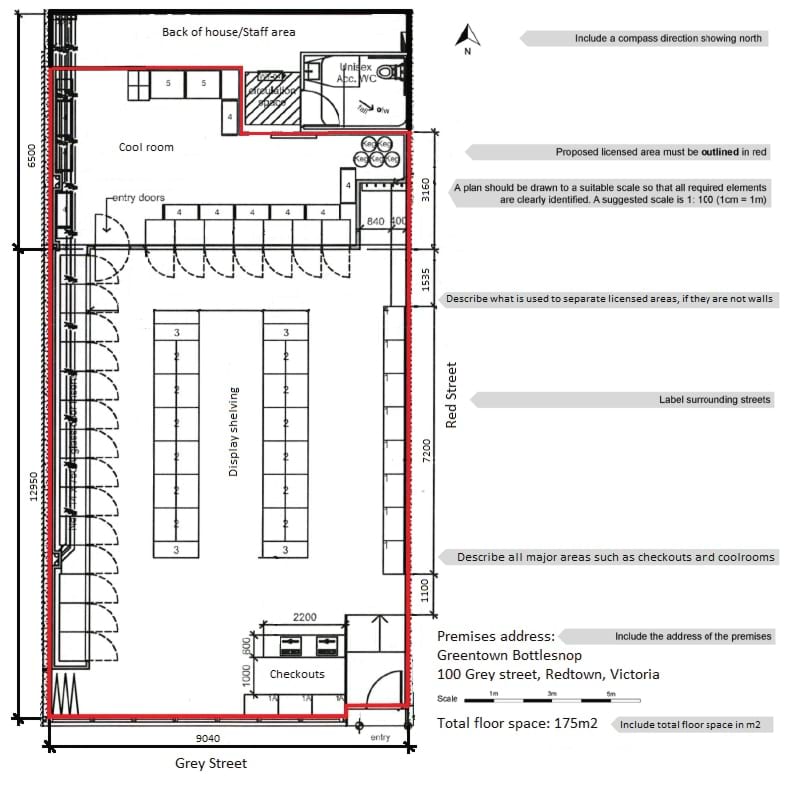
For a shop supplying packaged alcohol only.
Updated 5 December 2025
About the VIC Government
- The Premier and ministers
- Find a Vic Gov department, agency or service
- Strategies and policies
- Inquiries and royal commissions
Grants and programs
Jobs and careers
Arts, culture and heritage
Business and the workplace
- Mentally Healthy Workplaces Framework
- Portable Long Service Authority
- Victoria’s racing industry
- Workforce Inspectorate Victoria
- Liquor licensing, sale and supply
Communities
- Children
- First Peoples - State Relations
- Finding records
- Gender equality & women’s leadership
- LGBTIQA+ equality
- Multicultural communities
- Seniors Online
- Veterans support and commemoration
- Volunteering in Victoria
- Youth Central
Education and training
- Victorian Early Childhood Regulatory Authority
- Early childhood education – information for professionals
- Kinder: Best Start, Best Life
- Education – information for parents
- Schools.Vic - information for schools
- Education grants, programs, awards and events
- PROTECT
- TAFE, training and universities sector
- TAFE Victoria
- Victorian Skills Authority
- Apprenticeships Victoria
- Learn Local
Environment, water and energy
Finance and economy
Health and social support
- Family violence reform
- NDIS Worker Screening Check
- NDIS and disability services and support in Victoria
- Patient Review Panel
- Transforming Trauma Victoria
Housing and property
Law and justice
- Adoption
- Births, deaths and marriages
- Honorary justices
- Machete ban
- Safeguarding Victorians against terrorism
- Stolen Generations Reparations Package
- Victims of Crime
- Victorian Racing Tribunal
Safety and emergencies
- Emergency Recovery Victoria
- Victorian Emergency Relief and Recovery Foundation
- Emergency Recovery Resource Portal
- How well do you know fire
- Fire Services Reform
- Water safety
- Marine Search and Rescue
Science and technology
- Data sharing and open data
- Data.vic - discover and access Vic Gov open data
- Developer.Vic - portal for API developers
- Go.vic URL shortener
- Vic Gov IT project dashboard
- Victoria’s free public wi-fi network
- Cyber security in the Victorian Government
Sport and recreation
Traffic and transport
- Cameras Save Lives
- Transport Fines
- Getting Around
- Transport Planning
- Transport Future
- Climate Change and transport
- Future Directions For Transport
- Transport projects
- Ports and Freight
Working in the Victorian Government
- Single Digital Presence home
- Accommodation and Library Services
- Executive employment in the Victorian public sector
- Budget, procurement and funding
- Careers in the Victorian Government
- Council and Regulator Toolkit
- Guidelines for working in government
- Join a government network
- Standards and guidelines
- VicFleet CarPool
- Victorian Government style guide