Wellbeing planning and leadership
Support on how to develop a cohesive and effective wellbeing agenda at your school.
On this page
About wellbeing teams
Wellbeing teams play a vital role in schools, promoting and protecting the mental health and wellbeing of students.
There is no “one size fits all” approach for school wellbeing teams. They look different across schools. In small schools many of the responsibilities of the “wellbeing team” may rest with the Principal or Assistant Principal.
Regardless of their size or composition, wellbeing teams share common responsibilities. They respond to the school community, build a cohesive mental health agenda and identify clear and achievable priorities.
This guidance is primarily intended to support wellbeing teams in schools. It may also be useful for other school leaders and department area and regional staff.
An effective wellbeing team:
- Understands the school’s needs
- Wellbeing teams build a deep understanding of the mental health and wellbeing needs and aspirations of their school community. They use this knowledge to inform planning and to promote inclusion and the wellbeing of students.
- Plan and set priorities
- Wellbeing teams plan effective policies, processes, and structures that align with the strategic direction of the school.
- Lead tiered interventions and support
- Wellbeing teams lead the school community to put in place strategies, including whole-school approaches, to promote student mental health and wellbeing. They have clear referral pathways and act early when students have mental health and wellbeing concerns. See Figure 1: Tiers of intervention.
- Build capabilities
- Wellbeing teams build the capabilities of staff and students. They encourage the school community to support mental health and wellbeing. They help create a safe and inclusive school.
- Empower and partner
- Wellbeing teams empower students and give them voice in meeting their mental health and wellbeing needs. They partner with families to build engagement and improve outcomes. They partner with the community sector and health services to improve practice and access to resources and supports.
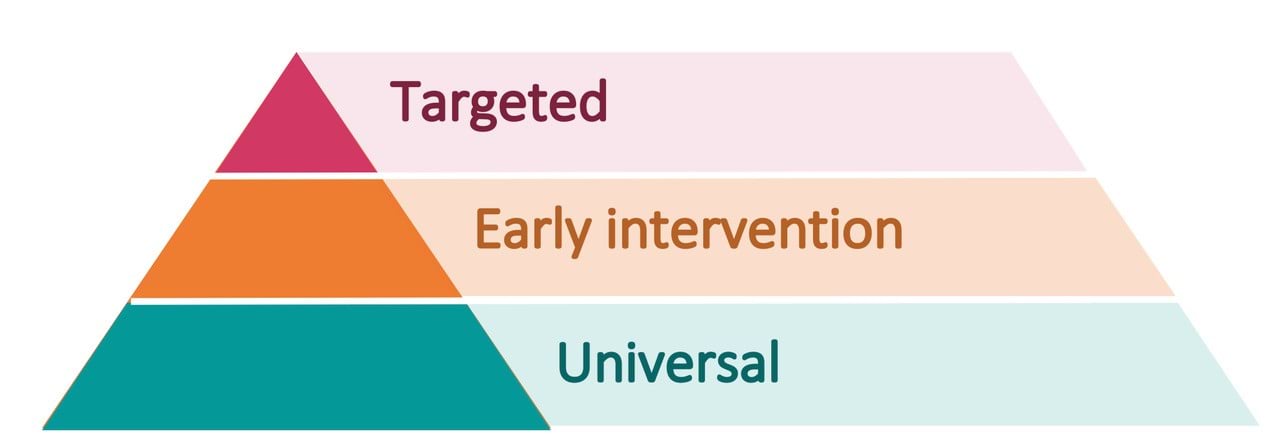
Figure 1: Tiers of intervention
Using FISO 2.0 for wellbeing planning and leadership
The Framework for Improving Student Outcomes (FISO 2.0) places learning and wellbeing at the centre of school improvement.
The FISO 2.0 Improvement Cycle can help Wellbeing Teams lift student learning and wellbeing outcomes. The FISO 2.0 Improvement Cycle (Figure 2) uses an evidence-based model to help schools to implement more effective continuous improvement. It provides a common process to evaluate, prioritise, plan and monitor change.
As the Wellbeing Team works through the improvement cycle, it is important that they consider how their work supports the broader strategic direction of the school.

Figure 2: Four stages of the improvement cycle
Evaluate and diagnose
It is critical to understand the unique needs and aspirations of the school community.
The first stage in the improvement cycle is an opportunity to prioritise student voice. This ensures students are considered throughout the entire process. It also helps students understand their own needs and empowers them to lead change and seek help.
Key actions
- Gather and analyse wellbeing and learning data (see below).
- Use the data to examine the effectiveness of current processes, programs and practices. Consider the following questions:
- Is the team achieving the desired outcomes from this program/process/practice?
- How consistently is the program/process/practice being implemented currently?
- Consider the three tiers of intervention. Where are resources and efforts currently concentrated?
- What are the barriers/enablers towards current progress?
- Use the Schools Mental Health Planning Tool (see Mental Health Fund and Menu: Resources) to understand the mental health and wellbeing needs of the school.
- Look through the FISO Illustrations of Practice (see FISO 2.0: Practice tools). Which illustrations of practice could become areas for improvement?
- Support the work of the School Improvement Team (SIT). This will help ensure wellbeing is prioritised through the school planning process. Depending on the school’s structure and preferences, Wellbeing Teams can:
- be represented on the SIT.
- offer to contribute to the work of the SIT, if it is not possible for a wellbeing team member to be on the team.
- provide/present the wellbeing data and needs to the SIT to ensure their work reflects insights unique to the school.
- Consult with the school community about their needs and aspirations, making sure to:
- seek feedback from staff across the school. It is important to understand their needs and observations about students, as well as the school environment.
- empower students to have influence and articulate their needs and aspirations. For instance, use surveys, student focus groups or consult with the Student Representative Council. For more strategies on engaging students, refer to Amplify.
- draw on perspectives from families and the wider school community. This should include Elders, emerging leaders, and cultural leaders. Engaging with the wider community will ensure actions are representative and inclusive. For information about engaging the school community, refer to: FUSE - Parents and carers as partners.
Key resources
Wellbeing data and support
- Panorama System: access school performance data through Panorama. Includes data dashboards which provide information about achievement, wellbeing and engagement measures. This can support wellbeing teams to identify strengths and areas for improvement.
- Attitudes to School Survey: administered to all students in Years 4-12 in Victorian Government schools. It includes key questions about individual social and emotional wellbeing, physical and mental health, emotional and relational engagement as well as connectedness to school and other factors related to student wellbeing.
- Victorian Student Health and Wellbeing Survey: conducted every two years in sample schools from all sectors, with students in Years 5, 8 and 11. It includes key questions about the health, development, learning, safety and wellbeing of students.
- Your school wellbeing check: available from the Student Wellbeing Hub and drawing on the Australian Student Wellbeing Framework (Commonwealth). The survey contains 25 statements across five areas: leadership, inclusion, student voice, partnerships and support.
- Data coaching: data coaching services are available to help schools interpret and use school data most effectively. Data coaches are experienced in using evidence to support school improvement discussions with leadership teams. To request a meeting with a data coach, complete the data coach support form(staff login required).
Student voice and community engagement
- Amplify: Amplify is the student voice practice guide. The guide supports school staff and students to have conversations, collaborate and take actions to empower students, whatever their current starting points.
- Inclusive Student Voice Toolkit: the Inclusive Student Voice Toolkit was developed with Deakin University and the Youth Disability Advocacy Service (YDAS) to support the implementation of Disability Inclusion and to complement Amplify.
- Parents and Carers as Partners: case studies and strategies for building effective communication, mutual trust and respect and shared responsibility with parents.
- National Voice for our Children: the national non-government peak body for Aboriginal and Torres Strait Islander children. It works to ensure their safety, development, and well-being. It provides activities, tools and resources for children and family services.
Other important data sources that could be relevant at this stage of the improvement cycle include:
- standardised assessments such as PAT-R and PAT-M assessment data
- school-based assessment data
- student management/behavioural data.
Prioritise and set goals
In this stage of the Improvement Cycle, wellbeing teams set priorities and goals that:
- align with the strategic direction of the school
- support the identified needs and aspirations of the school community
- are aimed at all three tiers, with a strong focus on prevention.
School strategic and annual planning
In their strategic and annual planning, schools set priorities and goals related to student wellbeing. Called ‘Key Improvement Strategies’ (KIS), these are critical for improving student wellbeing and mental health promotion.
Effective and achievable KIS will help to reduce the likelihood that students will require more intensive support. They also set up the conditions for all students to have a positive experience at school and achieve their best.
Wellbeing teams can support the SIT to develop the KIS and the actions to deliver the KIS. Wellbeing teams have expertise and knowledge of what works to support and improve student wellbeing and are aware of the tools and resources available.
The actions below will prompt the wellbeing team to consider priorities across the three tiers of intervention.
Key actions
- Ensure that a member of the wellbeing team participates in strategic and annual planning processes.
- Co-design wellbeing focused KIS with the SIT that are effective and achievable.
- Consider goals to build the capability of school staff to:
- support student wellbeing and high attendance through teaching practice and positive teacher-student relationships. For more information, refer to the High Impact Wellbeing Strategies and Schools’ Guide to Attendance (DOC).
- understand the importance of student wellbeing and identify and respond to the needs of students with respect and empathy.
- undertake mental health promotion, destigmatise mental health and promote help seeking.
- support their own mental health and wellbeing. Supporting staff wellbeing is important and it also helps staff to effectively undertake their role. For more information, refer to: Staff wellbeing.
- Consider goals to further empower students through the curriculum, with:
- social and emotional skills that provide foundations for life-long positive mental health and wellbeing.
- capabilities to manage the normal stresses of life, form healthy relationships and develop a sense of autonomy and purpose.
- Consider setting targets to evaluate the impact of the approach and to monitor progress, such as:
- identifying relevant sources of department system data (AtoSS, SSS, Personal and social capability).
- developing school-based staff and student surveys to evaluate specific changes in knowledge, attitudes and behaviours.
Key resources
FISO 2.0
- FISO 2.0: a continuous improvement framework for all Victorian government schools that informs how schools design their School Strategic Plan and develop their Annual Implementation Plan.
- School Improvement Team: the SIT at the school is responsible for developing a four-year School Strategic Plan that guides improvement. Each year the SIT develops an Annual Implementation Plan to operationalise the School Strategic Plan.
- Schools Mental Health Planning Tool: designed to help schools better understand the mental health and wellbeing needs of their school.
Staff capability
- High Impact Wellbeing Strategies (HIWS)
- Professional learning opportunities, including:
- SAFEMinds Training
- Orygen Education and Training Programs
- Be You Professional Learning
- Student Wellbeing Hub Professional Learning.
- Quick Guide to the VTLM: the Quick Guide distils the key elements in the model to support FISO 2.0 implementation. It includes strategies and advice to help classroom teachers at all levels of experience with their lesson and unit planning.
Empowering students through the curriculum
- Personal and social capability - essential in enabling students to understand themselves and others, and manage their relationships, lives, work and learning more effectively. For more information, refer to: Personal and Social Capability - Rationale and Aimsor FUSE Teacher Learning Areas
- Health and physical education - focuses on students enhancing their own and others’ health, safety, wellbeing and physical activity participation. For more information, refer to Health and Physical Education - Rationale and Aimsor FUSE Teacher Learning Areas
- Intercultural capability - enables students to explore their own and others’ cultural practices and cultural diversity in Australian society. For more information, refer to: Intercultural capability
- Respectful Relationships: supports schools to promote and model respect, positive attitudes and behaviours, including curriculum resources on building healthy relationships, resilience and confidence. For more information, refer to: Respectful Relationships
Develop and plan
This stage in the improvement cycle supports wellbeing teams to determine the strategies, programs and initiatives needed to achieve the school’s wellbeing goals.
To ensure greatest student benefit, wellbeing teams should focus on and direct significant efforts towards implementing whole school approaches (Tier 1 – universal). These provide strong foundations for Tier 2 and 3 interventions and help prevent students needing more intensive support later.
The key actions below will:
- prompt wellbeing teams to plan across the three tiers (refer to Figure 1 above)
- support wellbeing teams to form partnerships to enhance access to additional resources and supports
- support wellbeing teams to select key mental health and wellbeing strategies that can be embedded in the School Strategic Plan or align with KIS identified by the SIT. This is a powerful way to ensure wellbeing is prioritised.
Key actions
- Reflect on the data and feedback gathered in the initial stages of the improvement cycle. This will help the wellbeing team to:
- identify whether new strategies, programs and initiatives are required,
- or whether adjustments to implementation of existing strategies, programs and initiatives will effectively meet students’ wellbeing goals.
- Use the Schools Mental Health Planning Tool (see Mental Health Fund and Menu: Resources) and other resources listed below.
- Support the SIT to plan the strategies, programs and initiatives that have been identified.
- Champion and promote the school’s wellbeing agenda. This will ensure that staff are invested in the outcomes.
- Involve students and families. They need to be empowered to provide feedback and be part of the solution.
- Partner with community groups, health services and the community sector. This can help secure extra funding and supports to meet students’ mental health and wellbeing needs. Examples include local government, community health services, child and adolescent mental health services, cultural organisations and philanthropic groups.
At this stage it is also important to:
- map out timelines
- consider key actions, who will implement them and role clarity
- determine how and by who the actions will be monitored
- identify any barriers to implementation early so they can be removed, or approaches adapted if necessary.
Key resources
Mental health and wellbeing toolkit
- Tier 1: School-wide mental health and wellbeing promotion
- Tier 2: Early Intervention and cohort-specific mental health support for students
- Tier 3: Targeted support and crisis response in schools
- Map of key mental health and wellbeing support (PDF)
Planning and partnerships
- Schools Mental Health Planning Tool (refer to Mental Health Fund and Menu: Resources): designed to help schools better understand the mental health and wellbeing needs of their school. The Tool provides a framework to simplify schools’ decision-making process when planning their mental health and wellbeing interventions from the Menu.
- Our Place: an example of a philanthropic partnership, Our Place originated in Doveton and has extended to ten sites across Victoria. The approach provides tailored education, health, and wellbeing services from a single location, creating an integrated community resource that supports children and families to succeed.
- Schools’ Guide to Attendance (refer to Attendance: Policy): describes practical and universal actions that all schools can take to support the high attendance of every student
Implement and monitor
Within this stage of the Improvement Cycle the focus is on implementing the school’s wellbeing agenda with fidelity.
Successful implementation is a result of consistent application of agreed actions. Simple audit tools and checklists can support the team during this phase of the cycle.
Monitoring progress towards achievement of the school’s wellbeing goals is key. This allows the wellbeing team (and SIT where appropriate) to adjust plans for implementation and increases the impact of chosen strategies.
The improvement cycle is a flexible, ongoing process. With monitoring, the team will know if it is necessary to return to earlier stages in the model to set new goals as well as modify, refine and strengthen the agenda.
Critically, if monitoring suggests that school practice is changing, but you are not seeing the desired changes in learning, or wellbeing outcomes for students are not evident, revisit Steps 2 and 3 to test understanding of the issue. Improvement isn’t always linear, and it may be necessary to check, learn and adjust.
Remember, it can also take time for Tier 1 activities to become embedded and result in change. Before shifting efforts, or increasing the focus on Tiers 2 or 3:
- consider strengthening the Tier 1 approach
- examine whether the activities are being implemented appropriately and effectively.
Key actions
Whole school approaches
- Support the SIT to put in place wellbeing related KIS.
- Track progress on strategies and provide regular feedback on the observations and experiences of the wellbeing team.
- Provide professional development to build capacity in whole school approaches/programs.
- Build staff capability to identify concerns about mental health and wellbeing and to respond with respect, empathy and cultural safety.
- Work with and empower students and families.
- Implement ongoing assessment to gain feedback on the effectiveness of programs.
Targeted interventions
- Continue to act early and protectively for students with mental health concerns.
- Ensure the referral pathways within the school are well known as this supports early intervention.
- Establish care pathways to external services and supports for students with complex mental health needs.
- Establish clear responsibilities and actions for implementing the wellbeing KIS and monitoring progress.
- Meet regularly to support and discuss implementation and identify any emerging opportunities and needs.
- Collaborate with network and sector colleagues to share knowledge and good practice in promoting student and staff wellbeing (refer to Communities of Practice and Professional Learning Communities).
Key resources
Mental health and wellbeing toolkit
- Tier 1: School-wide mental health and wellbeing promotion
- Tier 2: Early Intervention and cohort specific mental health support for students
- Tier 3: Targeted support and crisis response in schools
- Map of key mental health and wellbeing support
Wellbeing data and support
Many of the data sources outlined in Stage 1 can support wellbeing teams to monitor progress throughout the year. Data can also be monitored over many years.
Partnerships
- FISO School Family Relationships Case Studies: these case studies and advice focus on practical strategies to build effective communication, mutual trust and respect with families.
- Communities of Practice: information, tools and evidence about Communities of Practice from the Victorian Academy of Teaching and Leadership.
Sharing good practice
Wellbeing Teams can draw on the Communities of Practice (CoP) and Professional Learning Community (PLC) models. This will help to connect with schools in their network. It will also help improve wellbeing, share knowledge and build effective wellbeing practice.
A CoP is a group of people who share a concern or a passion for something they do and learn how to do it better. It is an approach for networks and system leaders to share knowledge, experience and resources. A CoP can improve leadership, practice and student outcomes. For more information about how the CoPs model can support wellbeing leadership and planning, refer to: Communities of Practice
PLCs are an approach to school improvement where groups of wellbeing staff and teachers can work collaboratively at the school level to improve student outcomes. For more information on how PLCs can support school improvement in wellbeing, refer to: Using the Professional Learning Community.
Updated 26 March 2026
About the VIC Government
- The Premier and ministers
- Find a Vic Gov department, agency or service
- Strategies and policies
- Inquiries and royal commissions
Grants and programs
Jobs and careers
Arts, culture and heritage
Business and the workplace
- Mentally Healthy Workplaces Framework
- Portable Long Service Authority
- Victoria’s racing industry
- Workforce Inspectorate Victoria
- Liquor licensing, sale and supply
Communities
- Children
- First Peoples - State Relations
- Finding records
- Gender equality & women’s leadership
- LGBTIQA+ equality
- Multicultural communities
- Seniors Online
- Veterans support and commemoration
- Volunteering in Victoria
- Youth Central
Education and training
- Victorian Early Childhood Regulatory Authority
- Early childhood education – information for professionals
- Kinder: Best Start, Best Life
- Education – information for parents
- Schools.Vic - information for schools
- Education grants, programs, awards and events
- PROTECT
- TAFE, training and universities sector
- TAFE Victoria
- Victorian Skills Authority
- Apprenticeships Victoria
- Learn Local
Environment, water and energy
Finance and economy
Health and social support
- Family violence reform
- NDIS Worker Screening Check
- NDIS and disability services and support in Victoria
- Patient Review Panel
- Transforming Trauma Victoria
Housing and property
Law and justice
- Adoption
- Births, deaths and marriages
- Honorary justices
- Machete ban
- Safeguarding Victorians against terrorism
- Stolen Generations Reparations Package
- Victims of Crime
- Victorian Racing Tribunal
Safety and emergencies
- Emergency Recovery Victoria
- Victorian Emergency Relief and Recovery Foundation
- Emergency Recovery Resource Portal
- How well do you know fire
- Fire Services Reform
- Water safety
- Marine Search and Rescue
Science and technology
- Data sharing and open data
- Data.vic - discover and access Vic Gov open data
- Developer.Vic - portal for API developers
- Go.vic URL shortener
- Vic Gov IT project dashboard
- Victoria’s free public wi-fi network
- Cyber security in the Victorian Government
Sport and recreation
Traffic and transport
- Cameras Save Lives
- Transport Fines
- Getting Around
- Transport Planning
- Transport Future
- Climate Change and transport
- Future Directions For Transport
- Transport projects
- Ports and Freight
Working in the Victorian Government
- Single Digital Presence home
- Accommodation and Library Services
- Executive employment in the Victorian public sector
- Budget, procurement and funding
- Careers in the Victorian Government
- Council and Regulator Toolkit
- Guidelines for working in government
- Join a government network
- Standards and guidelines
- VicFleet CarPool
- Victorian Government style guide