Victoria’s Women in Construction Strategy
Building Gender Equality: How the Victorian Government plans to achieve greater representation of women in construction
On this page
- Message from the Minister
- Message from the Building Industry Consultative Council
- Building gender equality
- Women and construction: The story so far
- Partnerships for change
- Building a strategy for change
- Priority 1: Attract
- Priority 2: Recruit
- Priority 2: Retain
- Procurement: Leveraging for change
- References
- Footnotes
- Appendix: Women in Construction Strategy work plan
Message from the Minister
The Victorian Government is committed to achieving gender equality in the workplace. And we are making progress in many ways. However, we are not yet seeing this in construction.
More women are active in the Victorian labour market now than in the past, but they make up only 2% of the workers in Australian construction. We must put initiatives in place to ensure women can become fully qualified well-paid tradespeople.
Construction has always been a male-dominated industry, but that needs to change.
That is why the Government has funded the development of Building Gender Equality: Victoria’s Women in Construction Strategy 2019-2022.
The Building Industry Consultative Council (BICC) has overseen the development of the Strategy. The BICC acts as a forum for dialogue between Government, employers, industry associations and unions on significant issues affecting the building and construction industry.
The Strategy has been developed after extensive research and consultation with people in the industry, all of whom are committed to making it a success.
The Victorian Government has promised to close the gender pay gap. We know that boosting the number of women in traditionally male-dominated industries is key to achieving this.
There will only be equal numbers of men and women working in construction if we take steps to attract, recruit and retain female workers.
We need to make women aware that construction is an attractive and viable career option. Women must be proactively recruited and have access to strong career pathways. Workplaces must be inclusive and adaptive to ensure that women stay in the industry.
Greater diversity makes our workplaces stronger. Greater representation of women in construction will benefit everyone in the industry.
This strategy will help deliver just that.
Tim Pallas MP
Minister for Industrial Relations
Message from the Building Industry Consultative Council
The Building Industry Consultative Council (BICC) was established in 2001 as a high-level advisory council to the Minister for Industrial Relations. It is made up of employers, industry associations, unions and government. The BICC provides advice on economic and industrial relations issues affecting the building and construction industry.
The BICC comprises experienced people that are committed to working together to implement positive change in the building and construction industry.
The BICC identified a real need for serious steps to be taken to increase the number of women employed in the industry.
As such, we have been pleased to work with the Victorian Government to develop the Women in Construction Strategy.
The practical initiatives outlined in this Strategy will create lasting change not only for women in construction, but for the industry as a whole.
All stakeholders have worked with a high degree of consensus on this important initiative. We acknowledge the support and assistance provided by the Victorian Government, to the BICC, to develop this Strategy.
We look forward to working with the Victorian Government and all industry stakeholders to ensure these initiatives are implemented in order to make a real difference to the employment of women in the construction industry.
The BICC wishes to acknowledge the many people that provided their time and expertise to enable the development of this holistic Strategy.
As the Strategy has been developed in partnership with key organisations in the industry it provides a solid foundation for sustainable change and a more inclusive future.
On behalf of the BICC
Peter Parkinson, Chairperson
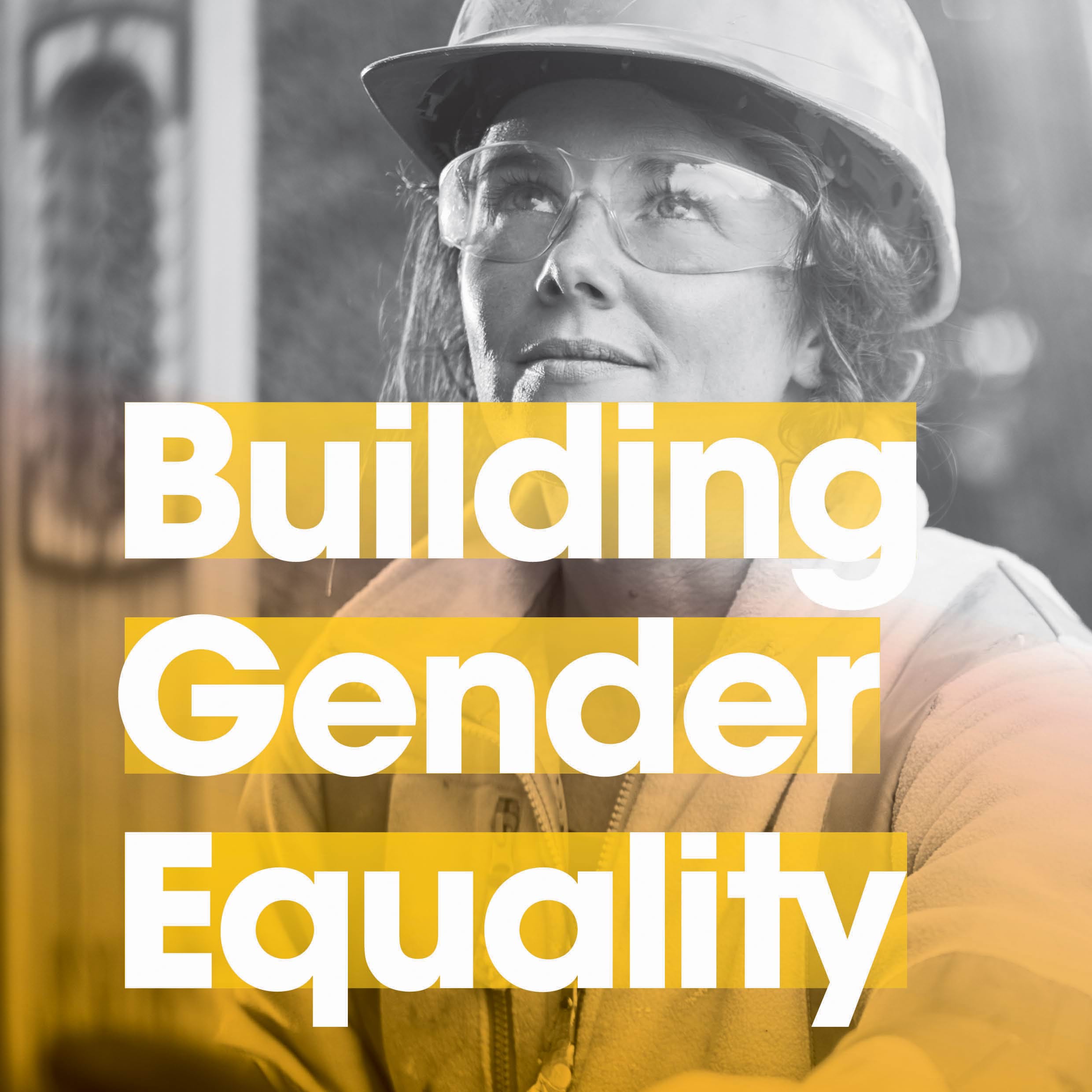
Building gender equality
In December 2016 the Victorian Government launched the state’s first gender equality strategy, Safe and Strong: A Victorian Gender Equality Strategy (the GES). The GES sets out a framework for enduring and sustained action to prevent violence against women through gender equality.
The GES seeks to ensure that:
- all Victorians live in a safe and equal society, have access to equal power, resources and opportunities, and are treated with dignity, respect and fairness
- all Victorians recognise that gender equality is essential to economic prosperity and that gender inequality has significant economic cost
- Victoria leads the way in gender equality with sustained, enduring and measurable action.
The GES recognises that work and economic security is a focal point for women’s equality. Women continue to be underrepresented in industries such as finance, construction, utilities, science and technical services. A failure to attract and equip women for careers in these industries leads to a loss of productivity gains, by not drawing on the skills and capabilities of a large sector of the labour force. It also entrenches occupational segregation, with potential to widen the gender pay gap and reduce economic security for women and their families.
To take further steps to implement the GES, the Victorian Government announced in June 2018 that it was developing Victoria’s Women in Construction Strategy, in partnership with the BICC.
The Strategy is designed to increase women’s participation in the trades and semi-skilled ‘blue-collar’ work in Victoria. In doing so, it will take another important step towards gender equality.
Women and construction: The story so far
The construction industry is often cited as the most male-dominated industry in Australia. There have been numerous attempts to increase female participation in the industry. However, rates of participation have not changed significantly since the 1980s.
The low levels of women’s employment in construction are explained by several factors:
- women do not get or keep the jobs. While the number of female students enrolled in construction and trade courses at registered training organisations (RTOs) is rising, there is a severe discrepancy between the number of female students and the number of women employed in construction for a sustained period
- women are in less secure, low-paid positions. Women are more likely to be employed in ancillary roles. This contributes to the limitation of career progression for women in construction and affects the overall poor level of retention
- women are excluded and made to feel unwelcome. Rigid work practices, a traditionally masculine or sexist culture, exclusion, gendered violence, inadequate work facilities and equipment, and informal recruitment processes have all contributed to the low numbers of women working in construction.
We must learn from what has been tried in the past. Key learnings that underpin this Strategy are:
- the Strategy must target barriers to attracting, recruiting and retaining women. Past strategies have failed to work on each of these three areas or to understand the interplay between them
- the responsibility for fixing this cannot rest on the shoulders of the small number of women in the industry. Previous campaigns to rectify the low levels of female participation have failed because they have not included or accepted the contribution of men within the industry as part of the solution. The burden of higher recruitment and retention has been placed on women.
Partnerships for change
Everyone has a stake in making gender equality a reality.
The Strategy has been developed in partnership with key organisations in the industry through the BICC, all of which have committed to making it a success.
The BICC was established in 2001 as a high-level forum for dialogue between employers, industry associations, unions and Government on significant economic and industrial relations issues in the building and construction industry. The BICC provides advice to the Minister for Industrial Relations.
The BICC also engages with state government agencies about the skill requirements and training needs of the building and construction industry.
The BICC has been a partner in creating the Strategy. It will continue to:
- oversee its implementation
- report on progress in relation to actions in the Strategy
- make recommendations to the Minister for Industrial Relations on initiatives to increase women’s participation in the trades and semi-skilled ‘blue-collar’ work in Victoria.
Strategic alliances will be formed with construction education and training providers, unions (and their peak body), employer associations, WorkSafe, VicHealth and many other organisations that provide services to the building and construction industry, including industry superannuation funds.
Building a strategy for change
The strength of the Strategy is that it is informed by evidence and was built by those who have the capacity to make a change in the industry.
Women and men employed in semi-skilled and trade jobs were consulted about their experiences and what could make a difference. Site managers and union delegates, roles that influence industry culture and day-to-day practices, were consulted. Leaders of business, unions and authorities such as WorkSafe deliberated on the content of the initiatives within the Strategy.
The development of the Strategy included the following phases:
- desktop review of current literature
- using key themes identified in the review as the basis for discussions with focus groups including: union delegates, women employed in construction, and site and other related managers
- evidence obtained from the literature scan and the focus groups was presented to BICC members or their nominees.
This working group was asked to consider the following three questions:
- how can we attract more women and girls to take up a trade or blue- collar job within the industry?
- how can recruitment practices be improved to help more women obtain jobs within the industry?
- how do we retain women within the industry?
- the BICC working group developed proposals for inclusion in the Strategy
- the BICC endorsed the final Strategy
- the BICC will oversee the implementation of the Strategy and will report to the Minister for Industrial Relations on its progress
To ensure momentum in the implementation of the Strategy, the BICC will be supported by an Implementation Advisory Team and Project Coordinator.
The Strategy will be evaluated by academics with expertise in this area. Information gained from this process will be made available to advance knowledge and practice in this space.
Priority 1: Attract
How can we attract more women and girls to take up a trade or job within the construction industry?
Barriers
The barriers to women and girls seeking a career in the construction industry are:
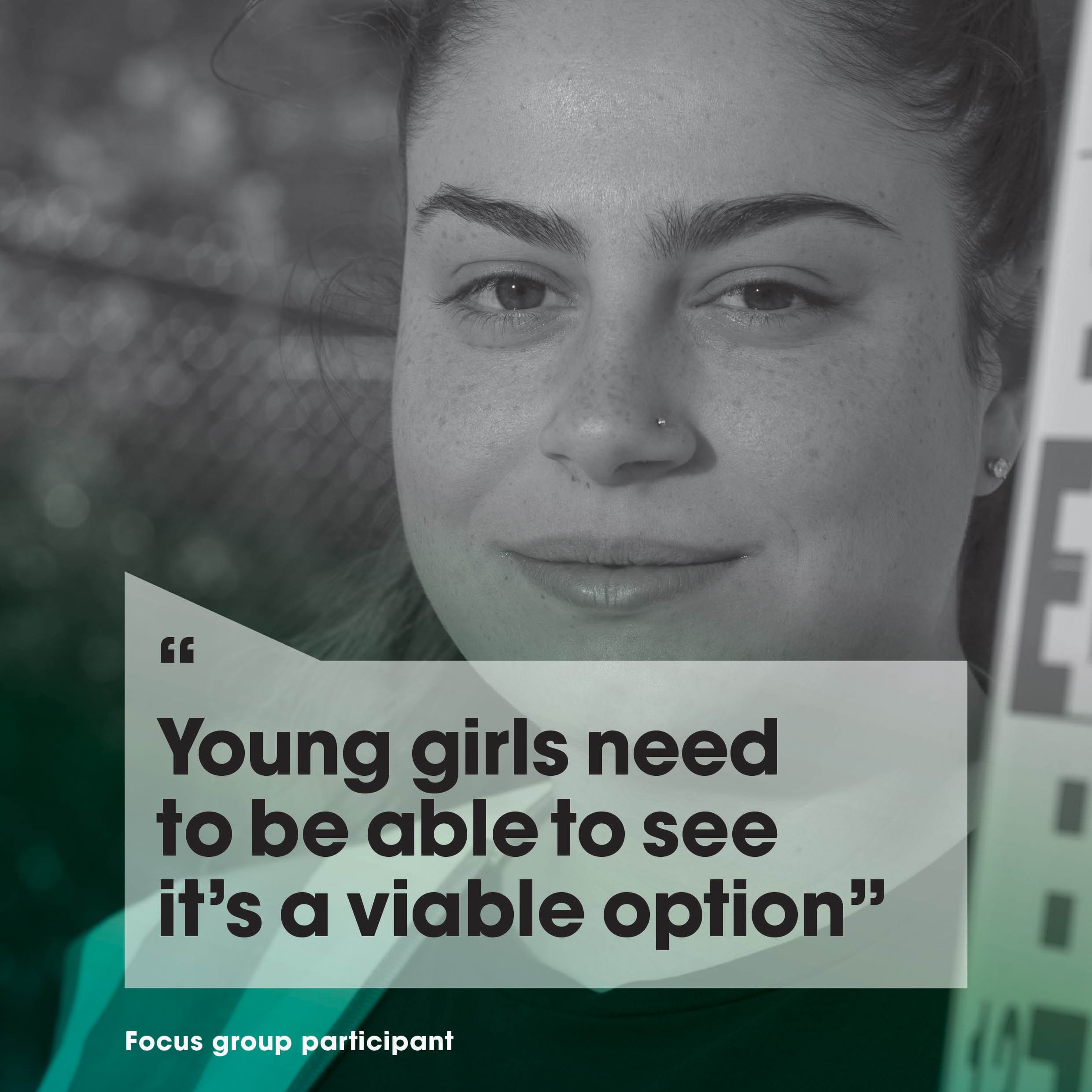
- failure to promote construction and trades as a viable career option to girls in schools
- steering girls towards university rather than trades
- lack of encouragement for girls interested in science, technology, engineering and mathematics (STEM)
- fewer role models for girls
- traditional views of men’s work and women’s work and gender stereotypes
- rigid workplace practices and cultures of prejudice that exclude women and treat them as ‘other’.
Solutions
Strategies that will attract women and girls to the industry are:
- schools giving more vocal and positive encouragement for girls about STEM subjects and trades
- emphasis on unpacking the gender bias of careers counsellors and trades teachers in schools and Technical and Further Education (TAFE)
- promotion of female role models to girls
- funding of apprenticeships, training and education should be gender-sensitive. It should acknowledge the unique barriers women face gaining access to the construction industry, and identify practical solutions to overcome these barriers
- a campaign to eliminate the attitudes that underpin the culture of gender inequality, involving all construction workers – including managers and employers.
Barriers to attracting women and girls to the construction industry
Impact of schools and vocational training
Young women are actively discouraged from, or have little to no exposure to, the construction industry while at school.1
Careers counselling is highly gendered, encouraging young women to undertake a university degree rather than a trade. Additionally, students are also filtered by gender to excel in humanities if they are female or STEM subjects if they are male. The assumption that women are not capable of, or interested in, STEM subjects. Coupled with a devaluing of vocational education and training (VET) in schools, this means few women are attracted to the construction industry and trade-based further education.2
Gendered assumptions
There is an underlying assumption that trade work is ‘dirty, dangerous and heavy’. More traditional or outdated views about femininity and women’s work lead to a perception that trade work is not suitable for women.3 These traditional notions of femininity and masculinity have been socialised within careers counsellors and teachers, often leading to an unconscious bias against encouraging women to pursue a trade career in the construction industry. However, when counsellors and teachers know someone who works in a trade-based industry and are more familiar with it, they are far more likely to encourage men and women (though still men in greater numbers) to pursue trade-based further education.4
Role models
There are few female role models in the construction industry for girls, which adds to the difficulty of attracting women to the industry.5 More vocal and positive promotion of the industry within a school-based careers education environment is needed to attract more women.6
Strategies to increase women’s engagement
Simply making the industry more attractive to women will not result in a sustainable increase in female participation. Efforts are needed to improve the retention of women workers.7
Apprenticeships
Any effort to implement strategies and allocate funding to apprenticeships, training and education should not be gender-neutral, as this can entrench the existing gender bias. Programs need to be gender-sensitive, acknowledging the unique barriers women face in gaining access to the construction industry.8
Culture
Workplace cultures of sexism, gendered stereotypes and gendered violence are a barrier to engaging and retaining women workers.9 Solutions have previously been recommended to overcome these barriers. They have included campaigns to eradicate the attitudes that underpin the culture of gender inequality, involving all construction workers – including managers and employers. Such a campaign can only be effective if men see they will also benefit from it. Any successful campaign should include roles for men as change-makers, while acknowledging that many are also perpetrators and will need education.10
Strategies to increase women’s uptake of roles are less likely to be successful without concerted efforts to educate the existing workforce around gender equality.
Without this, women recruited as a part of affirmative measures are broadly regarded as less qualified than their male counterparts and undermined in their roles.11
Rigid work practices
The male-dominated environment of construction work adheres to a ‘male breadwinner’ model. This results in rigid workplace hours, practices and pay that do not include those with caring responsibilities – most often women.
The industry’s failure to accommodate the family needs of employees has acted as a barrier to women’s entry into construction.12 Programs designed for women returning to work after raising children, caring or moving from income support would be one way to attract women to the industry. This would align with the existing data that shows most women enrolled in trade-based education are mature age.
Attraction
Points of intervention in the Strategy:
1.1 Break down the barriers that prevent girls and women considering trades and other roles within the industry. Target points are:
- school careers counsellors
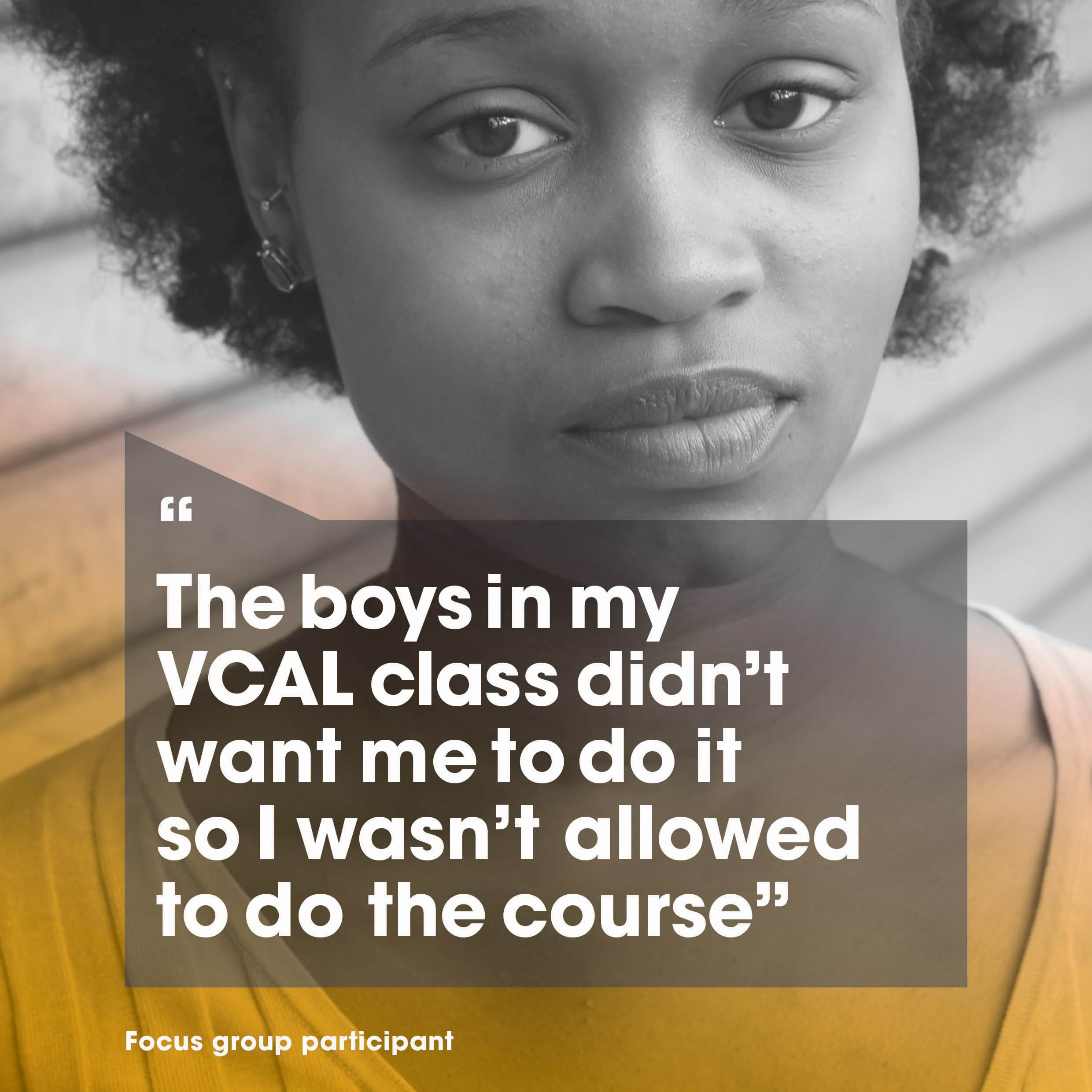
- providers of VET and Victorian Certificate of Applied Learning (VCAL) courses
- families of students.
1.2 Develop more transparent pathways for women to enter the construction industry and develop a career.
1.3 Establish pathways for women to move from low and semi-skilled roles within the industry through to skilled and trade roles.
Priority 2: Recruit
How can recruitment practices be improved to help more women obtain trade and semi-skilled roles in the industry?
Barriers
Barriers to women being recruited to roles in the industry include:
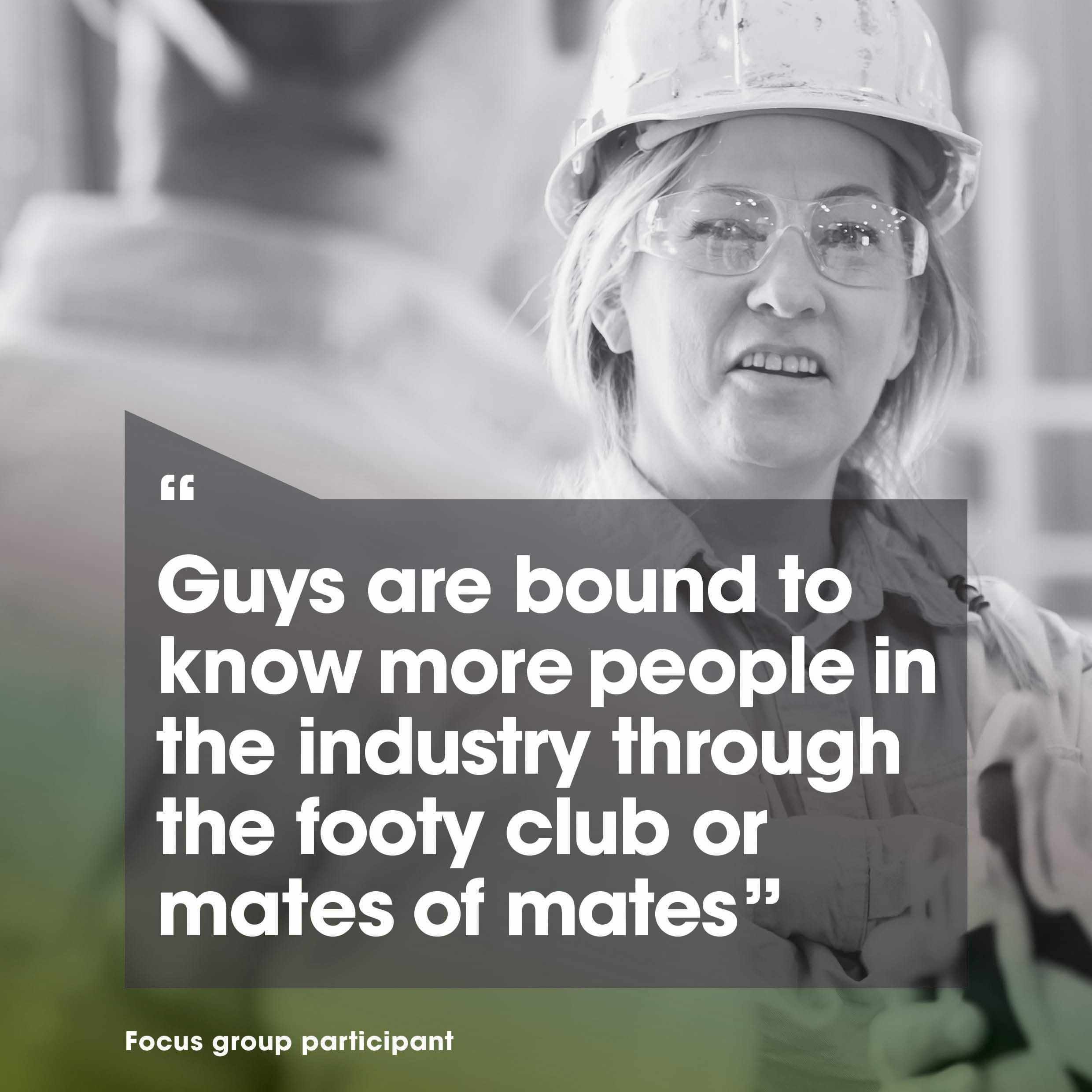
- employers hiring through the traditional ‘pipeline’ for employment – for example RTOs and informal networks that women do not have ready access to
- employers’ metric of cultural fit when hiring workers, which often excludes women
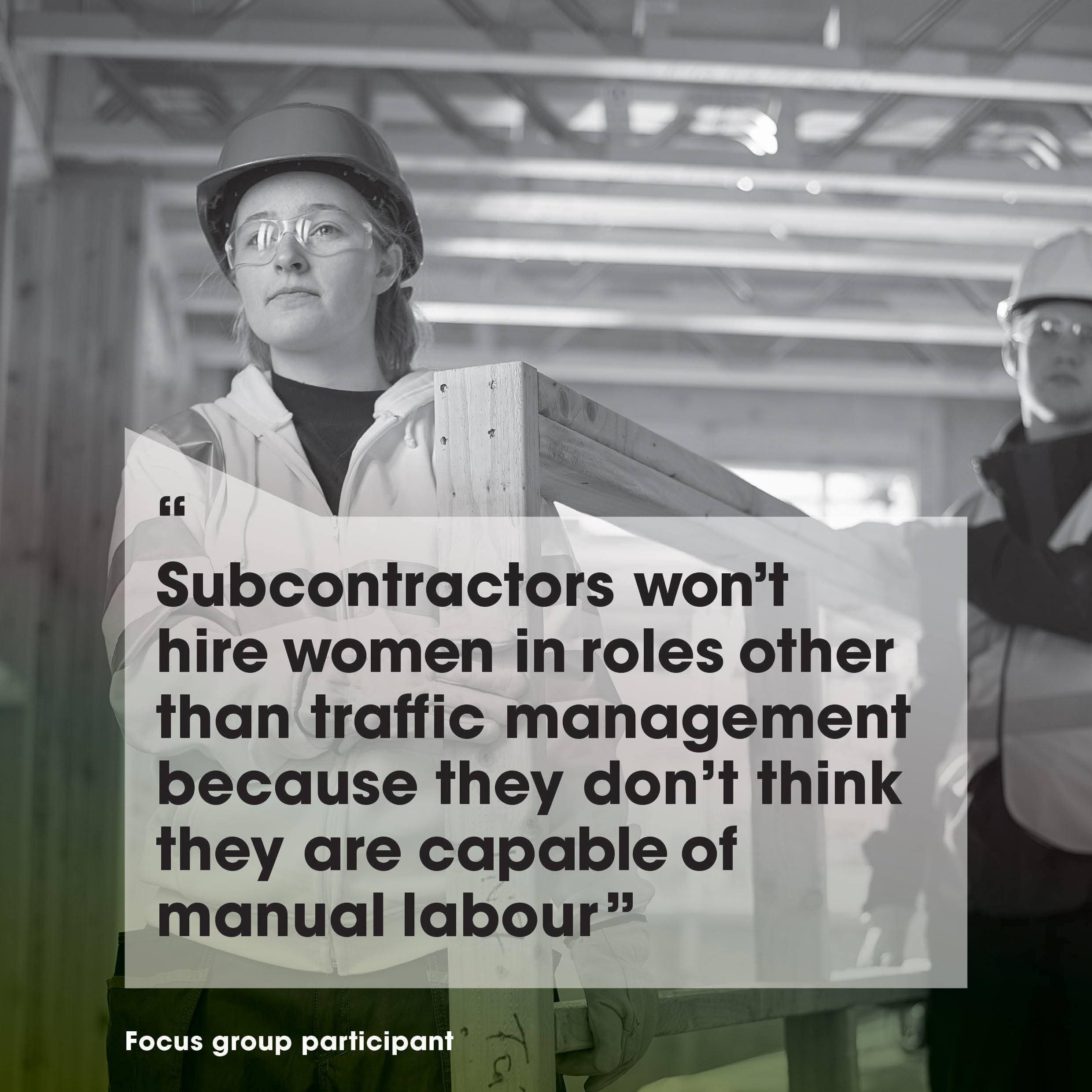
- most male workers are hired via informal recruitment processes, while most women workers are hired via formal processes, which are more strenuous and time-consuming
- discrimination in hiring processes, including reluctance to hire women based on the belief that construction work is too difficult for women or that they will require parental leave
- lack of commitment to hiring women by middle management and other workers.
Solutions
Strategies that will lead to more women being recruited to roles in the industry:
- a more independent and formalised hiring process, including an audit of metrics such as cultural fit to ensure they are not exclusionary or gendered
- programs that provide targeted support to women apprentices seeking employment in their trade
- increase the prominence and visibility of female role models in the industry
- a holistic approach to cultural change builds support throughout the entire workforce.
Barriers to recruiting women in construction
The recruitment of women in the construction industry shares many of the challenges that apply to attracting women workers. There is clearly interest from women in participating in trades, as evidenced from first-hand accounts of tradeswomen and the rising rates of female enrolment in trade-based education. However, the low numbers of women employed in the industry highlights a challenge in the recruitment of women in this sector.13
The lack of opportunity to participate in trade-based education at the school level has already been touched upon as a challenge for engaging women workers, but it also presents a barrier to the recruitment process. Many employers within the construction industry hire through the ‘pipeline’, which refers to traditional educational paths such as RTOs. Most women enrolled in trade-based education are mature students, having had their participation in the industry delayed rather than supported by their career counsellors and teachers.14
Some employers value the maturity that women can often bring to a work site. However, there is also evidence that some employers are reluctant to hire mature apprentices as they are required to pay them an award rate, rather than an apprentice rate, which results in a higher labour cost.15
Employer bias and cultural fit
Workplace culture also affects the recruitment of women.16 Many employers cite cultural fit as a key attribute when recruiting, which is rarely assessed or updated, and often excludes women.
Cultural fit means hiring workers who are like those already in the workforce, which in construction often means men. Other cited attitudes of employers include:
- bias in recruitment and selection processes
- the belief that construction work is too dangerous for women
- the expectation that women will leave the workforce to have children and that training them would be a ‘waste’ of time and resources17.
Recruitment practices
Informal recruitment processes have been cited as a barrier to women being recruited. Women are more likely to be recruited through formal recruitment processes, while men are more likely to gain employment through informal, internal networks. A process of male sponsorship and an industry-wide culture of ‘picking your team’ sometimes sees women overlooked for employment or career progression.18 Employment through formal recruitment processes also takes longer and requires more tenacity, which affects women adversely, and can add to the absence of women applying for construction jobs.19
A more independent and formalised hiring process would have a positive impact on the number of women recruited to the construction industry. This should include a review of ‘cultural fit’ to determine whether it is a gendered and exclusionary process. Investment in programs such as the Australian Apprenticeships Access Program would provide an opportunity to encourage women to commence work in construction or retrain to become trade-qualified.20
Affirmative strategies
Financial aid and study scholarships for women could encourage more women to enrol in trade-based education, leading to more recruitment by employers. However, further enrolment in trade-based education alone will not aid the increase of women’s employment in the construction industry.
Gender sensitive policies and action plans for recruitment and retention of women, from apprenticeships to graduate employment programs at all levels, must be considered to achieve meaningful change.21 Some affirmative action initiatives have been trialled in the past, but the literature suggests they did not lead to sustainable increases in women workers within the construction industry. A more holistic approach to cultural change on every worksite is also needed.
Beyond the commitment from the top
Initiatives to achieve gender equality within the recruitment process have previously been unsuccessful due to the lack of commitment by middle managers and workers. While there is often a statement of support from senior management, the failure to build this support throughout the entire workforce leads to the perpetuation of a culture that excludes women.22 Strategies to overcome exclusionary recruitment processes need support from workers, managers and employers if they are to succeed.
Role models
Another positive strategy for recruiting women into construction has been the prominence and visibility of female role models within the industry. Being able to see women’s involvement and their ability to excel has a positive impact on the willingness of other women to enter the recruitment process.23 This extends to female mentorship and networks, which assist in the retention of women within the construction industry.
Recruitment
Points of intervention in the Strategy:
2.1 Build the capacity of major builders, subcontractors and labour hire operators to attract and recruit women into the full range of trade and semi-skilled roles within the construction industry.
Priority 2: Retain
How do we retain women within the industry?
Barriers
The barriers to women staying in roles within the industry include:
- An industry and workplace culture of prejudice that results in numerous incidents of gendered violence
- Women report feeling unsafe and uncomfortable on the job
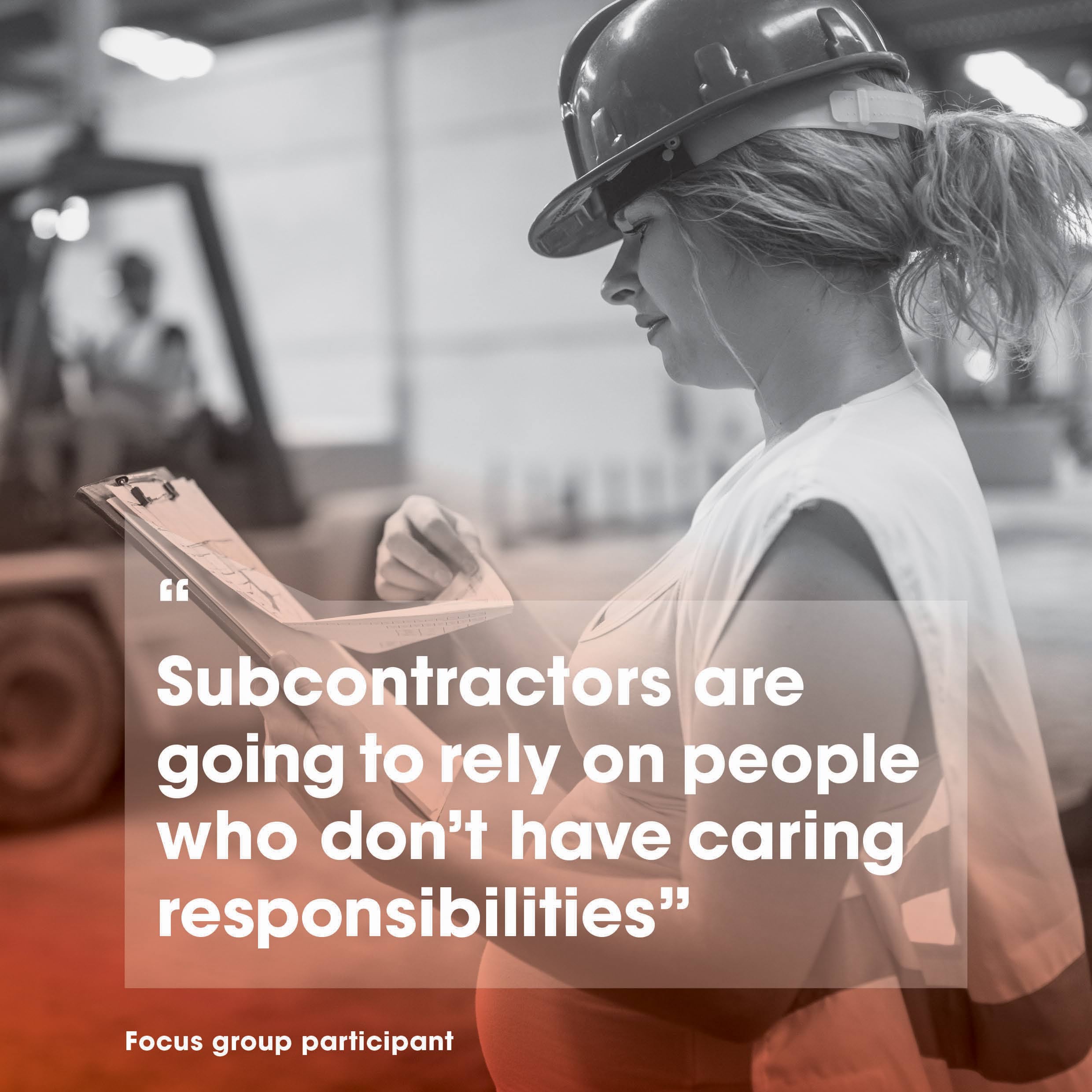
- Rigid workplace practices such as excessive work hours, inflexible work arrangements and a lack of consideration for caring responsibilities
- Occupational health and safety hazards, such as inappropriate equipment and clothing, the lack of adequate bathroom facilities and physicality of work.
Solutions
Strategies to assist in the retention of women in the industry include:
- Widespread industry, workplace and social change to abolish gendered violence at work and traditional ideas of women’s work
- Introduction of job-sharing, flexible work arrangements, provision of childcare, and changes to other workplace practices to accommodate caring responsibilities
- Women’s networks for tradeswomen, mentoring programs, and a greater number and visibility of female role models in the construction industry.
But:
- Not without the support of employers, managers and the wider workforce, as part of a widespread, long-term campaign to affect social and workplace culture
- Implementing a strong accountability mechanism that allows women and men (from the construction industry) to report and provide feedback on progress towards achieving systemic cultural change.
Barriers to retaining women in roles within the construction industry
There is clear desire and willingness from women to work in the construction industry, which is evident from increasing female enrolment in trade-based education, and the first-hand accounts of tradeswomen. Many women find great joy and satisfaction in engaging in meaningful work, and appreciate security of employment and remuneration. Many would recommend a career in construction and trades to other women. However, the existing literature shows that, while this job satisfaction certainly exists, it is eroded by a variety of negative experiences entrenched within this male-dominated industry.
Gendered violence
Women workers often experience incidents of gendered violence while employed in the industry. Gendered violence refers to actions and behaviours that express power inequalities between women and men and cause physical, sexual, psychological or economic harm. It is violence that is perpetrated against women because they are women.24
It also includes violence against those who do not conform to dominant gender stereotypes or those who don’t conform to socially accepted gender roles.25
Rates of gendered violence at work are particularly high for women workers in the construction industry and are a powerful driver for women to leave their jobs.
There are several commonly occurring behaviours within the workplace that negatively affect women’s physical and mental health, including:
- exclusion and ‘othering’ by workmates and managers
- the expectation to manage increased aggression from male mentors
- open resentment of women workers’ presence on site and a consistent undermining of women’s skills and qualifications
- being assigned feminised tasks such as office work and being denied opportunities to learn practical skills on site
- sexist comments, sexual innuendo and the display or sharing of pornographic images 26
This behaviour manifests in a culture that values a traditionally masculine stereotype and devalues women and those who do not conform to this stereotype. This ‘man’s world’ culture serves not only to limit the engagement and recruitment of women workers in construction, but also to drive them from the industry and leave their jobs. This has been cited as a cause for lower completion rates of apprenticeships for women than their male counterparts.27
Tradeswomen have recorded a lack of respect from their male colleagues and managers, including an overwhelming sense that they need to prove their worth and perform ‘better than anyone else’.
They report being overlooked for contracts and other employment opportunities because they are women, and high rates of sexual harassment at work.28
Other health and safety hazards
Other factors lead to women feeling unsafe and uncomfortable in their jobs, such as failure to provide adequate equipment and other infrastructure, including bathroom facilities, sanitary bins and appropriate clothing. Not only does this present a physical occupational health and safety risk, but it also negatively affects a women worker’s sense of belonging and worth in the workplace.29 Tradeswomen surveyed by the Association of Professional Engineers, Scientists and Managers Australia have also spoken about occupational health and safety hazards, such as the presence of toxic chemicals and its impact on having children and the physicality of manual labour when working alone.30
Rigid workplace practices
Some women leave their jobs in construction due to rigid workplace practices, including:
- inflexible hours and work arrangements
- an employer’s unwillingness to account for caring responsibilities
- a lack of access to paid parental leave or return-to-work provisions at a comparable position or pay scale
- an expectation to work excessive hours to prove one’s worth. 31
The negative effect of rigid workplace practices on women workers are cited in several reports. Studies have found that women report high levels of dissatisfaction with work/life balance in the construction industry, and emotional exhaustion. While these factors are present in other sectors, they are considered particularly pressing in construction and contribute to women leaving their jobs.32
Several practical strategies have been recommended to address these structural barriers to women staying in construction jobs, including the introduction of job- sharing, the standardisation of work hours and enforcing a workplace culture that does not tolerate biased attitudes or overwork.33 A greater deal of flexibility in hours worked has proven to be a successful strategy in retaining women in construction, although much of that flexibility is found only in construction businesses owned and operated by women.34 The provision of childcare for parents and carers would help to retain more women workers.35
Women’s networks and mentoring
One strategy that has proven effective in increasing retention of women workers is facilitating women’s networks and female mentorship within the industry.
Women workers have identified a positive feeling of family and camaraderie at work as a reason for staying in the industry and contributing to their job satisfaction.
This is amplified by their participation in women’s networks. Such networks range from those organised by employers, or the relevant union, such as the Electrical Trades Union or the Construction Forestry Mining Maritime and Energy Union Women’s Networks, or by independent women workers sharing their experiences across the country, such as the National Association of Women in Construction or Supporting and Linking Tradeswomen (SALT). These networks and the female mentorship programs often organised through RTOs, provide a level of support and community that can often be lacking in male-dominated workplaces, where a woman may be the only female worker on site.36
A greater number of female role models within the industry coupled with mentoring and networking programs would contribute to a culture of support and community for women construction workers.37
Mass cultural change
Existing literature cautions that strategies that place the responsibility for change on women cannot be used without also building the support of employers, managers and the wider workforce.38
Overall the most commonly cited strategy for retaining women in the industry is a widespread, long-term campaign to affect social and workplace culture. This would seek to abolish the notions of traditional men’s and women’s work and the devaluation of women, as well as raising awareness about gendered violence at work.39
Legislative measures to achieve gender equity, such as audits and targets for gender parity, or the adoption of flexible workplace practices and anti-discrimination policies to comply with their legislative obligations, are often not enforced or monitored systematically.
Research has found that these types of measures do not make a significant difference to the lived work experience of women in construction, or result in an increase in the number of women workers.40 Research has found that formal institutional rules are inherently gendered, and that “a lack of robustness and revisability in policy design is a key factor influencing the lack of progress in improving women’s representation and gender equality in the construction sector”.41
Case studies of two major Australian construction companies found that their policies were driven by business decisions such as profit and skills shortages, not values. Company policies aimed at increasing gender equality will have minimal impact if there is no robust monitoring system in place that allows for a formalised analysis processes and feedback loop to affect positive change in the workplace culture.
Research suggests that successful strategies include women and men in the policy-setting process, rather than imposing schemes from the top down. This approach leads to stronger accountability mechanisms, reporting and feedback processes.
Retention
Points of intervention in the Strategy
3.1 Create a culture of gender equality within the construction industry
3.2 Provide opportunities for women to create communities of practice and shared experience
3.3 Map the wellbeing of women employed in trades and semi-skilled roles in the industry
3.4 Address the lack of amenities for women workers and rigid work practices that exclude those with caring responsibilities (men and women) from having careers in the industry
Procurement: Leveraging for change
Changing culture and practice within the industry to help women feel encouraged and safe will take time. Through the Strategy, the construction industry (and those who influence decisions about who enters it, including schools and vocational education providers) is encouraged to make changes to increase women’s participation in the trades and semi-skilled blue-collar workforce in Victoria. This Strategy is an important step towards gender equality in this State.
Procurement standards and practices can provide incentives to participants within the industry to make changes in line with the Strategy.
4.1 Use procurement practices to promote gender equality
References
- APESMA (2010) Women in the professions: The state of play 2009- 2010, Executive Summary of the APESMA Women in the Professions Survey Report (http://www.apesma.asn.au/)
- Butler, E, Woolley, R, Shewring, F, & Women in Adult and Vocational Education (WAVE) (2011) I can’t think of any occupation women can’t do!: career pathways for women and girls: emergent and non-traditional occupations and industries (viable work), WAVE, Australia.
- Construction Skills Queensland (2018) Women in Construction: An Opportunity Lost? CSQ, Queensland.
- Department of Family and Community Services Women NSW (2013) Women in trades: the missing 48 percent, Women NSW Occasional Paper, Department of Family and Community Services Women NSW, Sydney, Australia.
- Fielden, SL, Davidson, MJ, Gale, AW and Davey, CL (2000) Women in construction: the untapped resource, Construction Management and Economics, Vol.18, pp 113–21
- Francis, V and Prosser, A (2014) Exploring vocational guidance and gender in construction. International Journal of Construction Education and Research, Vol.10, no.1, pp 39-57
- French, E and Strachan, G (2015) Women at work! Evaluating equal employment policies and outcomes in construction. Equality, Diversity and Inclusion: An International Journal, Vol.34, no.3, pp 227-243
- Galea et al (2017) Demolishing Gender Structures, Building Economist, pp 4–5
- Galea, N, Powell, A, Loosemore, M and Chappell, L (2015) Designing robust and revisable policies for gender equality: Lessons from the Australian construction industry, Construction Management and Economics, Vol. 33(5-6), pp 375-389
- Jones, Clayton, Pfitzner and Guthrie (2017) Perfect for a woman: Increasing the participation of women in electrical trades, Victoria University, Melbourne
- Lingard, H and Francis, V (2005) The decline of the ‘traditional’ family: work/life benefits as a means of promoting a diverse workforce in the construction industry of Australia, Construction Management and Economics, Vol.23, no.10 pp 1045-1057
- Scripps, J (2006) Why don’t more women go into the vocational trades?, Appendix 1, Women’s Trade Academy Project Report, Northland Polytechnic, Whangarei, North Island, New Zealand
- Shewring, F (2009) The Female ‘Tradie’: Challenging Employment Perceptions in Non-Traditional Trades for Women, Occasional Paper, National Centre for Vocational Education Research Ltd, Adelaide, Australia.
- VTHC (2016), Stop Gendered Violence at Work, Victorian Trades Hall Council, Melbourne.
Footnotes
- Jones et al (2017) pp 19-21; Department of Family and Community Services Women NSW (2013) p 33; Butler et al (2011)
- Jones et al (2017) p 21
- Department of Family and Community Services Women NSW (2013) p 33; Butler et al (2011) p 4
- Francis and Prosser (2014) p 43, 50
- The Department of Family and Community Services Women NSW (2013)
- Galea et al (2017) p 21
- Construction Skills Queensland (CSQ) (2018); Galea et al (2017)
- Butler et al (2011); French and Strachan (2015)
- CSQ (2018)
- CSQ (2018) p 16
- CSQ (2018) p 15; Shewring (2009) pp 12-13; Galea et al (2017) p 5; Jones et al (2017) p 25
- Fielden et al (2000)
- Butler et al (2011) p 35
- Jones et al (2017) p 21
- Jones et al (2017) p 17
- Galea et al (2017) p 4
- Department of Family and Community Services Women NSW (2013) p 33; Shewring (2009) p 21
- Galea et al (2017) p 4
- Shewring (2009) p 12
- Butler et al (2011) p 19
- Butler et al (2011) p 30
- Jones et al (2017) p 37
- Galea et al (2017) p 4
- Jones et al (2017) p 37
- Galea et al (2017) p 4
- Jones et al (2017) pp 23-24; Butler et al (2011) pp 19-23; Shewring (2009) p 20
- CSQ (2018) p 8; Department of Family and Community Services Women NSW (2013) p 30
- APESMA (2010)
- Jones et al (2017) pp24-25; APESMA (2010)
- APESMA (2010)
- Jones et al (2017) p 25
- Department of Family and Community Services Women NSW (2013); Shewring (2009); Lingard & Francis (2005)
- Galea et al (2017)
- Jones et al (2017) pp 35-36
- Butler et al (2011) p 36
- Jones et al (2017) pp 30-31; Butler et al (2011) p 36
- Butler et al (2011) p 29
- Butler et al (2011) p 36; Shewring (2009) p 20; CSQ (2018)
- Butler et al (2011) p 30; Department of Family and Community Services Women NSW (2013) p 33; APESMA (2010); CSQ (2018); Galea et al (2017).
- French and Strachan (2015) p 240
- French and Strachan (2015) p 378
Appendix: Women in Construction Strategy work plan
This strategy:
- targets three points of intervention: attraction, recruitment and retention
- is founded on evidence from academic literature, the experience of women and men within the industry, and the knowledge of industry stakeholders that have the capacity to make change in the industry
- acknowledges that the responsibility for addressing the problem cannot be the sole responsibility of the small number of women in the industry. Men’s inclusion and acceptance of women workers within the industry, as well as addressing gendered cultures, norms and practices, are key to the success of this strategy
- invites industry stakeholders, employers, unions and the construction workforce to become partners in making it a success
The points of intervention and actions have a direct link to the domains of the Government’s gender equality strategy, Safe and Strong: A Victorian Gender Equality Strategy (the GES).
The domains are:
Domain 1: Victorians live free from gendered norms, stereotypes, and expectations
Domain 2: Victorians are empowered, healthy, safe and strong
Domain 3: As Victorians we value and champion gender equality
Domain 4: The Victorian Government is a leader on gender equality
| Point of intervention | Actions | |
|---|---|---|
| ATTRACTION | ||
| 1.1 | Break down the barriers that prevent women considering trades and semi-skilled roles within the industry. Key target points include: school careers counsellors VET and VCAL course providers families of secondary students. | In consultation with the Department of Education and Training (DET) create a program and resources that target the gender bias held by careers counsellors, VET and VCAL providers. The tools developed will promote the uptake of trades and semi-skilled roles in the construction industry by women in secondary education. (Links to GES Domain 1.) BICC to lead in conjunction with DET. |
| In partnership with industry stakeholders, including employers and unions, produce resources and a public education campaign to promote the benefits of working in the construction industry. The target audience will be families of students (male and female) in secondary education. (Links to GES Domain 1.) BICC to lead. | ||
| In partnership with relevant unions and industry superannuation providers establish an annual structured initiative targeted at men employed within the industry (including fathers, brothers, uncles and partners). The event will provide an opportunity for these men to promote the benefits of working in the construction industry to their daughters and other women in their lives. (Links to GES Domain 3.) BICC to lead. | ||
| 1.2 | Develop more transparent pathways for young and mature women to enter the construction industry and develop a career. | Promote the construction industry to women exiting other male-dominated occupations and industries. This could be done via promotions at career events, holding forums and building relationships with career counsellors in those industries, for example the defence forces, mining or sports. (Links to GES Domain 1.) BICC to lead. |
| Establish a central contact point for women seeking information about opportunities to enter the construction industry that would include: how to apply for work in the industry an overview of pathways for career progression job-matching opportunities. (Links to GES Domain 1.) BICC to lead in conjunction with Incolink. | ||
| 1.3 | Establish pathways for women to move from low- and semi-skilled roles within the industry through to skilled and trade roles. | In conjunction with RTOs of union and industry employers, scope the pathways for career progress. Provide targeted assistance to women wanting to obtain qualifications and move through the pathways. (Links to GES Domain 1.) BICC to lead in conjunction with RTOs and DET. |
| RECRUITMENT | ||
| 2.1 | Build the capacity of major builders, subcontractors and labour hire operators to attract and recruit women into the full range of trade and semi-skilled roles within the construction industry. | Develop an agreed set of recruitment standards/practices and voluntary (in the first instance) targets for women employed in trade and semi-skilled roles. Undertake a review of current recruitment practices and policies to eliminate the potential for gender bias and outdated notions of ‘cultural fit’. Support early adopters/lighthouse employers who are prepared to implement and promote recruitment standards and new practices. (Links to GES Domains 1 and 3.) MBAV to lead in conjunction with BICC. |
| Establish, maintain and expand (over time) a central point for recruitment matters specific to the needs of women seeking employment within trade and semi-skilled roles within the industry. (Links to GES Domain 1.) BICC to lead in conjunction with Incolink. | ||
| RETENTION | ||
| 3.1 | Create a culture of gender equality within the construction industry. | A long-term culture change program (working title Project Respect) designed to end gendered violence and promote a culture of respect will be implemented using industry employers and unions as key advocates. Industry bodies and WorkSafe will be asked to partner in this program. The program will include: education on drivers of gendered violence management of gendered violence as a health and safety issue for managers, union delegates and health and safety representatives based on the Victorian Trades Hall Council Stop Gendered Violence training modules the development of best practice reporting, response, support systems and mechanisms for people experiencing gendered violence the establishment of trained ‘first point of contact’ on sites for people experiencing gendered violence or seeking support practice standards for managers (Links to GES Domains 1, 2 and 3.) VTHC to lead in conjunction with BICC. |
| 3.2 | Provide opportunities for women to create communities of practice and share experiences. | Create new (and engage with current) networks, structures and forums for women to come together to discuss their experience of working in trade and semi-skilled roles within the industry. (Links to GES Domain 2.) BICC to lead. |
| 3.3 | Map the wellbeing of women employed in trade and semi-skilled roles in the industry. | Support will be provided to assist in the rollout of the Resilient Women in Construction project commissioned by the CFMMEU and undertaken by researchers from the Construction Work Health and Safety Research at RMIT. (Links to GES Domain 2.) BICC to lead in conjunction with RMIT. |
| 3.4 | Address the lack of amenities for women workers and rigid work practices that exclude those with caring responsibilities (men and women) from having careers in the industry. | The industrial parties to immediately address amendments to the Amenities Code that can be made to improve the working conditions and ensure adequate access to facilities for women. (Links to GES Domain 1.) BICC to lead. |
| The industrial parties to consider how applicable industrial instruments and other policies and codes of practice can be reviewed or changed to: assist in attracting, recruiting and retaining women in the industry establish standards to end gendered violence against men and women and promote a culture of respect in the workplace. (Links to Domains 1 and 3.) BICC to lead. | ||
| PROCUREMENT | ||
| 4.1 | Use procurement practices to promote gender equality. | The Victorian Government places an emphasis on gender equality and the realisation of this strategy when commissioning builds and procuring services from the industry. (Links to GES Domain 4.) BICC to lead. |
| Industry is encouraged to lead the realisation of this strategy through its procurement policies and practices. (Links to GES Domain 3.) BICC to lead. | ||
| OVERSIGHT, MANAGEMENT, MONITORING & EVALUATION | ||
| 5.1 | Oversight – Principles of tripartism will be carried through the projects, processes and mechanisms to implement the Strategy. | The BICC will oversee the implementation of this Strategy and report to the Minister for Industrial Relations on the progress of initiatives within the Strategy. (Links to GES Domain 4.) BICC to lead. |
| 5.2 | Management – A central point for oversight of the operational implementation of the Strategy will be established. | Industrial Relations Victoria (IRV) will have operational responsibility for the Strategy. An Implementation Advisory Team will be established comprising an Independent Chair, representatives from the BICC and a Project Coordinator. (Links to GES Domain 4.) IRV to lead in conjunction with BICC. |
| 5.3 | Monitoring and Evaluation – An evaluation and monitoring framework will be developed to evaluate the effectiveness of the Strategy. | An independent person/s drawn from academia will be appointed to develop an evaluation and monitoring framework. The views of people affected by this Strategy, including women and men employed or seeking employment in the industry, employers, unions and industry stakeholders will be sought during the evaluation stage of the Strategy. Results and learnings from the implementation of the Strategy will, wherever possible, be made available for research purposes. (Links to GES Domain 4.) IRV to lead in conjunction with BICC. |
Evaluation Report: Victorian Women in Construction Strategy
How did the program actions support the attraction, recruitment and retention of women in on site-construction roles in Victoria?
Updated 6 February 2024
Related links
About the VIC Government
- The Premier and ministers
- Find a Vic Gov department, agency or service
- Strategies and policies
- Inquiries and royal commissions
Grants and programs
Jobs and careers
Arts, culture and heritage
Business and the workplace
- Mentally Healthy Workplaces Framework
- Portable Long Service Authority
- Victoria’s racing industry
- Workforce Inspectorate Victoria
- Liquor licensing, sale and supply
Communities
- Children
- First Peoples - State Relations
- Finding records
- Gender equality & women’s leadership
- LGBTIQA+ equality
- Multicultural communities
- Seniors Online
- Veterans support and commemoration
- Volunteering in Victoria
- Youth Central
Education and training
- Victorian Early Childhood Regulatory Authority
- Early childhood education – information for professionals
- Kinder: Best Start, Best Life
- Education – information for parents
- Schools.Vic - information for schools
- Education grants, programs, awards and events
- PROTECT
- TAFE, training and universities sector
- TAFE Victoria
- Victorian Skills Authority
- Apprenticeships Victoria
- Learn Local
Environment, water and energy
Finance and economy
Health and social support
- Family violence reform
- NDIS Worker Screening Check
- NDIS and disability services and support in Victoria
- Patient Review Panel
- Transforming Trauma Victoria
Housing and property
Law and justice
- Adoption
- Births, deaths and marriages
- Honorary justices
- Machete ban
- Safeguarding Victorians against terrorism
- Stolen Generations Reparations Package
- Victims of Crime
- Victorian Racing Tribunal
Safety and emergencies
- Emergency Recovery Victoria
- Victorian Emergency Relief and Recovery Foundation
- Emergency Recovery Resource Portal
- How well do you know fire
- Fire Services Reform
- Water safety
- Marine Search and Rescue
Science and technology
- Data sharing and open data
- Data.vic - discover and access Vic Gov open data
- Developer.Vic - portal for API developers
- Go.vic URL shortener
- Vic Gov IT project dashboard
- Victoria’s free public wi-fi network
- Cyber security in the Victorian Government
Sport and recreation
Traffic and transport
- Cameras Save Lives
- Transport Fines
- Getting Around
- Transport Planning
- Transport Future
- Climate Change and transport
- Future Directions For Transport
- Transport projects
- Ports and Freight
Working in the Victorian Government
- Single Digital Presence home
- Accommodation and Library Services
- Executive employment in the Victorian public sector
- Budget, procurement and funding
- Careers in the Victorian Government
- Council and Regulator Toolkit
- Guidelines for working in government
- Join a government network
- Standards and guidelines
- VicFleet CarPool
- Victorian Government style guide