Victorian Skills Plan for 2023 into 2024 clean economy fact sheet
The transition to a clean economy requires an expansion of the workforce and shifts in skills
On this page
This fact sheet provides summary information about the Victorian Skills Plan 2023 into 2024 specifically related to the clean economy.
You can download a PDF copy or read an accessible version below.
Also see our other fact sheets related to the plan.
Downloadable clean economy fact sheet
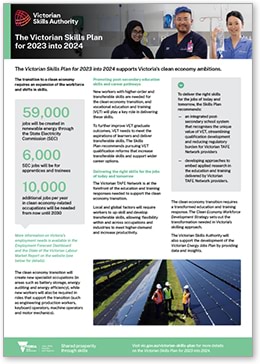 (opens in a new window)
Victorian Skills Plan fact sheet - clean economy PDF 258.01 KB (opens in a new window)
Accessible clean economy fact sheet
The Victorian Skills Plan for 2023 into 2024 supports Victoria’s clean economy ambitions
The transition to a clean economy requires an expansion of the workforce and shifts in skills.
- 59,000 jobs will be created in renewable energy through the State Electricity Commission (SEC)
- 6,000 SEC jobs will be for apprentices and trainees
- 10,000 additional jobs per year in clean economy-related occupations will be needed from now until 2030.
More information on Victoria’s employment needs is available in the State of the Victorian Labour Market Report 2023.
The clean economy transition will create new specialist occupations (in areas such as battery storage, energy auditing and energy efficiency), while new workers will also be required in roles that support the transition (such as engineering production workers, keyboard operators, machine operators and motor mechanics).
Promoting post-secondary education skills and career pathways
New workers with higher-order and transferable skills are needed for the clean economy transition, and vocational education and training (VET) will play a key role in delivering these skills.
To further improve VET graduate outcomes, VET needs to meet the aspirations of learners and deliver transferable skills. The skills plan recommends pursuing VET qualification reforms that increase transferable skills and support wider career options.
Delivering the right skills for the jobs of today and tomorrow
The Victorian TAFE Network is at the forefront of the education and training responses needed to support the clean economy transition.
Local and global factors will require workers to up-skill and develop transferable skills, allowing flexibility within and across occupations and industries to meet higher-demand and increase productivity.
To deliver the right skills for the jobs of today and tomorrow, the skills plan recommends:
- an integrated postsecondary school system that recognises the unique value of VET, streamlining qualification development and reducing regulatory burden for Victorian TAFE Network providers
- developing approaches to embed applied research in the education and training delivered by Victorian TAFE Network providers.
The clean economy transition requires a transformed education and training response. The Clean Economy Workforce Development Strategy sets out the transformation needed in Victoria’s skilling approach.
The Victorian Skills Authority will also support the development of the Victorian Energy Jobs Plan by providing data and insights.
Updated 5 December 2025
Related links
About the VIC Government
- The Premier and ministers
- Find a Vic Gov department, agency or service
- Strategies and policies
- Inquiries and royal commissions
Grants and programs
Jobs and careers
Arts, culture and heritage
Business and the workplace
- Mentally Healthy Workplaces Framework
- Portable Long Service Authority
- Victoria’s racing industry
- Workforce Inspectorate Victoria
- Liquor licensing, sale and supply
Communities
- Children
- First Peoples - State Relations
- Finding records
- Gender equality & women’s leadership
- LGBTIQA+ equality
- Multicultural communities
- Seniors Online
- Veterans support and commemoration
- Volunteering in Victoria
- Youth Central
Education and training
- Victorian Early Childhood Regulatory Authority
- Early childhood education – information for professionals
- Kinder: Best Start, Best Life
- Education – information for parents
- Schools.Vic - information for schools
- Education grants, programs, awards and events
- PROTECT
- TAFE, training and universities sector
- TAFE Victoria
- Victorian Skills Authority
- Apprenticeships Victoria
- Learn Local
Environment, water and energy
Finance and economy
Health and social support
- Family violence reform
- NDIS Worker Screening Check
- NDIS and disability services and support in Victoria
- Patient Review Panel
- Transforming Trauma Victoria
Housing and property
Law and justice
- Adoption
- Births, deaths and marriages
- Honorary justices
- Machete ban
- Safeguarding Victorians against terrorism
- Stolen Generations Reparations Package
- Victims of Crime
- Victorian Racing Tribunal
Safety and emergencies
- Emergency Recovery Victoria
- Victorian Emergency Relief and Recovery Foundation
- Emergency Recovery Resource Portal
- How well do you know fire
- Fire Services Reform
- Water safety
- Marine Search and Rescue
Science and technology
- Data sharing and open data
- Data.vic - discover and access Vic Gov open data
- Developer.Vic - portal for API developers
- Go.vic URL shortener
- Vic Gov IT project dashboard
- Victoria’s free public wi-fi network
- Cyber security in the Victorian Government
Sport and recreation
Traffic and transport
- Cameras Save Lives
- Transport Fines
- Getting Around
- Transport Planning
- Transport Future
- Climate Change and transport
- Future Directions For Transport
- Transport projects
- Ports and Freight
Working in the Victorian Government
- Single Digital Presence home
- Accommodation and Library Services
- Executive employment in the Victorian public sector
- Budget, procurement and funding
- Careers in the Victorian Government
- Council and Regulator Toolkit
- Guidelines for working in government
- Join a government network
- Standards and guidelines
- VicFleet CarPool
- Victorian Government style guide