Public Service Medal
The Public Service Medal is national recognition of outstanding public service by public sector employees of the Commonwealth, state, territory and local governments.
On this page
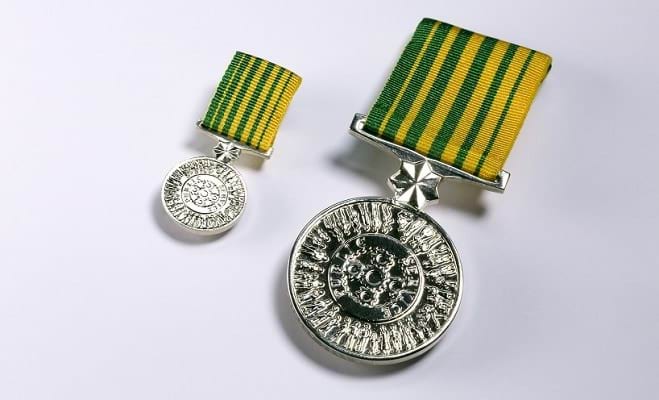
The Public Service Medal (PSM) is part of the official Australian honours and awards system. It acknowledges public sector employees who demonstrate excellence, leadership and innovation.
Outstanding service could be shown through:
- service excellence to the public, or to external or internal clients
- innovation in developing a program, project or policy development
- leadership, including as a member of a team or
- more efficient processes, cost savings, improved productivity or better service delivery.
Up to 100 medals are awarded each year, including up to 17 nominees from Victoria.
Recipients can use the post-nominal initials PSM after their names.
Recipients will be invited to attend an official ceremony at Government House where they will receive their medal.
Eligibility
- All employees of the Victorian Government and local government at any level are eligible for the medal.
- A person does not have to be an Australian citizen to be awarded the medal. The nomination should indicate if the nominee is not an Australian citizen, as the Australian Government must seek agreement from the government of the nominee’s country before awarding the medal. The Governor-General’s office will arrange for the Australian Government to seek the appropriate agreement.
- The medal is not awarded posthumously.
- You can nominate a former public servant. You must submit your nominations within 12 months of ceased service.
Exception
Members of uniformed services, (such as police, fire, ambulance and emergency services) are eligible for comparable awards and not the Public Service Medal.
It is possible to be awarded more than one type of award if it recognises different service, for example, Public Service Medal and Australian Antarctic Medal.
For more information contact the Australian Government Public Service Medal Secretariat.
Nomination deadlines
The Public Service Medal secretariat and the committee work one year ahead of the current year.
Deadlines for Australia Day 2027
-
Advertising across the Victorian Public Service
23 March to 1 June 2026
-
Nominations open
23 March to 1 June 2026
-
Nominations close
1 June 2026
-
Public Service Medal committee meeting
Late June 2026
Deadlines for King’s Birthday 2027
-
Advertising across the Victorian Public Service
21 September to 1 December 2026
-
Nominations open
21 September to 1 December 2026
-
Nomination close
1 December 2026
-
Public Service Medal committee meeting
Mid December 2026
Who can nominate
Anyone can nominate a public sector employee for consideration for a PSM.
How to nominate
All information provided in the submission is treated as confidential. If the nomination is successful, nominees will be asked for permission to publish their suburb or town details.
Public Service Medal (PSM) nomination form Word 561.67 KB (opens in a new window)
Open all
- 1Download and complete the nomination form
Public Service Medal (PSM) nomination form Word 561.67 KB (opens in a new window)
-
Save the Word document as soon as you open it.
-
Complete the ‘Click or tap here to enter text’ sections.
-
Review the document for spelling and grammar before you save.
-
Use the word count function to check your answers are 400 words or less.
-
If you are the nominator complete all sections before you sign the form.
-
2Signing the nomination form
-
To sign the form, double click or tap the line with the x above it. A pop-up screen will open and you can use your mouse or your finger to sign your name or initials in the box. Then select sign to close the box.
-
Your signature is now on the form. It will be dated for you too.
-
Save the nomination form and have it ready to send to your department’s secretary or agency’s Chief Executive Officer (CEO) for their endorsement (step 5).
-
3Complete the nomination statement
The nomination statement is made up of five questions. All questions must contain comprehensive information on the nominee’s services or achievements. A list of positions held over several years is not enough.
Please keep your answer below the 400 word limit for each question.
Always be mindful that your nomination will be considered alongside many other nominations. The committee needs a clear description of what the nominee has done to fulfil the criteria of outstanding service.
Do not assume the committee knows the area in which the nominee has worked or has a full understanding of the significance of certain achievements. These services should be put into context in the nomination statement.
- 4Provide three referee letters
All nominations must be accompanied by at least three referee letters. These will comment on the nominee’s services.
You can provide referee letters from people outside of the public sector. For example, if the nominee is being nominated for outstanding services to a particular community or industry.
If the nominee’s service relates to the work of another agency, a referee letter from that agency may also help the committee consider the nomination. There is no limit on the number of referee letters provided, although 3 to 4 is enough.
Please keep the referee letters to one page.
- 5Department secretary or CEO endorsement
You need to include a letter of endorsement from the nominee’s department secretary or agency CEO.
Submitting your nomination
Nominations can be submitted by a nominator or the department’s Public Service Medal coordinator.
Checklist
Check that the following have been completed
- All applicable sections of the nomination form.
- The nominator has signed the declaration section.
- The signed and dated letters from each of the listed referees in the nomination form have been provided.
- The department secretary or CEO has signed the nomination form.
- The department secretary or CEO has provided an original signed and dated letter of endorsement.
- Any additional information is included (if applicable).
Final submission
When all the information is ready, email the following documents to the psm@dpc.vic.gov.au email:
- The nomination form.
- At least 3 signed and dated referee letters.
- The signed and dated department secretary or CEO letter of endorsement.
- Any additional information included (if applicable).
What happens after submitting my nomination
- Your nomination will be discussed at a Victorian Public Service Medal committee meeting in June or December.
- The committee recommends a shortlist of proposed recipients to the Premier or responsible minister, who then makes a recommendation to the Governor-General.
- The Honours Secretariat of Government House contacts the proposed recipients, who can accept or decline the award.
- The awards are announced in the Commonwealth Gazette on Australia Day (26 January) and King’s Birthday in June.
- Recipients are invited to attend an official ceremony at Government House where they will receive their medal.
Public Service Medal
Find out more about the Public Service Medal on the Department of Prime Minister and Cabinet website.
Find past recipients of the Public Service Medal
Search the Australian Honours database for all past recipients. Use the filter section on the Australian Honours Search Facility. Choose ‘Public Service Medal’ under Award Name to see all.
Updated 9 February 2026
About the VIC Government
- The Premier and ministers
- Find a Vic Gov department, agency or service
- Strategies and policies
- Inquiries and royal commissions
Grants and programs
Jobs and careers
Arts, culture and heritage
Business and the workplace
- Mentally Healthy Workplaces Framework
- Portable Long Service Authority
- Victoria’s racing industry
- Workforce Inspectorate Victoria
- Liquor licensing, sale and supply
Communities
- Children
- First Peoples - State Relations
- Finding records
- Gender equality & women’s leadership
- LGBTIQA+ equality
- Multicultural communities
- Seniors Online
- Veterans support and commemoration
- Volunteering in Victoria
- Youth Central
Education and training
- Victorian Early Childhood Regulatory Authority
- Early childhood education – information for professionals
- Kinder: Best Start, Best Life
- Education – information for parents
- Schools.Vic - information for schools
- Education grants, programs, awards and events
- PROTECT
- TAFE, training and universities sector
- TAFE Victoria
- Victorian Skills Authority
- Apprenticeships Victoria
- Learn Local
Environment, water and energy
Finance and economy
Health and social support
- Family violence reform
- NDIS Worker Screening Check
- NDIS and disability services and support in Victoria
- Patient Review Panel
- Transforming Trauma Victoria
Housing and property
Law and justice
- Adoption
- Births, deaths and marriages
- Honorary justices
- Machete ban
- Safeguarding Victorians against terrorism
- Stolen Generations Reparations Package
- Victims of Crime
- Victorian Racing Tribunal
Safety and emergencies
- Emergency Recovery Victoria
- Victorian Emergency Relief and Recovery Foundation
- Emergency Recovery Resource Portal
- How well do you know fire
- Fire Services Reform
- Water safety
- Marine Search and Rescue
Science and technology
- Data sharing and open data
- Data.vic - discover and access Vic Gov open data
- Developer.Vic - portal for API developers
- Go.vic URL shortener
- Vic Gov IT project dashboard
- Victoria’s free public wi-fi network
- Cyber security in the Victorian Government
Sport and recreation
Traffic and transport
- Cameras Save Lives
- Transport Fines
- Getting Around
- Transport Planning
- Transport Future
- Climate Change and transport
- Future Directions For Transport
- Transport projects
- Ports and Freight
Working in the Victorian Government
- Single Digital Presence home
- Accommodation and Library Services
- Executive employment in the Victorian public sector
- Budget, procurement and funding
- Careers in the Victorian Government
- Council and Regulator Toolkit
- Guidelines for working in government
- Join a government network
- Standards and guidelines
- VicFleet CarPool
- Victorian Government style guide