Plan and prepare for fire
Having a fire plan and preparing your property now could save your life. Get started today with our Online Fire Planner.
On this page
- Fire Danger Ratings
- Learn more about each of the ratings
- How to plan for bushfires and grassfires
- What does Leave Early mean?
- Total Fire Ban Days
Having a fire plan and preparing your property now could save your life.
During an emergency such as a bushfire, it is hard to think clearly. You may forget important things or waste valuable time deciding where to go.
There are some simple steps you can take to get ready now:
- familiarise yourself with the new Australian Fire Danger Ratings and check them every day during the fire season
- make your fire plan and talk with your family about what you will do. Just as every family or household is unique, every plan will be different
- if you live in a regional area at risk of bushfires or grassfires, be prepared to leave early on very high risk days or if a fire starts. Leaving early is the safest option.

Get started with our Online Fire Planner
Getting started is easy and you can create a basic plan in as little as 10 minutes.
Fire Danger Ratings
The Fire Danger Rating is a scale that tells you how dangerous and unpredictable a fire will be if one starts.
As of 1 September 2022, Fire Danger Ratings changed across Australia.
Fire Danger Ratings provide information so people can take action to protect themselves and others. The higher the fire danger, the more dangerous the conditions and the greater the impact will be if a fire starts.
The new system uses better technology and research to determine fire danger ratings, and was developed using feedback from one of Australia’s largest surveys of communities.
The new ratings are designed to be easier to understand and provides clear advice about actions to take.
The new Australian Fire Danger Rating system is determined by:
- weather data from the Bureau of Meteorology
- other environmental conditions such as fuel load.
Fires can start on any day with any rating. On higher danger-rated days, fire is more likely to be unpredictable and difficult for emergency services to control.
You need to know the rating in your area.
Victoria has 9 weather districts based on council boundaries:
- Mallee
- Wimmera
- South West
- Northern Country
- North Central
- Central
- North East
- West and South Gippsland
- East Gippsland
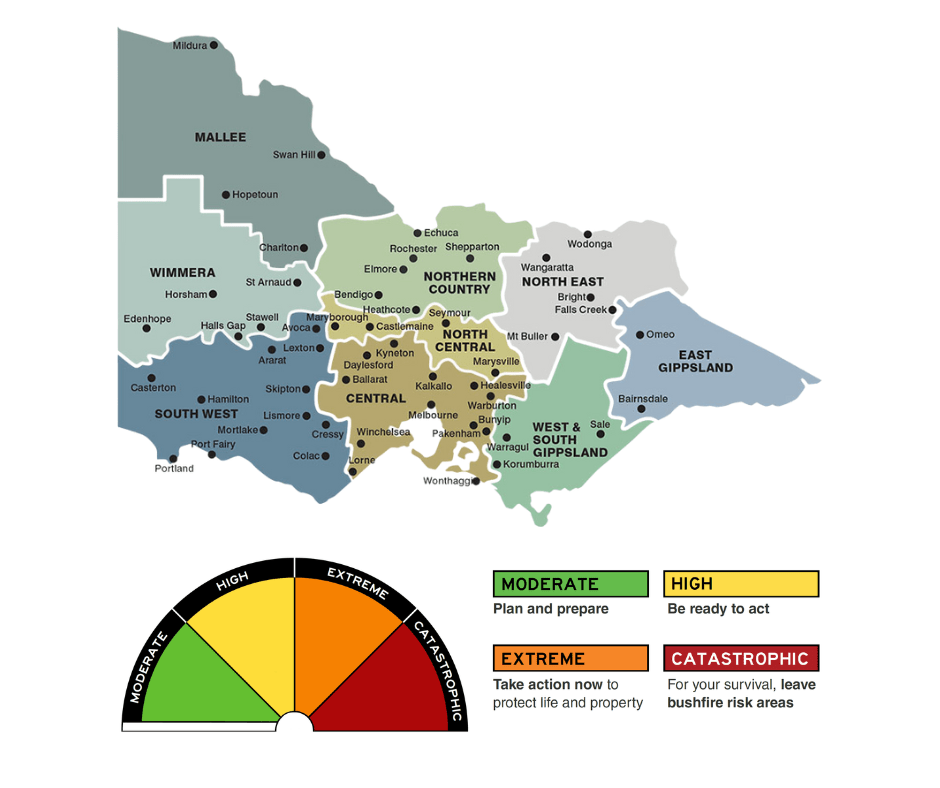
Each district is given its own rating for each day over the warmer months. Ratings are forecast up to four days in advance and updated daily. Find your fire district on the CFA’s website.
You can also find important localised information to help you plan for bushfire in your area at the CFA Local Information page.
Learn more about each of the ratings
Open all
- Catastrophic
- If a fire starts and takes hold, lives are likely to be lost.
- These are the worst conditions for a bush or grass fire.
- Schools, parks/forests and some businesses will close when a Catastrophic day is declared.
What should I do?
For your survival, leave bushfire risk areas. Your life may depend on the decision you make, even before there is a fire.
Stay safe by going to a safer location early in the morning or the night before. Homes cannot withstand fires in these conditions. You may not be able to leave and help may not be available.
Avoid forested areas, thick bush or long, dry grass.
Know your trigger to leave.
Make a decision about:
- when you will leave
- where you will go
- how you will get there
- when you will return
- what will you do if you cannot leave.
- Extreme
- These are dangerous fire conditions and the safest options is to leave fire risk areas early in the morning or the night before.
- Fires will spread quickly and be extremely dangerous.
- Expect extremely hot, dry and windy conditions.
What should I do?
Take action now to protect your life and property.
Check your bushfire plan and that your property is fire ready. If a fire starts, take immediate action. If you and your property are not prepared to the highest level, go to a safer location well before the fire impacts.
Reconsider travel through bushfire risk areas. Leaving bushfire risk areas early in the day is your safest option.
Be aware of local conditions and seek information.
You can:
- listen to your emergency broadcasters
- visit the CFA website
- call the VicEmergency Hotline on 1800 226 226.
- High
- Fires can be dangerous.
What should I do?
Check your fire plan.
There’s heightened risk. Be alert for fires in your area,
Decide what you will do if a fire starts.
If a fire starts, your life and property may be at risk. The safest option is to avoid bushfire risk areas.
Be aware of local conditions and seek information.
You can:
- listen to your emergency broadcasters
- visit cfa.vic.gov.au
- call the VicEmergency Hotline on 1800 226 226.
- Moderate
- Most fires can be controlled.
What should I do?
Stay up to date and be ready to act if there is a fire.
Check your fire plan.
Monitor conditions.
Action may be needed.
Leave if necessary.
- No rating
The system has an ‘off’ level for days where no proactive action is required by the community. This does not mean that fires cannot happen, but that they are not likely to move or act in a way that threatens the safety of the community. This rating is the thin white wedge on the colour wheel sitting under ‘Moderate'.
How to plan for bushfires and grassfires
Open all
- Which Fire Danger Rating is your trigger to leave?
It is very important to know what your plan will be for fire risk days. Decide what you will do on High, Extreme and Catastrophic days.
For more information on Fire Danger Ratings and warnings, you can visit the Vic Emergency website.
- Will you leave early that morning or the night before?
Leaving early on fire risk days is always the safest option. It is rare that you will need to do this. Once the Fire Danger Rating reaches Extreme or Catastrophic, you should plan to leave all fire prone areas for the day.
Leaving early on fire risk days before a fire starts is safer. It means you will be in a clear mindset to follow your fire plan. It also reduces the risk of leaving too late when a fire has already started.
Always discuss with your family and friends when you’ll leave, so that everyone is clear what the plan is.
- Where will you go?
It is best to have a couple of places to go. The person you planned to visit may not be home, or the route you planned to take may be closed.
Will you go to a:
- relative’s house?
- hotel?
- shopping centre far away from fire-prone areas? Decide on some options and make sure you let everyone in your family or fire plan know what they are.
- What route will you take and how will you get there?
When you are making your fire plan, think about the unexpected and consider back-up plans.
What if:
- a tree has fallen on the main road out of town?
- the kids are at a sleepover?
- your partner is out of town? Think about how you will put your plan into action and what you might need to change at short notice.
It is particularly important to know what you will do if you are not able to drive for any reason. How will you get away from fire prone areas?
It is always safer to leave early.
- What will you take with you?
Make a list of things you will need and important documents and items you want to keep safe. This is your Emergency Kit.
Pack things like:
- a phone charger
- bottles of water
- spare clothes
- toiletries
- medication
- pet food
- torch/batteries
- cash
- passports
- photos and precious possessions. How much do you need to pack? As a guide, think about what you will need if you are away for three days.
Put a reminder in your calendar to put together your Emergency Kit before the fire season.
Need help with your list? The Red Cross have a great app ‘Get Prepared’ to help organise all the important items you need to consider.
You can download:
- What do you need to organise for your pets or livestock?
Fires are also a very stressful time for your pets and livestock.
Having a plan for them means they will be happier and safer when an emergency hits:
- Visit the Country Fire Authority website for tips on caring for your pets during and after a fire.
- Don’t forget to pack items for your animals in your Emergency Kit.
- Who do you need to keep informed of your movements?
It is important to let your family and friends know you’re safe and what your movements are. It can reduce everyone’s stress and concern.
Make a list of people you will inform. Make sure to note down their contact details, just in case you lose your phone or it runs out of battery.
- Is there anyone outside your household who you need to help or check up on?
Is there anyone in your street who may need a little extra help?
They could be:
- elderly neighbours
- families with small children
- people who are not able to drive or travel easily. Check in with them to see what their fire plan is and if they will need help in an emergency.
- How will you stay informed about warnings and updates?
You can:
-
visit VicEmergency for all emergency information
-
download the VicEmergency App from the App Store or Google Play for on the go information
-
listen to your local radio
-
call the VicEmergency hotline for fire information on 1800 226 226. Social media is also a great way to stay across bushfire information. You can follow:
-
Country Fire Authority (CFA) on Facebook and Twitter
What does Leave Early mean?
If you live in a regional area at risk of bushfire and grass fires, we recommend to always leave the night before or morning of an Extreme or Catastrophic (Fire Danger Rating) day.
These days are rare. They are rated high risk because of:
- the heat
- how dry the area is
- how much dry vegetation there is (for example if there is dry forest, long grass, thick bush)
- the wind.
The worse these conditions are, the more difficult it is for emergency services to control fire. If the fire is unpredictable and uncontrollable, you do not want to be anywhere near it. Leave early.
Fires can start at any rating. Watch the conditions and check warnings so you know what to do if a fire starts.
You can:
- download the VicEmergency App from the App Store or Google Play
- add your location preferences (for example your home or other family member’s homes)
- set up notifications to be alerted of Fire Danger Ratings and emergency warnings.
Total Fire Ban Days
Total Fire Ban Days are different to Fire Danger Ratings:
- A Fire Danger Rating tells you how dangerous a fire is likely to be if one starts. It gives you information to help you decide how you should put your fire plan into action.
- A Total Fire Ban tells you if it is legal to do certain activities that may start fires.
Total Fire Bans are declared by CFA on days when fires are likely to spread rapidly and be difficult to control. This sets legal restrictions on what activities can or cannot occur in a district for that day.
The purpose of a Total Fire Ban is to reduce the activities that may start a fire such as campfires and some outdoor BBQs.
You can find out more about what you can and cannot do on Total Fire Ban days on the CFA website.
Updated 15 November 2023
About the VIC Government
- The Premier and ministers
- Find a Vic Gov department, agency or service
- Strategies and policies
- Inquiries and royal commissions
Grants and programs
Jobs and careers
Arts, culture and heritage
Business and the workplace
- Mentally Healthy Workplaces Framework
- Portable Long Service Authority
- Victoria’s racing industry
- Workforce Inspectorate Victoria
- Liquor licensing, sale and supply
Communities
- Children
- First Peoples - State Relations
- Finding records
- Gender equality & women’s leadership
- LGBTIQA+ equality
- Multicultural communities
- Seniors Online
- Veterans support and commemoration
- Volunteering in Victoria
- Youth Central
Education and training
- Victorian Early Childhood Regulatory Authority
- Early childhood education – information for professionals
- Kinder: Best Start, Best Life
- Education – information for parents
- Schools.Vic - information for schools
- Education grants, programs, awards and events
- PROTECT
- TAFE, training and universities sector
- TAFE Victoria
- Victorian Skills Authority
- Apprenticeships Victoria
- Learn Local
Environment, water and energy
Finance and economy
Health and social support
- Family violence reform
- NDIS Worker Screening Check
- NDIS and disability services and support in Victoria
- Patient Review Panel
- Transforming Trauma Victoria
Housing and property
Law and justice
- Adoption
- Births, deaths and marriages
- Honorary justices
- Machete ban
- Safeguarding Victorians against terrorism
- Stolen Generations Reparations Package
- Victims of Crime
- Victorian Racing Tribunal
Safety and emergencies
- Emergency Recovery Victoria
- Victorian Emergency Relief and Recovery Foundation
- Emergency Recovery Resource Portal
- How well do you know fire
- Fire Services Reform
- Water safety
- Marine Search and Rescue
Science and technology
- Data sharing and open data
- Data.vic - discover and access Vic Gov open data
- Developer.Vic - portal for API developers
- Go.vic URL shortener
- Vic Gov IT project dashboard
- Victoria’s free public wi-fi network
- Cyber security in the Victorian Government
Sport and recreation
Traffic and transport
- Cameras Save Lives
- Transport Fines
- Getting Around
- Transport Planning
- Transport Future
- Climate Change and transport
- Future Directions For Transport
- Transport projects
- Ports and Freight
Working in the Victorian Government
- Single Digital Presence home
- Accommodation and Library Services
- Executive employment in the Victorian public sector
- Budget, procurement and funding
- Careers in the Victorian Government
- Council and Regulator Toolkit
- Guidelines for working in government
- Join a government network
- Standards and guidelines
- VicFleet CarPool
- Victorian Government style guide