Our compliance process
The Housing Registrar provides regulatory oversight of registered community housing agencies by monitoring and enforcing compliance with the Housing Act 1983 and Performance Standards.
On this page
Regulatory framework
Housing Act 1983
The Housing Act 1983 (Vic)(opens in a new window) sets out the Housing Registrar’s functions, duties and powers.
Performance Standards
Registered agencies must comply with Performance Standards at all times. The Performance Standards are broad, and the Housing Registrar assesses the performance of registered agencies with reference to the individual agency’s scale and complexity, risk profile, past performance, and relative performance of similar agencies.
Gazetted Performance Standards:
- Tenant and housing services
- Housing assets
- Community engagement
- Governance
- Probity
- Management
- Financial viability
Performance standards for registered housing agencies PDF 270.84 KB (opens in a new window)
Performance standards for registered housing agencies Word 522.52 KB (opens in a new window)
We actively assess registered agencies’ compliance with Performance Standards throughout the year.
Monitoring and assessment
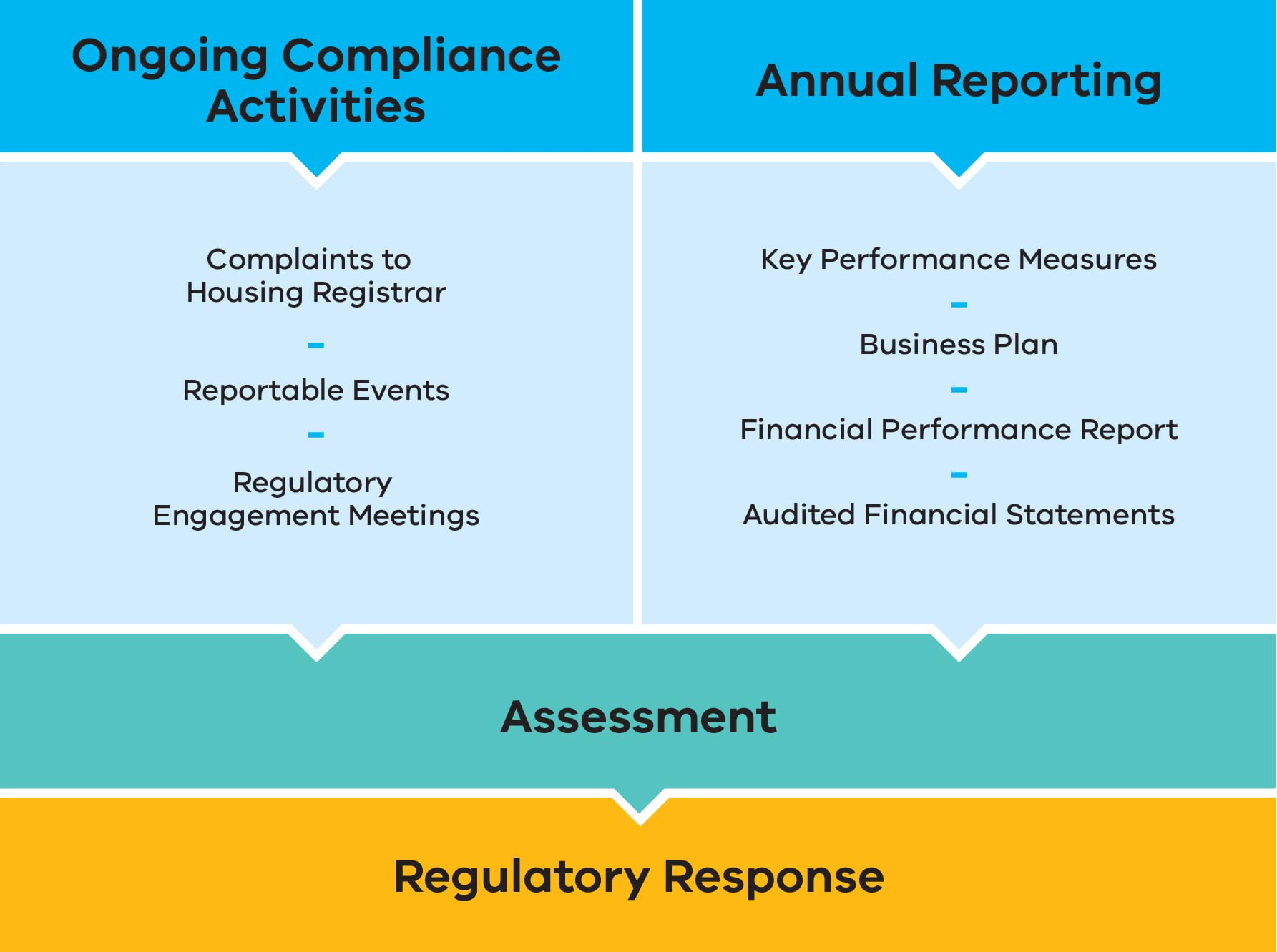
We use a range of tools to monitor the performance of registered agencies, including:
- ongoing compliance activities to collect information in real time
- annual reporting to collect information at the end of each financial year.
We assess each registered agency’s performance continuously based on the information we collect.
Regulatory response
After we assess evidence of registered agency performance, we may conclude that the agency’s performance needs improvement. Depending on the compliance risk, our regulatory response may include:
- Monitoring Items
- Regulatory Action Items
- Regulatory Intervention
Monitoring Items
Issues that require registered agency action but are not considered a serious risk to compliance are recorded as Monitoring Items. These items do not impact an agency’s compliance rating.
For Monitoring Items, we advise the registered agency if a response is required within a specified timeframe and manage the item towards resolution by regularly checking on progress with the agency. Monitoring Items that are not satisfactorily addressed by an agency may be escalated to Regulatory Action Items.
Regulatory Action Items
For issues considered a serious risk to compliance, we collaborate with the registered agency to develop Regulatory Action Items that are specific, have a clear performance improvement objective, and can feasibly be actioned by the agency. Regulatory Action Items are accompanied by a change to the agency’s compliance rating, from ‘Compliant’ to either ‘Compliant with recommendations’ or ‘Not compliant’.
Registered agencies are required to report on the completion of Regulatory Action Items on or before the agreed deadline. We may also request informal updates on the status of Regulatory Action Items during regulatory engagement meetings. Satisfactory completion of all Regulatory Action Items relating to a Performance Standard will return the agency’s compliance rating for that Performance Standard to ‘Compliant’.
Regulatory Action Items are not published.
Regulatory intervention
A registered agency may be subject to more robust regulatory intervention if it has long-standing performance issues and it has been unwilling or unable to remedy its performance through Regulatory Action Items. Regulatory intervention is considered a last resort to enforce compliance.
Compliance ratings
Compliance ratings, published on the Registered agency performance page, reflect a registered agency’s current compliance status.
| Outcome | Description |
|---|---|
| Compliant | The registered agency is complying with the Performance Standard. |
| Compliant with recommendations | The registered agency is complying with the Performance Standard but performance gaps have been identified which the agency is required to address through Regulatory Action Items. |
| Not compliant | The registered agency is not complying with the Performance Standard. |
| Not applicable | The registered agency is not currently undertaking the relevant activity. |
Our regulatory principles
We apply the following principles to all our regulatory activities:
- Tenants first – We are focused on whether a registered agency’s activities support the tenant journey, ensuring they feel heard and have appropriate avenues to resolve complaints.
- Outcomes focussed – Each registered agency varies in scope and size. We accept that different agencies will have different operational approaches to complying with Performance Standards.
- Informed – We understand that the housing sector is complex and that there are a multitude of factors that will affect an agency’s performance, some of which may be beyond an agency’s direct control. We are committed to using data and other information to inform the way we regulate.
- Efficient – We seek to minimise the administrative burden placed on agencies by only requesting information from registered agencies that directly contributes to our ability to assess performance.
- Consistent and targeted – We have clear and consistent compliance practices that result in consistent decision-making across all registered agencies.
- Collaborative and transparent – Where performance risks are identified, we will work together with registered agencies on practical mitigation strategies, which will be clearly articulated and recorded.
- Committed to improvement – We are constantly seeking to improve the way we regulate for the benefit of tenants and registered agencies. We welcome feedback and suggestions for improvement.
Community housing regulation
The Housing Registrar monitors and regulates the community housing sector in Victoria.
Managing complaints
Guidance on making a complaint about a registered community housing agency in Victoria.
Updated 10 February 2026
About the VIC Government
- The Premier and ministers
- Find a Vic Gov department, agency or service
- Strategies and policies
- Inquiries and royal commissions
Grants and programs
Jobs and careers
Arts, culture and heritage
Business and the workplace
- Mentally Healthy Workplaces Framework
- Portable Long Service Authority
- Victoria’s racing industry
- Workforce Inspectorate Victoria
- Liquor licensing, sale and supply
Communities
- Children
- First Peoples - State Relations
- Finding records
- Gender equality & women’s leadership
- LGBTIQA+ equality
- Multicultural communities
- Seniors Online
- Veterans support and commemoration
- Volunteering in Victoria
- Youth Central
Education and training
- Victorian Early Childhood Regulatory Authority
- Early childhood education – information for professionals
- Kinder: Best Start, Best Life
- Education – information for parents
- Schools.Vic - information for schools
- Education grants, programs, awards and events
- PROTECT
- TAFE, training and universities sector
- TAFE Victoria
- Victorian Skills Authority
- Apprenticeships Victoria
- Learn Local
Environment, water and energy
Finance and economy
Health and social support
- Family violence reform
- NDIS Worker Screening Check
- NDIS and disability services and support in Victoria
- Patient Review Panel
- Transforming Trauma Victoria
Housing and property
Law and justice
- Adoption
- Births, deaths and marriages
- Honorary justices
- Machete ban
- Safeguarding Victorians against terrorism
- Stolen Generations Reparations Package
- Victims of Crime
- Victorian Racing Tribunal
Safety and emergencies
- Emergency Recovery Victoria
- Victorian Emergency Relief and Recovery Foundation
- Emergency Recovery Resource Portal
- How well do you know fire
- Fire Services Reform
- Water safety
- Marine Search and Rescue
Science and technology
- Data sharing and open data
- Data.vic - discover and access Vic Gov open data
- Developer.Vic - portal for API developers
- Go.vic URL shortener
- Vic Gov IT project dashboard
- Victoria’s free public wi-fi network
- Cyber security in the Victorian Government
Sport and recreation
Traffic and transport
- Cameras Save Lives
- Transport Fines
- Getting Around
- Transport Planning
- Transport Future
- Climate Change and transport
- Future Directions For Transport
- Transport projects
- Ports and Freight
Working in the Victorian Government
- Single Digital Presence home
- Accommodation and Library Services
- Executive employment in the Victorian public sector
- Budget, procurement and funding
- Careers in the Victorian Government
- Council and Regulator Toolkit
- Guidelines for working in government
- Join a government network
- Standards and guidelines
- VicFleet CarPool
- Victorian Government style guide