Governance structures
Understand typical governance structures relevant to a project, based on its size and complexity, that will help ensure appropriate oversight and decision-making to successfully deliver and maximise benefits realised. The most appropriate governance structure for a project and the process for decision-making and oversight needs to recognise its characteristics, in particular its size and complexity. Exact governance structures will also be influenced by the specific oversight and approvals processes relevant to existing TAFE governance arrangements.
Governance structures need to incorporate relevant advisory and decision-making bodies, addressing both the TAFE’s internal oversight and approvals requirements for the project, as well as the level of expected broader government and third-party involvement.
Under the Commercial Guidelines – TAFE Institutes, it is recommended that the TAFE board (or relevant sub-committee) provide guidance on whether the governance arrangements are appropriate for the size, risk and type of activity prior to entering into a construction project.
However, to ensure best practice and appropriate decision-making, an appropriate project governance structure should be determined from the outset during the project definition, funding and approvals phase.
Open all
- Business-as-usual project governance
Suggested governance structure
A suggested governance structure for a business-as-usual (BAU) project is provided below:
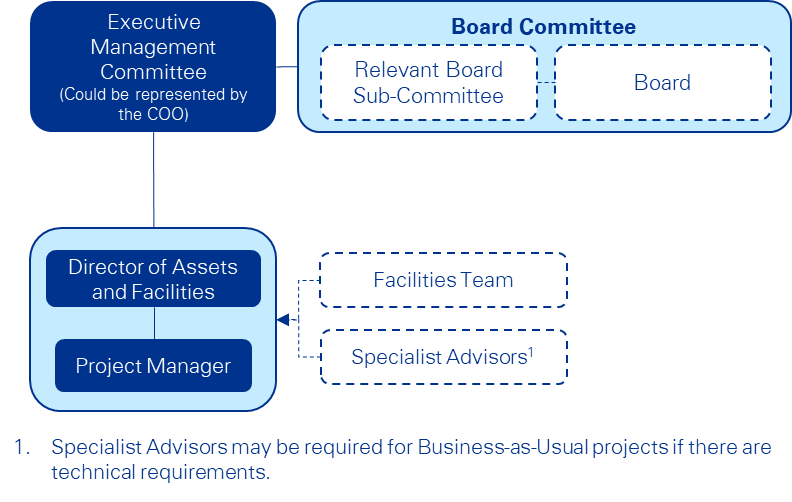
This governance structure may need to be modified depending on the TAFE’s internal governance structure and processes, as well as the specifics of the project.
Roles and responsibilities
BAU projects are typically undertaken by a sole project manager, given their relatively low value and low complexity project characteristics.
The project manager may interface with the facilities team, particularly in the consideration of handover requirements, future facilities maintenance and project reporting. Depending on the technical nature of the project, support may also be sought from specialist advisors, such as the development of a technical performance specification for a specialist piece of equipment. The project manager will typically be responsible for making day-to-day project decisions, overseen by the director of assets and facilities (or equivalent person within the TAFE).
Key approvals may also be required from the executive management committee or representative delegate, such as the Chief Operating Officer (COO).
This governance structure provides a foundation for all project phases. However, it is likely that personnel for key delivery roles, such as specialist advisors, may change over the project lifecycle. Furthermore, particular processes, such as tender evaluation, may involve different governance structures as well as support from procurement, legal and commercial advisors.
The following links provide further information on the approvals process, roles and responsibilities within this governance structure and reporting requirements within the project’s governance structure.
- Low complexity project governance
Suggested governance structure
A suggested governance structure for a low complexity project is highlighted below:
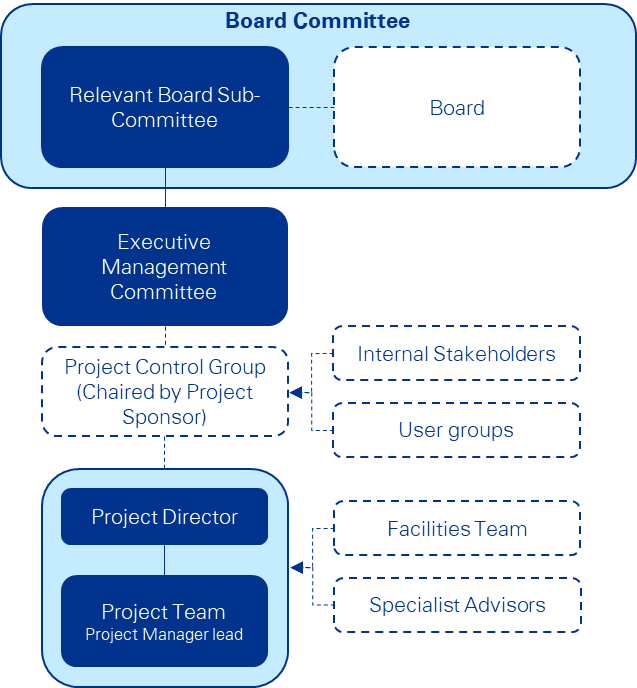
This governance structure may need to be modified depending on the TAFE’s internal governance structure and processes, as well as the specifics of the project.
Roles and responsibilities
Low complexity projects are typically expected to require a project team, with the project manager responsible for completing day-to-day project tasks. The project director will oversee project delivery and is anticipated to be the director of assets and facilities (or equivalent) or a specialised consultant where more specialist skills or additional capacity is required to oversee the project.
The project manager may interface with the facilities team, particularly in the consideration of handover requirements, future facilities maintenance and project reporting. It is also anticipated that support and advice will also be provided by specialist advisors.
The project control group may include, but is not limited to the following members:
- director of assets and facilities (or equivalent, if not the project director) (chair)
- project manager
- representative head of department (of key functions impacted by the project)
- representative of the executive management committee (to be nominated by the TAFE but often the COO)
- appropriate TAFE representatives based on the size and complexity of the project, and
- Office of TAFE Coordination and Delivery (OTCD) representative (for low complexity projects which form part of a government-funded program of work). This governance structure provides a foundation for all phases of the project. However, it is likely that personnel for key delivery roles, such as the project manager and specialist advisors, may change over the project lifecycle. Furthermore, particular processes, such as tender evaluation, may involve different governance structures as well as support from procurement, legal and commercial advisors.
The following links provide further information on the approvals process, roles and responsibilities within this governance structure and reporting requirements within the project’s governance structure.
- Medium complexity project governance
Suggested governance structure
A suggested governance structure for a medium complexity project is highlighted below:
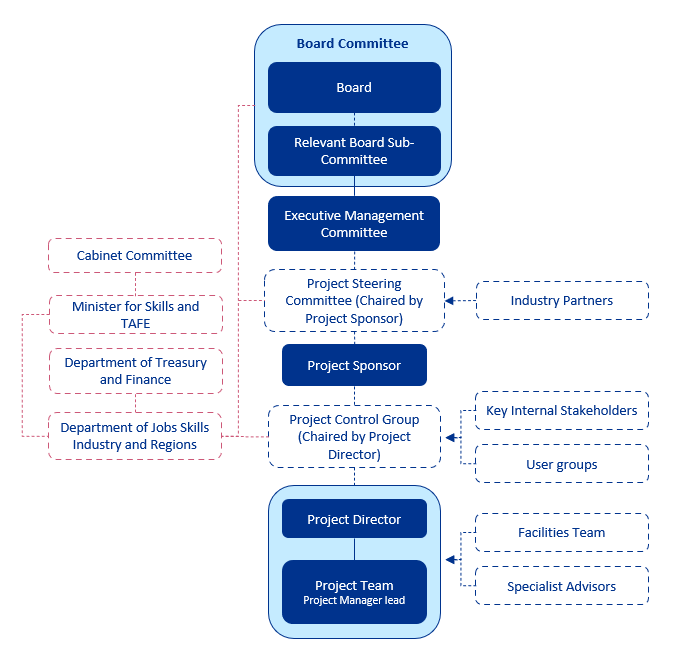
This governance structure may need to be modified depending on the TAFE’s internal governance structure and processes, as well as the specifics of the project (including whether you are seeking funding from and involvement of government and/or third-party participants such as industry partners).
Roles and responsibilities
Medium complexity projects are typically expected to require a project team, with the project manager responsible for completing day-to-day project tasks. The project director will oversee project delivery and is typically an individual with experience matched to the characteristics of the project or a specialist advisor where more specialist skills or capacity is required to oversee the project.
The project manager may interface with the facilities team, particularly in the consideration of handover requirements, future facilities maintenance and project reporting. It is also anticipated that support and advice will also be provided by specialist advisors.
If the project is externally funded, the project control group (PCG) will likely include OTCD representation, providing contribution and guidance in accordance with the capital works funding agreement (CWFA).
If the project involves a number of additional stakeholders such as central government agencies and/or industry partners, you may wish to have a project steering committee (PSC) typically chaired by the project sponsor (COO or CEO). As opposed to the PCG, which is responsible for project delivery issues, the PSC may provide an appropriate distinction between the resolution of technical project delivery issues from key strategic, whole of government, project decision making.
Please note that where the project governance structure includes both a PCG and PSC, the OTCD may wish to attend the PCG and be a member of the PSC.
The PSC may consist of the following members:
- project sponsor (chair)
- project director
- Chief Operating Officer (or an appropriate delegate)
- TAFE representatives
- subject matter experts relevant to each phase of the project
- OTCD representatives, and
- industry partners. In addition to the internal approvals process, where external funding is sought separate approvals will be required from within government (which may include the OTCD, the Minister for Skills and TAFE, DTF and cabinet committees). Your nominated OTCD representative will provide you with guidance specific to the project. It is recommended that all matters requiring external consideration and approvals first receive board committee endorsement/approval.
This governance structure provides a foundation for all phases of the project. However, it is likely that personnel for key delivery roles, such as the project manager and specialist advisors, may change over the project lifecycle. Furthermore, particular processes, such as tender evaluation, may involve different governance structures as well as support from procurement, legal and commercial advisors.
The following links provide further information on the approvals process, roles and responsibilities within this governance structure, and reporting requirements within the project’s governance structure.
- High-value-high-risk project governance
Suggested governance structure
Externally and internally funded projects that meet the Department of Treasury and Finance’s (DTF) high-value-high-risk (HVHR) definition will be classified as HVHR. This can be done using DTF’s project profile model tool. The typical governance structure for a HVHR project is highlighted below:
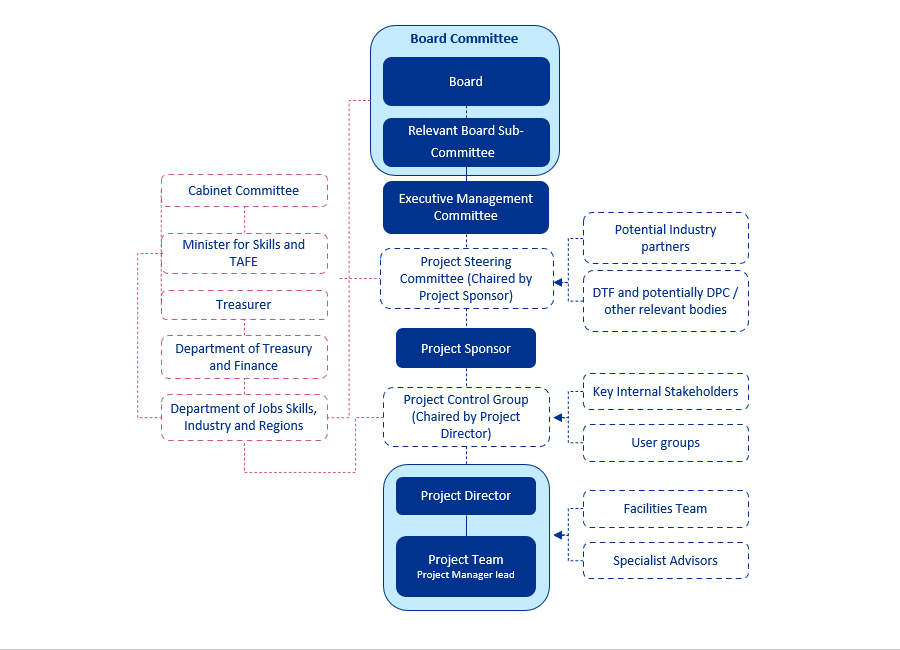
This governance structure may need to be modified depending on the TAFE’s internal governance structure and processes, as well as the specifics of the project. However, DTF and specific Treasurer approval requirements must be included in all HVHR project governance structures.
Roles and responsibilities
HVHR projects are typically expected to require a project team, with the project manager responsible for completing day-to-day project tasks. The project director will oversee project delivery and is typically an individual with experience matched to the characteristics of the project or a specialised consultant where more specialist skills or capacity is required to oversee the project.
The project manager may interface with the facilities team, particularly in the consideration of handover requirements, future facilities maintenance and project reporting. It is also anticipated that support and advice will also be provided by specialist advisors.
If the project is externally funded, the project control group (PCG) will likely include OTCD representation, providing contribution and guidance in accordance with the capital works funding agreement (CWFA).
If the project involves a number of additional stakeholders such as central government agencies and/or industry partners, you may wish to have a project steering committee (PSC), typically chaired by the project sponsor (COO or CEO). As opposed to the PCG which is responsible for project delivery issues, the PSC may provide an appropriate distinction between the resolution of technical project delivery issues from key strategic, whole of government, project decision making.
Please note that where the project governance structure includes both a PCG and PSC, the OTCD may wish to attend the PCG and be a member of the PSC.
The PSC may consist of the following members:
- project sponsor (chair)
- project director
- Chief Operating Officer (or an appropriate delegate)
- TAFE representatives
- subject matter experts relevant to each phase of the project
- OTCD representatives
- DTF representatives
- industry partners. In addition to internal approvals process, separate approvals will be required from within government (this may include the OTCD, the Minister for Skills and TAFE, DTF and cabinet committees). Your nominated OTCD representative will provide you with guidance specific to the project. It is recommended that all matters requiring external consideration and approvals first receive board committee endorsement/approval.
The Department of Treasury and Finance will provide close oversight during project implementation for the following matters:
- time, scope and budget reporting and analysis
- governance advice and monitoring
- risk assessments and mitigation reviews
- any recommended interventions or remedial actions. This governance structure provides a foundation for all phases of the project. However, it is likely that personnel for key delivery roles, such as the project manager and specialist advisors, may change over the project lifecycle. Furthermore, particular processes, such as tender evaluation, may involve different governance structures as well as support from procurement, legal and commercial advisors.
The following links provide further information on the approvals process, roles and responsibilities within this governance structure, and reporting requirements within the project’s governance structure.
For further information on DTF’s HVHR process is available.
I need to:
Updated 31 December 2025
Related links
About the VIC Government
- The Premier and ministers
- Find a Vic Gov department, agency or service
- Strategies and policies
- Inquiries and royal commissions
Grants and programs
Jobs and careers
Arts, culture and heritage
Business and the workplace
- Mentally Healthy Workplaces Framework
- Portable Long Service Authority
- Victoria’s racing industry
- Workforce Inspectorate Victoria
- Liquor licensing, sale and supply
Communities
- Children
- First Peoples - State Relations
- Finding records
- Gender equality & women’s leadership
- LGBTIQA+ equality
- Multicultural communities
- Seniors Online
- Veterans support and commemoration
- Volunteering in Victoria
- Youth Central
Education and training
- Victorian Early Childhood Regulatory Authority
- Early childhood education – information for professionals
- Kinder: Best Start, Best Life
- Education – information for parents
- Schools.Vic - information for schools
- Education grants, programs, awards and events
- PROTECT
- TAFE, training and universities sector
- TAFE Victoria
- Victorian Skills Authority
- Apprenticeships Victoria
- Learn Local
Environment, water and energy
Finance and economy
Health and social support
- Family violence reform
- NDIS Worker Screening Check
- NDIS and disability services and support in Victoria
- Patient Review Panel
- Transforming Trauma Victoria
Housing and property
Law and justice
- Adoption
- Births, deaths and marriages
- Honorary justices
- Machete ban
- Safeguarding Victorians against terrorism
- Stolen Generations Reparations Package
- Victims of Crime
- Victorian Racing Tribunal
Safety and emergencies
- Emergency Recovery Victoria
- Victorian Emergency Relief and Recovery Foundation
- Emergency Recovery Resource Portal
- How well do you know fire
- Fire Services Reform
- Water safety
- Marine Search and Rescue
Science and technology
- Data sharing and open data
- Data.vic - discover and access Vic Gov open data
- Developer.Vic - portal for API developers
- Go.vic URL shortener
- Vic Gov IT project dashboard
- Victoria’s free public wi-fi network
- Cyber security in the Victorian Government
Sport and recreation
Traffic and transport
- Cameras Save Lives
- Transport Fines
- Getting Around
- Transport Planning
- Transport Future
- Climate Change and transport
- Future Directions For Transport
- Transport projects
- Ports and Freight
Working in the Victorian Government
- Single Digital Presence home
- Accommodation and Library Services
- Executive employment in the Victorian public sector
- Budget, procurement and funding
- Careers in the Victorian Government
- Council and Regulator Toolkit
- Guidelines for working in government
- Join a government network
- Standards and guidelines
- VicFleet CarPool
- Victorian Government style guide