A guide for organisations on how to share information
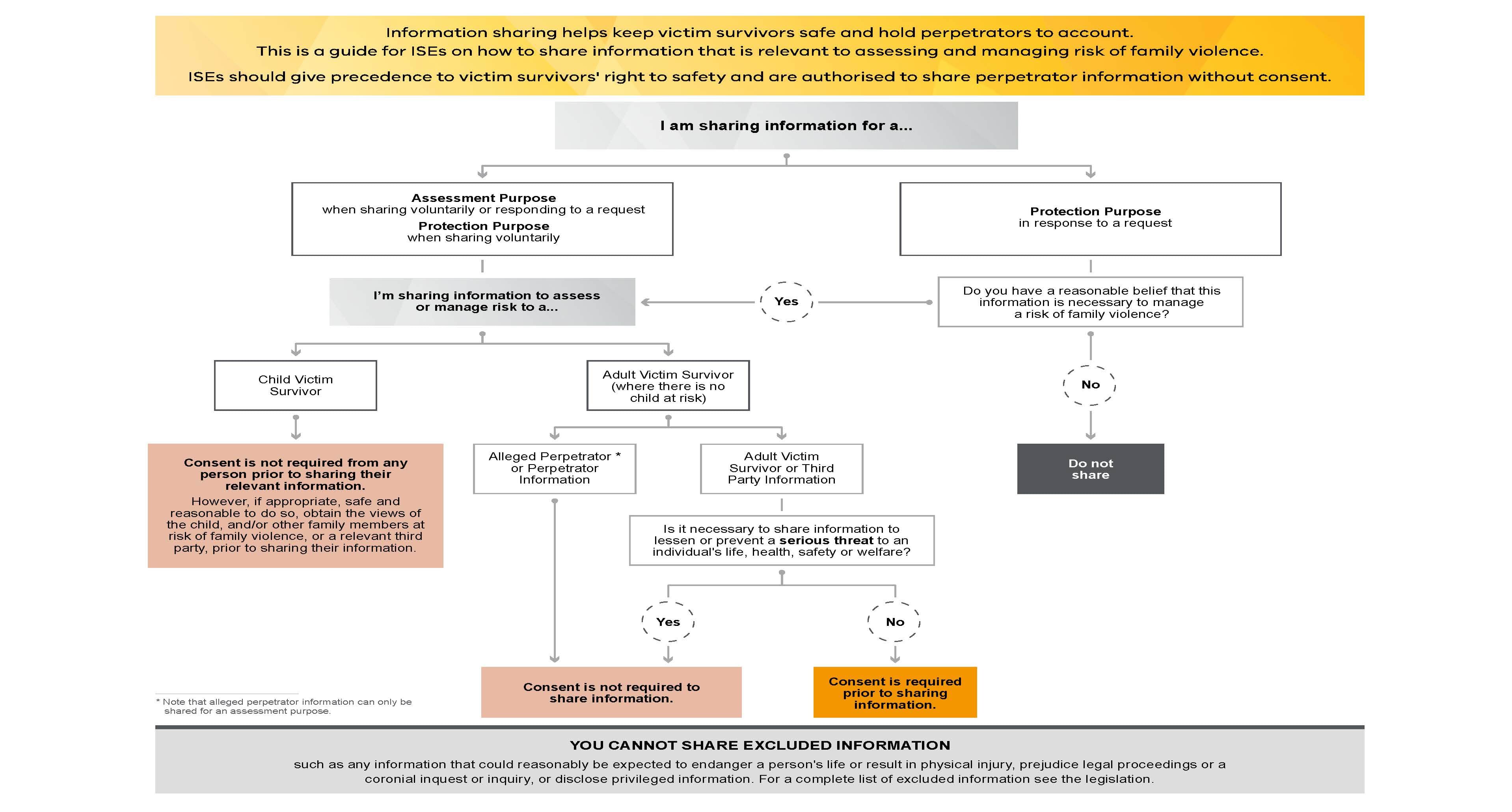
This diagram shows a process flow for sharing information about adult and child victim survivors, perpetrators, alleged perpetrators and third parties.
The diagram has an introduction text at the top, which states “Information sharing helps keep victim survivors safe and hold perpetrators to account. This is a guide for ISEs on how to share information that is relevant to assessing and managing risk of family violence. ISEs should give precedence to victim survivors’ right to safety and are authorised to share perpetrator information without consent.”
The top level (first level) starts with “I am sharing information for a…”. Option 1 is both “Assessment Purpose (when sharing voluntarily or responding to a request) and Protection Purpose (when sharing voluntarily)”, and option 2 is “Protection Purpose (in response to a request)“.
If option 1 to this first level Q, then Q: “I’m sharing information to assess or manage risk to a…”. Options for this second level Q are: “Child Victim Survivor” and “Adult Victim Survivor (where there is not child at risk)”.
If “Child Victim Survivor”, then process flow ends with “Consent is not required from any person prior to sharing their relevant information. However, if appropriate, safe and reasonable to do so, obtain the views of the child, and/or other family members at risk of family violence, or a relevant third party, prior to sharing their information.”
If “Adult Victim Survivor (where there is not child at risk)”, then options are “Alleged Perpetrator (note that alleged perpetrator information can only be shared for an assessment purpose) or Perpetrator Information” and “Adult Victim Survivor or Third Party Information”. If “Alleged Perpetrator or Perpetrator Information”, then process flow ends with “Consent is not required to share information.”
If “Adult Victim Survivor or Third Party Information”, then Q: “Is it necessary to share information to lessen or prevent a serious threat to an individual’s life, health, safety or welfare?”. If yes, then process flow ends with “Consent is not required to share information.” If no, then process flow ends with “Consent is required prior to sharing information.”
If option 2 to the first level Q, then Q: “Do you have a reasonable belief that this information is necessary to manage a risk of family violence?”. If yes, then process flow goes to the second level Q: “I’m sharing information to assess or manage risk to a…” (see above paragraphs for the flow for this. If no, then process flow ends with “Do not share”.
The diagram has the following text in the footer: “You cannot share excluded information", such as any information that could reasonably be expected to endanger a person’s life or result in physical injury, prejudice legal proceedings or a coronial inquest or inquiry, or disclose privileged information. For a complete list of excluded information see the legislation.”
A guide for organisations on how to share information PDF 1.94 MB (opens in a new window)
Updated 10 February 2026
About the VIC Government
- The Premier and ministers
- Find a Vic Gov department, agency or service
- Strategies and policies
- Inquiries and royal commissions
Grants and programs
Jobs and careers
Arts, culture and heritage
Business and the workplace
- Mentally Healthy Workplaces Framework
- Portable Long Service Authority
- Victoria’s racing industry
- Workforce Inspectorate Victoria
- Liquor licensing, sale and supply
Communities
- Children
- First Peoples - State Relations
- Finding records
- Gender equality & women’s leadership
- LGBTIQA+ equality
- Multicultural communities
- Seniors Online
- Veterans support and commemoration
- Volunteering in Victoria
- Youth Central
Education and training
- Victorian Early Childhood Regulatory Authority
- Early childhood education – information for professionals
- Kinder: Best Start, Best Life
- Education – information for parents
- Schools.Vic - information for schools
- Education grants, programs, awards and events
- PROTECT
- TAFE, training and universities sector
- TAFE Victoria
- Victorian Skills Authority
- Apprenticeships Victoria
- Learn Local
Environment, water and energy
Finance and economy
Health and social support
- Family violence reform
- NDIS Worker Screening Check
- NDIS and disability services and support in Victoria
- Patient Review Panel
- Transforming Trauma Victoria
Housing and property
Law and justice
- Adoption
- Births, deaths and marriages
- Honorary justices
- Machete ban
- Safeguarding Victorians against terrorism
- Stolen Generations Reparations Package
- Victims of Crime
- Victorian Racing Tribunal
Safety and emergencies
- Emergency Recovery Victoria
- Victorian Emergency Relief and Recovery Foundation
- Emergency Recovery Resource Portal
- How well do you know fire
- Fire Services Reform
- Water safety
- Marine Search and Rescue
Science and technology
- Data sharing and open data
- Data.vic - discover and access Vic Gov open data
- Developer.Vic - portal for API developers
- Go.vic URL shortener
- Vic Gov IT project dashboard
- Victoria’s free public wi-fi network
- Cyber security in the Victorian Government
Sport and recreation
Traffic and transport
- Cameras Save Lives
- Transport Fines
- Getting Around
- Transport Planning
- Transport Future
- Climate Change and transport
- Future Directions For Transport
- Transport projects
- Ports and Freight
Working in the Victorian Government
- Single Digital Presence home
- Accommodation and Library Services
- Executive employment in the Victorian public sector
- Budget, procurement and funding
- Careers in the Victorian Government
- Council and Regulator Toolkit
- Guidelines for working in government
- Join a government network
- Standards and guidelines
- VicFleet CarPool
- Victorian Government style guide