Gippsland Regional circular economy plan
A circular economy plan by Gippsland for Gippsland
On this page
The Gippsland regional circular economy plan sets out Gippsland’s aspirations to 2030 for a sustainable and thriving circular economy.
Representatives from 51 organisations contributed to the plan, including:
- local government
- businesses and business associations
- manufacturers
- social enterprise
- the waste and resource recovery industry
- research and education institutions
- and the Victorian Government.
They participated in robust discussions and workshops facilitated by the Victorian Government designed to encourage strategic thinking about their region, where they are now, where they want to be by 2030, and how they can work together to get there.
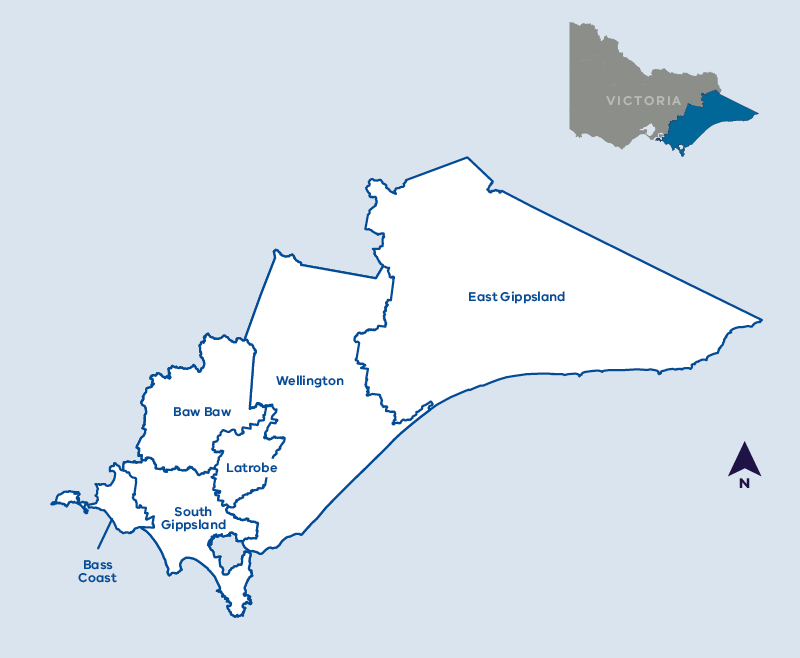
Aspirations to 2030
Gippsland’s five circular economy aspirations to 2030 are detailed below, along with six important changes, or ‘key enablers’, that have been identified to help realise these aspirations.
By 2030, in Gippsland
1.The circular economy is part of everyday life in Gippsland
In the Gippsland region all materials are understood to have value, and everyone is engaged in the reuse and stewardship of resources in a circular economy.
2. Collaboration and partnership drive action
All levels of government, industry, education institutions, researchers and community in the Gippsland region are working collaboratively to deliver shared local circular economy outcomes.
3. End use markets are aligned with resource recovery processing and supply
The Gippsland region industry sectors and services are integrated with advanced resource recovery infrastructure that produces large volumes of high-quality recycled products and materials that are used to their highest value.
4. An established and maturing circular economy
In the Gippsland region, there is a clear value chain, return on investment and market opportunities for recovering and recovered materials which is well known, systemised and well utilised.
5. Organics processing capacity and capability is strengthened
The Gippsland region is Victoria’s leader in extracting maximum value from organics processing.
Key enablers
Gippsland key enablers
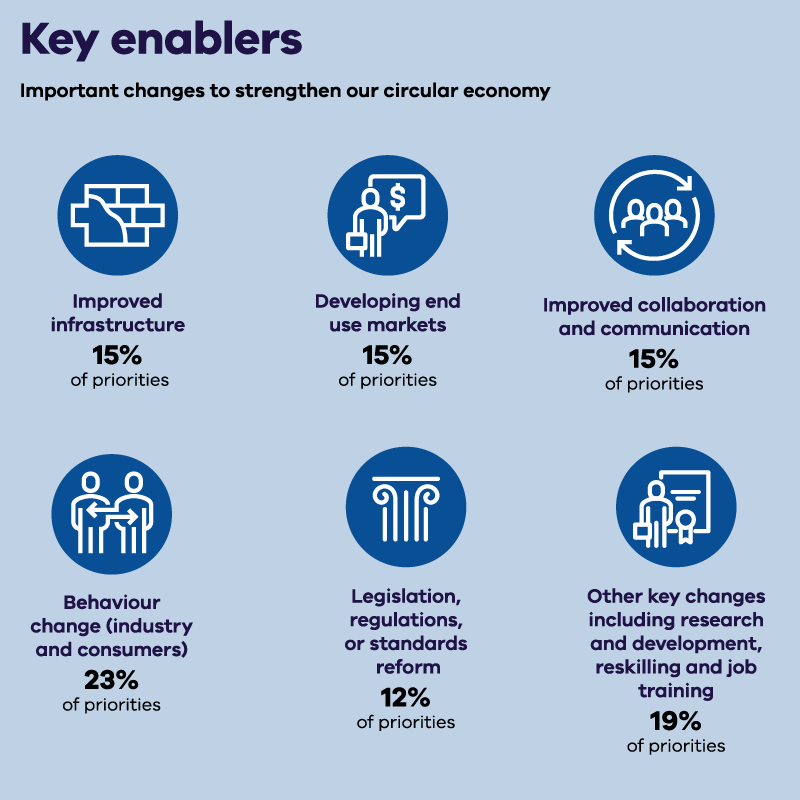
Priorities to achieve our aspirations
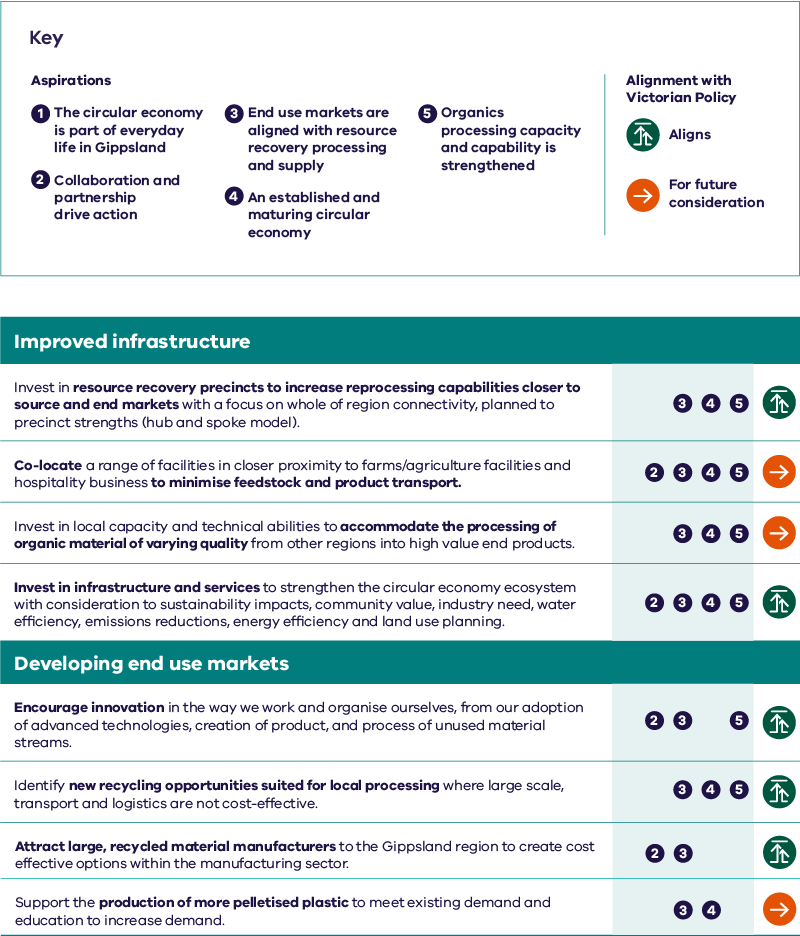
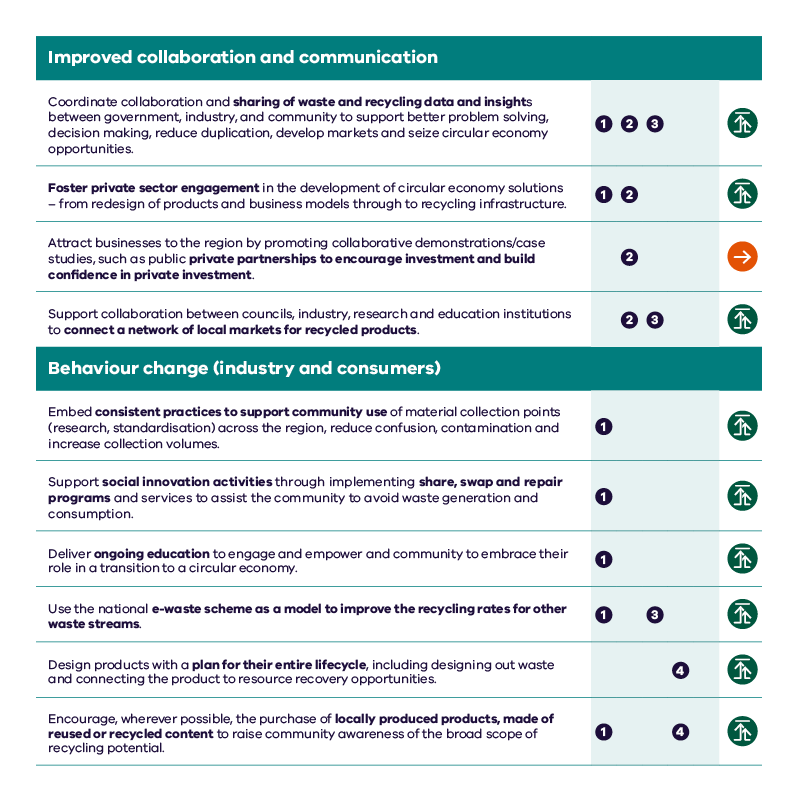
Gippsland has developed 26 priorities to achieve their circular economy aspirations to 2030. Each priority has been identified as contributing to one or more aspiration and has been grouped by Key Enablers. Many of the priorities align with current Victorian Government policy, whilst others will be for future consideration.
Improved infrastructure, developing end use markets
Improved collaboration and communication, Behaviour change industry and consumers
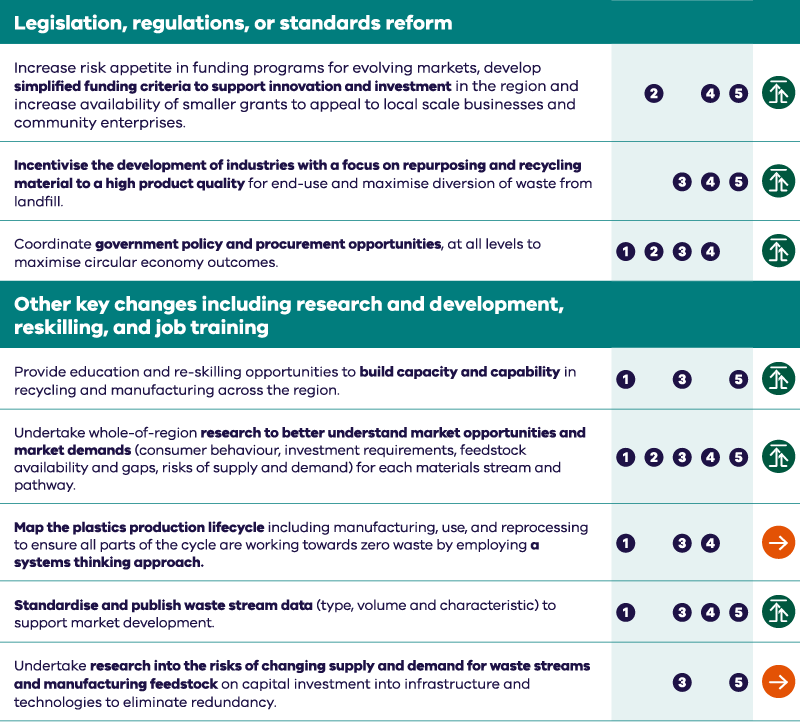
Legislation, regulations or standards reform and other key changes
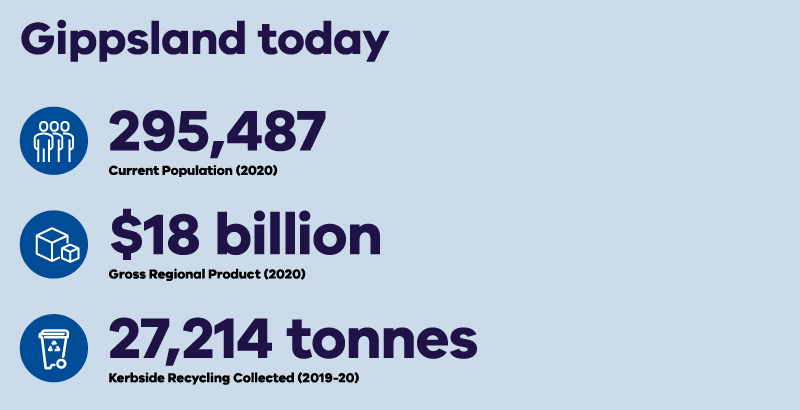
Gippsland today
Gippsland today
Gippsland representatives developed the regions circular economy aspirations and priorities. The representatives brought a local understanding of the region’s strengths and challenges. They considered ‘where we are today’ as a region, before projecting forward to ‘where we want to be’ in 2030 and beyond.
The process identified the region’s key strengths. These strengths will help the region work towards their 2030 aspirations.
Gippsland has a skilled technical workforce and strong agricultural sector. The region also has existing local circular economy project already underway.
There is space to co-locate infrastructure tu support and encourage circular economy outcomes. This could include locating local manufacturing near material processing infrastructure.
Refer to Victoria’s Regional Economic Development Strategies (REDS) for in-depth economic analysis.
Strengths
Gippsland
- Land availability for local processing and manufacturing plants or precincts, with the potential to co-locate these with industries.
- Skilled technical workforce transitioning from mining.
- Strong agricultural sector as both a generator of organic feedstock and an end-user of soil enhancers produced from recycled organic material.
- Local circular economy projects to draw upon and promote, such as local biochar production where wood waste is converted for use in agriculture.
Gippsland in 2030
Gippsland in 2030
Gippsland representatives also considered the region’s challenges. They developed the region’s circular economy priorities to mitigate these challenges.
The region’s large size is a key challenge.This includes long distances between recycled and reused material sources and processing facilities. The cost of accessing local processing facilities can be greater than transporting materials to facilities in Melbourne.
Accessing high-quality recycled materials is difficult for existing manufacturers. It is also a barrier for encouraging new entrants into the region.
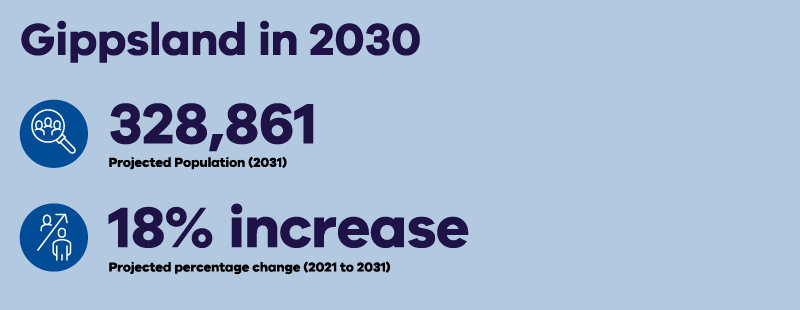
By 2030, the Gippsland region forecast to be home to 328,861 people, increasing by 18% from 2021 to 2031.
Higher rates of waste and recyclable materials are likely where populations increase. This will increase demand for sorting, processing, and storage infrastructure. Increased material transport out of the region will place added pressure on regional roads.
Some areas that are not forecast to increase their populations may continue not to need household collection. This could present a challenge for local councils and industry aiming to divert materials from landfill.Availability of high-quality recycled materials is a challenge for existing manufacturers. It is also a barrier for encouraging new entrants into the region.
Refer to Victoria’s Regional Economic Development Strategies (REDS) for in-depth economic analysis.
Challenges
Gippsland
- Large distances between waste sources and processing facilities attribute a high transport cost to recycling.
- Cost of accessing local processing facilities is, in some instances, greater than transporting to larger facilities in Melbourne.
- Lack of availability of recycled product is a barrier for manufacturers.
- Variation in quality with recycled products/contamination reduces the attractiveness of it as a commodity.
- Low economies of scale of some waste streams and the high relative costs of small processing facilities reduce the cost effectiveness of recycling.
How to use the regional circular economy plans
Gippsland regional circular economy plan
Gippsland regional circular economy plan PDF 4.36 MB (opens in a new window)
Engagement program summary report
For more information on the Engagement Program refer to the Regional circular economy plans engagement summary report.
Regional circular economy plans engagement summary report PDF 7.44 MB (opens in a new window)
Updated 6 December 2022
About the VIC Government
- The Premier and ministers
- Find a Vic Gov department, agency or service
- Strategies and policies
- Inquiries and royal commissions
Grants and programs
Jobs and careers
Arts, culture and heritage
Business and the workplace
- Mentally Healthy Workplaces Framework
- Portable Long Service Authority
- Victoria’s racing industry
- Workforce Inspectorate Victoria
- Liquor licensing, sale and supply
Communities
- Children
- First Peoples - State Relations
- Finding records
- Gender equality & women’s leadership
- LGBTIQA+ equality
- Multicultural communities
- Seniors Online
- Veterans support and commemoration
- Volunteering in Victoria
- Youth Central
Education and training
- Victorian Early Childhood Regulatory Authority
- Early childhood education – information for professionals
- Kinder: Best Start, Best Life
- Education – information for parents
- Schools.Vic - information for schools
- Education grants, programs, awards and events
- PROTECT
- TAFE, training and universities sector
- TAFE Victoria
- Victorian Skills Authority
- Apprenticeships Victoria
- Learn Local
Environment, water and energy
Finance and economy
Health and social support
- Family violence reform
- NDIS Worker Screening Check
- NDIS and disability services and support in Victoria
- Patient Review Panel
- Transforming Trauma Victoria
Housing and property
Law and justice
- Adoption
- Births, deaths and marriages
- Honorary justices
- Machete ban
- Safeguarding Victorians against terrorism
- Stolen Generations Reparations Package
- Victims of Crime
- Victorian Racing Tribunal
Safety and emergencies
- Emergency Recovery Victoria
- Victorian Emergency Relief and Recovery Foundation
- Emergency Recovery Resource Portal
- How well do you know fire
- Fire Services Reform
- Water safety
- Marine Search and Rescue
Science and technology
- Data sharing and open data
- Data.vic - discover and access Vic Gov open data
- Developer.Vic - portal for API developers
- Go.vic URL shortener
- Vic Gov IT project dashboard
- Victoria’s free public wi-fi network
- Cyber security in the Victorian Government
Sport and recreation
Traffic and transport
- Cameras Save Lives
- Transport Fines
- Getting Around
- Transport Planning
- Transport Future
- Climate Change and transport
- Future Directions For Transport
- Transport projects
- Ports and Freight
Working in the Victorian Government
- Single Digital Presence home
- Accommodation and Library Services
- Executive employment in the Victorian public sector
- Budget, procurement and funding
- Careers in the Victorian Government
- Council and Regulator Toolkit
- Guidelines for working in government
- Join a government network
- Standards and guidelines
- VicFleet CarPool
- Victorian Government style guide