Fuel supply
On this page
At a glance
Fuel supply in Victoria remains stable and there is enough fuel to meet normal demand.
Temporary disruptions may occur in some areas due to increased demand or supply chain pressure. Government and industry are actively monitoring the situation.
What you should do
- Buy only the fuel you normally need.
- Plan ahead and fill up before longer trips, especially if you rely on fuel for work or essential travel.
- Check this page for updates if conditions change.
How Victorians can help
We know many people are worried about fuel prices and availability. Simple steps can help make sure fuel stays available for everyone.
Plan ahead
- Buy only what you usually need, so no one has to go without.
- Fill up before you head out, especially if you rely on fuel for work, school or travel.
Check prices before you go
- Use Servo Saver in the Service Victoria app to check fuel prices near you.
- You can see where fuel is cheapest and plan when to fill up.
Be kind at the servo
- Service station staff are doing their best during a busy and stressful time.
- Please treat service station workers with patience and respect, just as you would expect at your own workplace.
Be safe when handling and storing fuel
If you need to handle, transport, or store fuel, it is important that you do so safely. Unsafe handling, transport or storage can create serious safety risks.
Visit safe handling and storage of fuel for more information.
Support that is in place
Temporary fuel excise reduction
Australian Government has announced it will halve the fuel excise on petrol and diesel for 3 months, from Wednesday 1 April to 30 June.
This is expected to reduce fuel price by around 32 cents per litre.
Other Victorian support
- Free public transport between 31 March and 30 April, including Melbourne and regional trains, trams, buses and coach services. Find more information at the Transport Victoria website.
- Fuel price rules apply across Victoria. Service stations publish a daily maximum fuel price in advance, which can only stay the same or go down during the day.
- Servo Saver in the Service Victoria app shows fuel prices at Victorian service stations to help people compare prices and plan ahead.
Support for heavy vehicle operators
The Australian Government has announced the Heavy Vehicle Road User Charge will be reduced to zero between 1 April and 30 June.
They have also deferred the next scheduled increase in the Heavy Vehicle Road User Charge by 6 months.
Other national support
- Released 20% of domestic fuel reserves to support supply, with priority given to regional areas experiencing shortages.
- Strengthened ACCC monitoring and compliance arrangements to support transparency and oversight of fuel pricing.
- Temporary adjusted fuel quality settings to allow more domestically produced fuel to be sold locally and increase diesel imports.
What governments are doing
National Fuel Security Plan
The Australian Government has announced that National Cabinet has agreed to the National Fuel Security Plan, which sets out how the Commonwealth, states and territories will work together to respond to fuel supply issues.
The plan is designed to keep communities and businesses informed, and to provide early visibility of any further fuel security measures that may be needed
National Fuel Security Plan infographic
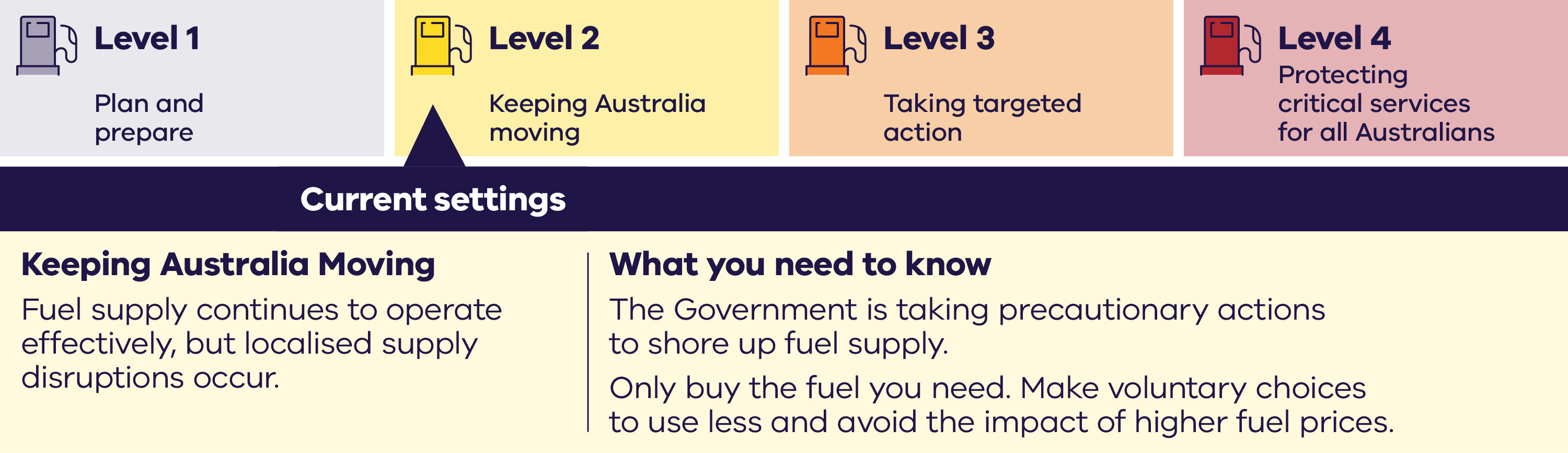
Victorian Government response
Under the current Level 2 arrangements, the Victorian Government has taken the following steps:
- Planning and preparedness: Using real-time data from industry and the community to understand impacts and prepare for potential fuel shortages.
- Working with industry: A state Fuel Security and Supply Chain Planning taskforce has been established to oversee and coordinate the government’s response and planning in relation to fuel supply, distribution and cost.
- Monitoring fuel supply: Fuel availability is being closely monitored using live data from the Services Victoria Servo Saver app, allowing early identification of outages and quicker responses.
- Cost of living support: Free public transport has been announced for April to help families and workers manage rising petrol prices and access lower-cost travel options.
- National coordination: working actively to coordinate a consistent response to fuel disruptions, supporting supply chain continuity, prioritising fuel for critical services and regional communities, and helping manage price and availability pressures for Victorians.
- Keeping people informed: Up-to-date fuel supply information is available on vic.gov.au, alongside a new campaign encouraging Victorians to use the Servo Saver app to find cheaper fuel and avoid paying more than necessary.
- Fair pricing and compliance: Consumer Affairs Victoria inspectors are visiting service stations to ensure fuel prices are reported accurately.
- Engaging fuel companies: The government has written to fuel companies to seek cooperation in sharing fuel supply information. Following legislation passed on April 2, Victoria also has strengthened powers to require key fuel supply and distribution information where needed, helping government target interventions, improve transparency, and support resilience across metropolitan and regional supply chains.
For updates and practical guidance, continue to check this page. If conditions change, additional advice will be provided.
Updated 8 April 2026
Related links
About the VIC Government
- The Premier and ministers
- Find a Vic Gov department, agency or service
- Strategies and policies
- Inquiries and royal commissions
Grants and programs
Jobs and careers
Arts, culture and heritage
Business and the workplace
- Mentally Healthy Workplaces Framework
- Portable Long Service Authority
- Victoria’s racing industry
- Workforce Inspectorate Victoria
- Liquor licensing, sale and supply
Communities
- Children
- First Peoples - State Relations
- Finding records
- Gender equality & women’s leadership
- LGBTIQA+ equality
- Multicultural communities
- Seniors Online
- Veterans support and commemoration
- Volunteering in Victoria
- Youth Central
Education and training
- Victorian Early Childhood Regulatory Authority
- Early childhood education – information for professionals
- Kinder: Best Start, Best Life
- Education – information for parents
- Schools.Vic - information for schools
- Education grants, programs, awards and events
- PROTECT
- TAFE, training and universities sector
- TAFE Victoria
- Victorian Skills Authority
- Apprenticeships Victoria
- Learn Local
Environment, water and energy
Finance and economy
Health and social support
- Family violence reform
- NDIS Worker Screening Check
- NDIS and disability services and support in Victoria
- Patient Review Panel
- Transforming Trauma Victoria
Housing and property
Law and justice
- Adoption
- Births, deaths and marriages
- Honorary justices
- Machete ban
- Safeguarding Victorians against terrorism
- Stolen Generations Reparations Package
- Victims of Crime
- Victorian Racing Tribunal
Safety and emergencies
- Emergency Recovery Victoria
- Victorian Emergency Relief and Recovery Foundation
- Emergency Recovery Resource Portal
- How well do you know fire
- Fire Services Reform
- Water safety
- Marine Search and Rescue
Science and technology
- Data sharing and open data
- Data.vic - discover and access Vic Gov open data
- Developer.Vic - portal for API developers
- Go.vic URL shortener
- Vic Gov IT project dashboard
- Victoria’s free public wi-fi network
- Cyber security in the Victorian Government
Sport and recreation
Traffic and transport
- Cameras Save Lives
- Transport Fines
- Getting Around
- Transport Planning
- Transport Future
- Climate Change and transport
- Future Directions For Transport
- Transport projects
- Ports and Freight
Working in the Victorian Government
- Single Digital Presence home
- Accommodation and Library Services
- Executive employment in the Victorian public sector
- Budget, procurement and funding
- Careers in the Victorian Government
- Council and Regulator Toolkit
- Guidelines for working in government
- Join a government network
- Standards and guidelines
- VicFleet CarPool
- Victorian Government style guide