Lines of recovery
The State Emergency Management Plan (SEMP) identifies 4 recovery environments:
- social
- economic
- built
- natural.
Together they provide a framework within which recovery can be planned, coordinated, delivered, monitored and evaluated. Each environment contains one or more functional areas that bring together related recovery roles that address specific community needs.
Emergency Recovery Victoria’s (ERV) approach to recovery builds on the SEMP, identifying 5 lines of recovery that both align to the SEMP recovery environments and include a separate line of recovery for aboriginal culture and healing. This is because ERV is committed to embedding Aboriginal self-determination into our practices to improve strengthened recovery outcomes, in line with Victorian Government commitments under the Victorian Aboriginal Affairs Framework 2018-2023 and Self-Determination Reform Framework.
Aboriginal people’s relationships to country, culture and community are not only interconnected but intrinsically linked and enmeshed within identity. Incorporating Aboriginal knowledge into the recovery system benefits all Victorians. Aboriginal ways of knowing encourage us to live in connection with the land, and for communities to see themselves as part of that land and place, rather than separate.
Lines of recovery diagram
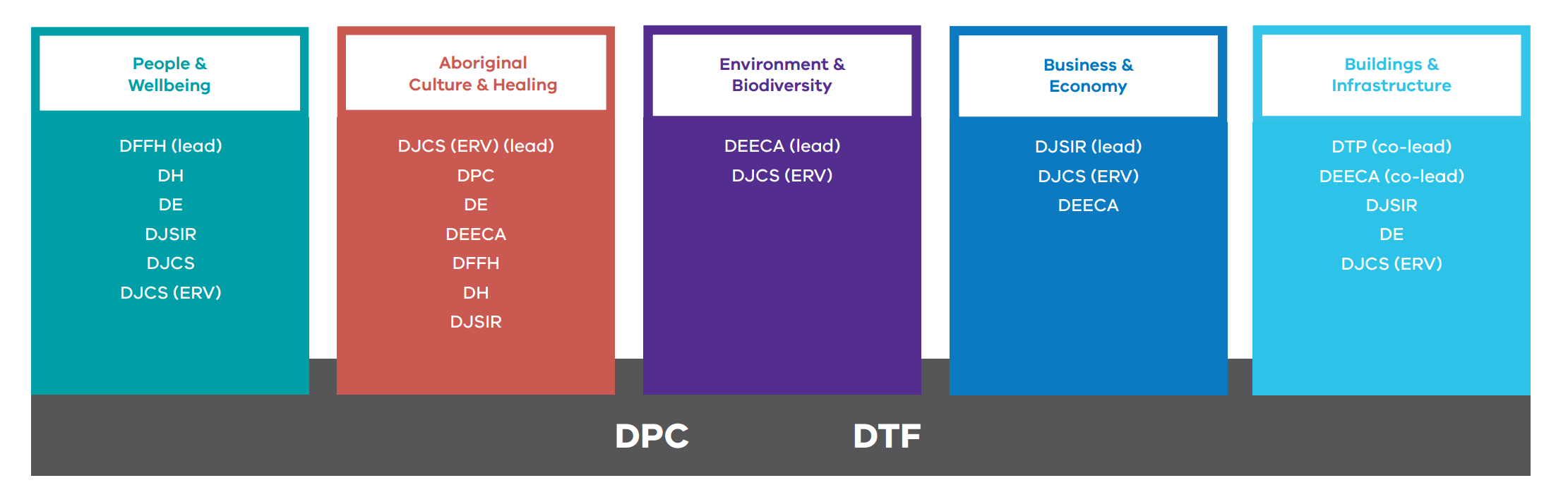
About the lines of recovery
People and wellbeing
State head department
Department of Families, Fairness and Housing
Overview
The people and wellbeing line of recovery works to ensure community members impacted by emergencies are healthy, safe and connected within their community.
It coordinates and commissions programs that provide:
- wrap around recovery support across the breadth of individual and community needs
- financial counselling, assistance accessing grants and support with financial wellbeing
- tailored psychosocial support
- community resilience training and development of the capabilities of the health and wellbeing workforce to deliver these services
- resilience capability and capacity of schools
- training in family violence support and recovery
- access to disaster legal aid.
Recovery outcomes
- People are managing their physical and mental health.
- People have timely access to a safe, stable and secure home.
- Communities recover and build resilience together.
Aboriginal culture and healing
State lead agency
Emergency Recovery Victoria (ERV)
Overview
The Aboriginal culture and healing line of recovery is the first of its kind in Australia.
It stands alongside traditional lines of recovery to ensure the voice of Aboriginal Victorians affected by disasters is represented in government decision-making.
This line of recovery was designed to ensure overall recovery efforts consider and safeguard a culturally appropriate and safe recovery for Aboriginal Victorians.
Recovery outcomes
- Aboriginal peoples’ unique experiences of trauma are addressed, and healing is supported.
- The recovery and resilience of the whole community is strengthened through Aboriginal culture, knowledge, traditions and connection to country.
- Aboriginal communities have increased capability to lead recovery and build resilience.
Aboriginal self-determination
We are committed to embedding Aboriginal self-determination into our practices to improve recovery outcomes for Aboriginal communities. This commitment extends from the Victorian Government’s delivery of the Self-Determination Reform Framework, a guide for public service action enabling self-determination, and aligned with the delivery of the Victorian Aboriginal Affairs Framework 2018–2023.
We work closely with Aboriginal communities to develop their recovery solutions and encourage this practice in its service and agency partners for all rebuilding and recovery activities. Enabling and embedding Aboriginal peoples’ self-determination is a significant commitment to place choice and decision-making in the hands of Aboriginal people.
Environment and biodiversity
State lead department
Department of Energy, Environment and Climate Action
Overview
The environment and biodiversity line of recovery works alongside the community, the Department of Environment, Land, Water and Planning (DELWP), and other agencies to coordinate and support recovery efforts for biodiversity and environment with a focus on biodiversity, water and catchments, and sustainability.
This includes:
- coordinating the delivery of funding
- working with the community to understand their needs for biodiversity and environment
- delivering programs to meet these needs.
Recovery outcomes
- The natural habitat and processes that support threatened and iconic species and ecological communities are restored and protected.
- The community benefits of parks, forests and catchments are restored.
- Capacity to support environmental recovery and resilience is strengthened.
Business and economy
State lead department
Department of Jobs, Skills, Industry and Regions
Overview
The business and economy line of recovery works to support businesses and industry sectors impacted by disasters to recover and strengthen while ensuring employment opportunities are accessible and resilience is increased.
In collaboration with recovery partners, this includes the delivery of initiatives that help relieve immediate recovery needs of affected businesses, primary producers and industries, to set them on the path to recovery.
Recovery outcomes
- Industries and businesses recover and leverage economic strengths and opportunities.
- People participate in established and new employment opportunities.
- Local economies have increased capacity to respond and adapt to any future disaster.
Buildings and infrastructure
State lead departments
Department of Energy, Environment and Climate Action - co-lead Department of Transport and Planning - co-lead
Overview
The buildings and infrastructure line of recovery is responsible for coordinating the recovery efforts of partner agencies to restore essential community and statewide infrastructure safely and quickly.
This also includes supporting the rebuilding or repair of residential, commercial and agricultural properties and community facilities.
Recovery outcomes
- Utilities and transport routes are restored and strengthened.
- Public infrastructure is resilient and supports recovery.
- Residential, commercial and agricultural property is rebuilt and improved.
Updated 28 June 2024
Emergency Recovery Frameworkpdf1.94 MB
About the VIC Government
- The Premier and ministers
- Find a Vic Gov department, agency or service
- Strategies and policies
- Inquiries and royal commissions
Grants and programs
Jobs and careers
Arts, culture and heritage
Business and the workplace
- Mentally Healthy Workplaces Framework
- Portable Long Service Authority
- Victoria’s racing industry
- Workforce Inspectorate Victoria
- Liquor licensing, sale and supply
Communities
- Children
- First Peoples - State Relations
- Finding records
- Gender equality & women’s leadership
- LGBTIQA+ equality
- Multicultural communities
- Seniors Online
- Veterans support and commemoration
- Volunteering in Victoria
- Youth Central
Education and training
- Victorian Early Childhood Regulatory Authority
- Early childhood education – information for professionals
- Kinder: Best Start, Best Life
- Education – information for parents
- Schools.Vic - information for schools
- Education grants, programs, awards and events
- PROTECT
- TAFE, training and universities sector
- TAFE Victoria
- Victorian Skills Authority
- Apprenticeships Victoria
- Learn Local
Environment, water and energy
Finance and economy
Health and social support
- Family violence reform
- NDIS Worker Screening Check
- NDIS and disability services and support in Victoria
- Patient Review Panel
- Transforming Trauma Victoria
Housing and property
Law and justice
- Adoption
- Births, deaths and marriages
- Honorary justices
- Machete ban
- Safeguarding Victorians against terrorism
- Stolen Generations Reparations Package
- Victims of Crime
- Victorian Racing Tribunal
Safety and emergencies
- Emergency Recovery Victoria
- Victorian Emergency Relief and Recovery Foundation
- Emergency Recovery Resource Portal
- How well do you know fire
- Fire Services Reform
- Water safety
- Marine Search and Rescue
Science and technology
- Data sharing and open data
- Data.vic - discover and access Vic Gov open data
- Developer.Vic - portal for API developers
- Go.vic URL shortener
- Vic Gov IT project dashboard
- Victoria’s free public wi-fi network
- Cyber security in the Victorian Government
Sport and recreation
Traffic and transport
- Cameras Save Lives
- Transport Fines
- Getting Around
- Transport Planning
- Transport Future
- Climate Change and transport
- Future Directions For Transport
- Transport projects
- Ports and Freight
Working in the Victorian Government
- Single Digital Presence home
- Accommodation and Library Services
- Executive employment in the Victorian public sector
- Budget, procurement and funding
- Careers in the Victorian Government
- Council and Regulator Toolkit
- Guidelines for working in government
- Join a government network
- Standards and guidelines
- VicFleet CarPool
- Victorian Government style guide