The Working with Children Check explained
All the basics about the Working with Children Check, including who needs it, the different types and the cost.
On this page
If you plan to do child-related work in Victoria you’ll need to apply for a Working with Children Check (check), unless you’re exempt under the Act.
If you pass the check, it is valid for 5 years, unless it is suspended, cancelled or surrendered.
By law, there are some activities or jobs that need a check. If you can’t find your type of activity or work listed, you won’t need a check unless your organisation has asked you to get one.
The purpose of the check
The check assists in protecting children from sexual and physical harm by ensuring that people who work with, or care for, them are subject to a screening process.
Your obligation to apply for a check
You are breaking the law if you start child-related work without applying for a check first. Your organisation is also breaking the law if they allow you to do child-related work when you have not yet applied for a check.
Volunteer check versus employee check
There is one assessment process for the check, but you must choose between 2 application types:
- Volunteer
- Employee
If you’re getting paid for child-related work (excluding reimbursement of out-of-pocket expenses), you’ll need to apply as an employee.
Volunteer check
If you plan to do volunteer child-related work in Victoria (where you’re not paid for the work), you will likely need this check. Some examples of volunteer child-related work are:
- Coaching a sports team
- Scout leader
- School-based activities.
We’ve created a list of job categories that need a check for you to use to work out if you need a check.
If you’re reimbursed for any out-of-pocket expenses you incur in doing voluntary work, you are still eligible for this type of check.
Employee check
To do paid child-related work, you might need an Employee check. Some examples of paid child-related work are:
- Teacher’s aides
- Child care
- Child protection services
- Healthcare professionals in a hospital paediatric ward.
The employee check covers both volunteer and paid work. There are some scenarios in which you may not need a check. Find out when exemptions apply.
Costs of the check
Fees valid from 1 July 2025
| Type of check | Cost |
|---|---|
| Volunteer check / renewal of volunteer check / replacement of volunteer card | Free |
| Employee check | $135.50 |
| Volunteer to employee check | $135.50 |
| Renewal of employee check | $102.50 |
| Replacement of employee check card | $8.40 |
Fees valid until 30 June 2025
| Type of check | Cost |
|---|---|
| Volunteer check / renewal of volunteer check / replacement of volunteer card | Free |
| Employee check | $131.60 |
| Volunteer to employee check | $131.60 |
| Renewal of employee check | $99.60 |
| Replacement of employee check card | $8.20 |
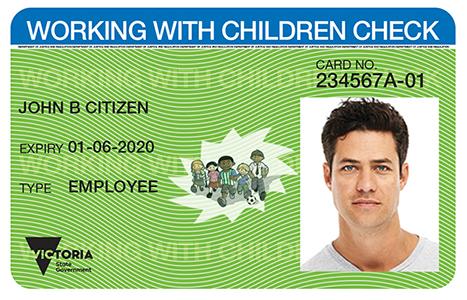
What your card looks like
The card will display your:
- name
- photograph
- card number
- card type
- card expiry date
What your digital card looks like
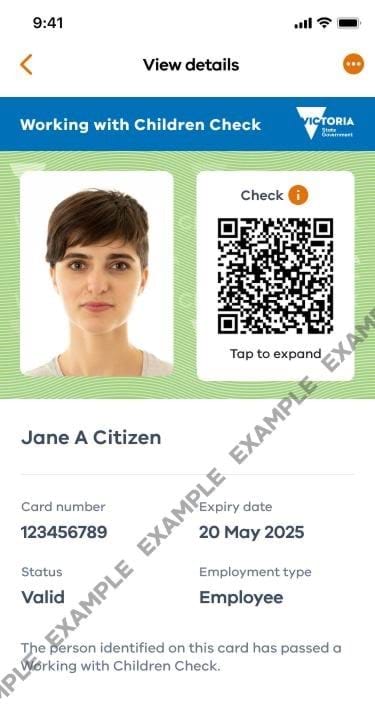
Your digital card is stored on your Service Vic app.
You can see if someone’s card is current or expired by using the Service Victoria app to scan the QR code on the digital card. A cancelled or suspended card can’t be scanned with the app.
The card will display your:
- name
- photograph
- card number
- card type
- card expiry date
- QR code for scanning
What we look for with the check
The check looks at a few different elements to determine if you’re permitted to do child-related work in Victoria.
When you apply, we’ll look at and assess your:
- criminal record in all Australian states and territories across your lifetime – including serious sexual, violent and drug offences you have previously been charged with, regardless of the outcome of those charges
- professional conduct, which is determined by:
- the Victorian Institute of Teaching (VIT)
- the Suitability Panel, established under the Children, Youth and Families Act 2005, which makes findings related to the suitability of registered out-of-home carers
- the Commission for Children and Young People (CCYP) through the Reportable Conduct Scheme.
- compliance (if applicable) with historical and current health practitioner legislation
- current or historical reporting obligations or orders under the Sex Offenders Registration Act 2004 or the Serious Offenders Act 2018.
Relevant offences under the Worker Screening Act 2020
The Worker Screening Act 2020 (the Act) classifies a range of relevant WWC offences into three categories: A,B and C. Applicable WWC offences are categorised according to severity with category A offences being the most severe. We also screen and monitor every applicant and Check holder for any new offences or charges that fall within the Act.
Open all
- Category A offences (Schedule 2)
- An offence (other than a child abuse material offence, a carnal knowledge offence** or an offence specified in clause 4, 5, 6, 7 or 8 of this Schedule) specified in clause 1 of Schedule 1 to the Sentencing Act 1991 (sexual offences) in circumstances where the person against whom the offence is committed is a child or, in cases of an offence of bestiality, against an animal.
- A child abuse material offence or an offence under a law of a jurisdiction other than Victoria that if it had been committed in Victoria, would have constituted a child abuse material offence.
- An offence specified in clause 2(a) of Schedule 1 to the Sentencing Act 1991 (murder).
- The common law offence of rape.
- An offence against section 38 of the Crimes Act 1958 (rape).
- An offence against, or for which the penalty or the maximum or minimum penalty is fixed by, any of the following sections (as amended) of the Crimes Act 1958 inserted by section 3 of the Crimes (Sexual Offences) Act 1991 and repealed by section 3 of the Crimes (Rape) Act 1991—
- section 40 (rape);
- section 41 (rape with aggravating circumstances).
- An offence against, or for which the penalty or the maximum or minimum penalty is fixed by, any of the following sections (as amended) of the Crimes Act 1958 by section 5 of the Crimes (Sexual Offences) Act 1980 and repealed by section 3 of the Crimes (Sexual Offences) Act 1991—
- section 45(1) (rape);
- section 45(3) (rape with aggravating circumstances).
- An offence against, or for which the penalty or the maximum or minimum penalty is fixed by, any of the following sections (as amended) of the Crimes Act 1958 repealed by section 5 of the Crimes (Sexual Offences) Act 1980—
- section 44(1) (rape);
- section 44(2) (rape with mitigating circumstances).
- An offence of attempting to commit an offence specified in clause 1, 3, 4, 5, 6, 7 or 8 of this Schedule.
- An offence under a law of a jurisdiction other than Victoria that, if it had been committed in Victoria, would have constituted an offence specified in clause 1, 3, 4, 5, 6, 7, 8 or 9 of this Schedule. ** Carnal knowledge is defined in the Worker Screening Act 2020 and only includes limited Victorian offences. If your criminal record contains an offence of carnal knowledge, we advise that you should obtain independent legal advice to determine whether the offence in your criminal history falls within the definition of ‘carnal knowledge’ within the Worker Screening Act 2020
- Category B offences (Schedule 4)
- An offence (other than a child abuse material offence, a carnal knowledge offence** or an offence specified in clause 4, 5, 6, 7, 8 or 9 of Schedule 2) specified in clause 1 of Schedule 1 to the Sentencing Act 1991 (sexual offences) in circumstances where the person against whom the offence is committed is not a child.
- A carnal knowledge offence**.
- An offence specified in clause 2 of Schedule 1 to the Sentencing Act 1991 (violent offences) other than murder or attempted murder.
- An offence specified in clause 4 of Schedule 1 to the Sentencing Act 1991 (drug offences).
- An offence against section 71AB (trafficking in a drug of dependence to a child) or 71B (supply of a drug of dependence to a child) of the Drugs, Poisons and Controlled Substances Act 1981 or an offence under a law of a jurisdiction other than Victoria that, if it had been committed in Victoria, would have constituted an offence against section 71AB or 71B of that Act.
- An offence—
- against section 46 or 47 of the Sex Offenders Registration Act 2004 or against Part 5 of that Act (other than section 70); or
- against the Serious Sex Offenders Monitoring Act 2005 (other than section 42(3)); or
- against the Serious Sex Offenders (Detention and Supervision) Act 2009 (other than section 182, 186 or 189(1A)); or
- against the Serious Offenders Act 2018 (other than section 277, 281, 284 or 289A); or
- under a law of a jurisdiction other than Victoria that, if it had been committed in Victoria, would have constituted an offence against—
- section 46 or 47 of the Sex Offenders Registration Act 2004 or Part 5 of that Act (other than section 70); or
- the Serious Sex Offenders Monitoring Act 2005 (other than section 42(3)); or
- the Serious Sex Offenders (Detention and Supervision) Act 2009 (other than section 182, 186 or 189(1A)); or
- the Serious Offenders Act 2018 (other than section 277, 281, 284 or 289A).
- An offence against section 271.4 (trafficking in children) or 271.7 (domestic trafficking in children) of the Criminal Code of the Commonwealth other than in circumstances where the purpose of the exploitation is to provide sexual services within the meaning of that section.
- An offence against section 21A (stalking) of the Crimes Act 1958 or an offence under a law of a jurisdiction other than Victoria that, if it had been committed in Victoria, would have constituted an offence against section 21A of that Act, in circumstances where the person against whom the offence is committed is a child.
- An offence against section 49N(1) (loitering near schools etc. by sexual offender) of the Crimes Act 1958 or an offence under a law of a jurisdiction other than Victoria that, if it had been committed in Victoria, would have constituted an offence against section 49N(1) of that Act.
- An offence —
- against any of the following sections of the Crimes Act 1958—
- Section 49O (1) (failure by a person in authority to protect a child from a sexual offence);
- Section 327 (failure to disclose sexual offence committed against child under the age of 16 years); or
- under a law of a jurisdiction other than Victoria that, if it had been committed in Victoria, would have constituted an offence against a section of the Crimes Act 1958 specified in paragraph (a).
- An offence against Chapter 6 of this Act (other than section 128 or 130).
- An offence against against section 18 (causing injury intentionally or recklessly) of the Crimes Act 1958 or under a law of a jurisdiction other than Victoria that, if it had been committed in Victoria, would have constituted an offence against section 18 of the Crimes Act 1958.
- An offence—
- against any of the following sections of the Crimes Act 1958 if the offence was committed before the commencement of the Crimes (Amendment) Act 1985;
- section 19(unlawfully and maliciously wounding or inflicting grievous bodily harm);
- section 37 (common assault); or
- under a law of a jurisdiction other than Victoria that, if it had been committed in Victoria before the commencement of the Crimes (Amendment) Act 1985, would have constituted an offence against a section of the Crimes Act 1958 specified in paragraph (a).
- An offence against section 19 (sexual exposure) of the Summary Offences Act 1966 or an offence under a law of a jurisdiction other than Victoria that, if it had been committed in Victoria would have constituted an offence against section 19 of the Summary Offences Act 1966.
- An offence against Division 4A of Part I of the Summary Offences Act 1996 (upskirting offences) or an offence under a law of a jurisdiction other than Victoria that, if it had been committed in Victoria, would have constituted an offence against that Division.
- An offence—
- against section 17(1) (obscene, indecent, threatening language and behaviour etc. in public) of the Summary Offences Act 1966 constituted by indecent behaviour if the offence was committed before the commencement of the Vagrancy (Repeal) and Summary Offences (Amendment) Act 2005; or
- under a law of a jurisdiction other than Victoria before the commencement of the Vagrancy (Repeal) and Summary Offences (Amendment) Act 2005, would have constituted an offence against section 17(1) of the Summary Offences Act 1966 constituted by indecent behaviour.
- An offence against section 19 (obscene exposure) of the Summary Offences Act 1966, if the offence was committed before the commencement of section 25 of the Crimes Amendment (Sexual Offences) Act 2016.
- An offence—
- against section 7(1)(c) (willful and obscene exposure) of the Vagrancy Act 1966 if the offence was committed before the commencement of the Vagrancy (Repeal) and Summary Offences (Amendment) Act 2005; or
- under a law of a jurisdiction other than Victoria that, if it had been committed in Victoria before the commencement of the Vagrancy (Repeal) and Summary Offences (Amendment) Act 2005, would have constituted an offence against section 7(1)(c) of the Vagrancy Act 1966.
- An offence—
- against any of the following sections of the Crimes Act 1958—
- section 63 (child stealing);
- section 75A (armed robbery); or
- under a law of a jurisdiction other than Victoria that, if it had been committed in Victoria, would have constituted an offence against a section of the Crimes Act 1958 specified in paragraph (a).
- An offence—
- against any of the following sections of the Children, Youth and Families Act 2005—
- section 493 (failing to protect a child from harm);
- section 494 (leaving a child unattended); or
- under a law a law of a jurisdiction other than Victoria that, if it had been committed in Victoria, would have constituted an offence against a section of the Children, Youth and Families Act 2005 specified in paragraph (a).
- An offence—
- against the following sections of the Surveillance Devices Act 1999—
- section 7 (installing, using or maintaining a device to record or observe a private activity);
- section 9B (employer installing, using or maintaining a device to record or observe a private activity of a worker); or
- under a law of a jurisdiction other than Victoria that, if it had been committed in Victoria, would have constituted an offence against a section of the Surveillance Devices Act 1999 specified in paragraph (a).
- An offence against section 49C(2) of the Crimes Act 1958 (failure by person in authority to protect child from sexual offence) inserted in the Crimes Act 1958 by section 3 of the Crimes Amendment (Protection of Children) Act 2014 and repealed by section 16 of the Crimes Amendment (Sexual Offences) Act 2016 or an offence under a law of a jurisdiction other than Victoria that, if it had been committed in Victoria, would have constituted an offence against section 49C(2) of the Crimes Act 1958.
- An offence against section 60B(2) of the Crimes Act 1958 (loitering near schools etc.) inserted in the Crimes Act 1958 by section 10 of the Crimes (Amendment) Act 1993 and repealed by section 16 of the Crimes Amendment (Sexual Offences) Act 2016 or an offence under a law of a jurisdiction other than Victoria that, if it had been committed in Victoria, would have constituted an offence against section 60B(2) of the Crimes Act 1958. ** Carnal knowledge is defined in the Worker Screening Act 2020 and only includes limited Victorian offences. If your criminal record contains an offence of carnal knowledge, we advise that you should obtain independent legal advice to determine whether the offence in your criminal history falls within the definition of ‘carnal knowledge’ within the Worker Screening Act 2020
When you receive your check
Show your physical or digital card to every organisation you do child-related work for, and make sure you provide your check information to them before you start working.
You are responsible for:
- making sure your personal and organisation’s details are up to date
- not letting anyone else use your check for child-related work
- letting us know if any of your circumstances change, including if you are charged with or found guilty of any offences
- renewing your check before it expires if you are, or will still be doing, child-related work
- changing your check from volunteer to employee if have a volunteer check but are going to do paid child-related work.
These tasks can all be done online at Service Vic.
Difference between a Working with Children Check and a Police Check
The Working with Children Check and Police Check are different checks. Depending on what your organisation requires, you might need both.
What is a Police Check?
A Police Check is not an assessment, like the Check, but a list of findings. You might need a Police Check when you start a new job, volunteer or do work experience. Your employer might use a Police Check to assess your suitability for other kinds of work.
If you need to obtain a Police Check for paid or unpaid work, licences or registration in Victoria, contact Victoria Police.
If you need a Police Check for immigration and visa applications, working overseas, adoption, a Federal Government job, or for any other reason under Commonwealth legislation, contact the Australian Federal Police.
You can get a Police Check online via their website or download an application form to complete.
How is a Working with Children Check different?
Under the Worker Screening Act 2020 (the Act) if you’re doing child-related work and are not otherwise exempt under the Act, you must have a Check even if you already have a Police Check.
The main differences between a Working with Children Check and a Police Check are:
- A Police Check won’t allow you to do child-related work in Victoria.
- You can’t pass or fail a Police Check, but you will pass or fail a Working with Children Check.
- A Working with Children Check is valid for 5 years (unless suspended, surrendered or revoked), but a Police Check only provides results as at the date of issue.
- When you apply for a Check, we review professional conduct determinations and findings from prescribed bodies listed in the Act. A Police Check doesn’t.
- We are notified by other regulators and prescribed bodies about changes to your circumstances while your Working with Children Check is valid. A Police Check only provides a snapshot as at the date of the check, with no future information provided.
Updated 13 February 2026
Related links
Working with Children Check transactions online at Service Victoria
- Apply for a Check
- Check your status
- Renew your Check
- Update your details
- Get a copy of your Check - Get a digital Check
- Find your card number
- Upgrade from volunteer to employee status
- Teacher notification to WWCCV
About the VIC Government
- The Premier and ministers
- Find a Vic Gov department, agency or service
- Strategies and policies
- Inquiries and royal commissions
Grants and programs
Jobs and careers
Arts, culture and heritage
Business and the workplace
- Mentally Healthy Workplaces Framework
- Portable Long Service Authority
- Victoria’s racing industry
- Workforce Inspectorate Victoria
- Liquor licensing, sale and supply
Communities
- Children
- First Peoples - State Relations
- Finding records
- Gender equality & women’s leadership
- LGBTIQA+ equality
- Multicultural communities
- Seniors Online
- Veterans support and commemoration
- Volunteering in Victoria
- Youth Central
Education and training
- Victorian Early Childhood Regulatory Authority
- Early childhood education – information for professionals
- Kinder: Best Start, Best Life
- Education – information for parents
- Schools.Vic - information for schools
- Education grants, programs, awards and events
- PROTECT
- TAFE, training and universities sector
- TAFE Victoria
- Victorian Skills Authority
- Apprenticeships Victoria
- Learn Local
Environment, water and energy
Finance and economy
Health and social support
- Family violence reform
- NDIS Worker Screening Check
- NDIS and disability services and support in Victoria
- Patient Review Panel
- Transforming Trauma Victoria
Housing and property
Law and justice
- Adoption
- Births, deaths and marriages
- Honorary justices
- Machete ban
- Safeguarding Victorians against terrorism
- Stolen Generations Reparations Package
- Victims of Crime
- Victorian Racing Tribunal
Safety and emergencies
- Emergency Recovery Victoria
- Victorian Emergency Relief and Recovery Foundation
- Emergency Recovery Resource Portal
- How well do you know fire
- Fire Services Reform
- Water safety
- Marine Search and Rescue
Science and technology
- Data sharing and open data
- Data.vic - discover and access Vic Gov open data
- Developer.Vic - portal for API developers
- Go.vic URL shortener
- Vic Gov IT project dashboard
- Victoria’s free public wi-fi network
- Cyber security in the Victorian Government
Sport and recreation
Traffic and transport
- Cameras Save Lives
- Transport Fines
- Getting Around
- Transport Planning
- Transport Future
- Climate Change and transport
- Future Directions For Transport
- Transport projects
- Ports and Freight
Working in the Victorian Government
- Single Digital Presence home
- Accommodation and Library Services
- Executive employment in the Victorian public sector
- Budget, procurement and funding
- Careers in the Victorian Government
- Council and Regulator Toolkit
- Guidelines for working in government
- Join a government network
- Standards and guidelines
- VicFleet CarPool
- Victorian Government style guide