Career pathways and course exploration with your child
Opportunities to help your child shape their future through self-discovery and goal-setting.
On this page
- Years 7 – 8
- Year 9 – 10
- Secondary certificate and VET choices for senior secondary
- Years 10, 11 and 12
- Find out more
There are key moments in years 7-12 when you can support your child to make important decisions about their future.
These decisions will include:
- the school subjects they want to complete
- work experience and other industry experiences they seek
- their senior secondary certificate subjects
- the post-school pathway they want to pursue
- the careers they are interested in exploring.
Your child’s school will provide a career education program that helps them make these decisions. It will include opportunities for self-discovery, to explore opportunities relating to industries and careers of interest, and to pursue pathways that align with their goals.
Some of these opportunities are only available for government school students. For general advice, see tips on how to talk to your child about their career.
Years 7 – 8
In Years 7 and 8, your child will explore their interests, skills, values, beliefs and attributes. They will reflect on how these connect to potential careers, pathways and aspirations. This will broaden their understanding of future options and how these can inform early subject choices. Your child will also become increasingly comfortable exploring concepts relating to careers and pathways.
Career exploration activities
To support this investigation, students in government schools often complete career exploration activities in years 7-8. These activities may include:
- engaging with career resources
- participating in career and pathway counselling
- taking part in pastoral care lessons and community engagement
- reflecting on careers and pathways as part of subjects delivered through the Foundation – Year 10 curriculum (i.e Science or Geography)
Career action planning
Students in government schools do career action planning activities in secondary school. This can start in Year 7. This will help them:
- reflect on what they’ve learned and how their interests and strengths have changed over time
- deepen their understanding of how their interests, strengths and aptitudes connect to various post-school options
- choose their school subjects and set goals for post school
Your school might use the My Career Portfolio online career planning tools for these activities.
You can ask your child or their school for their plan, so you can talk about it together.
Tech School programs
Tech School programs engage and inspire secondary students to consider STEM careers in emerging and growth industries across Victoria. These programs allow students to use cutting edge technologies and experience hands-on STEM activities that promote further study and career pathways.
Ask your school if they participate in any Tech School programs.
Year 9 – 10
In Years 9 and 10, your child can gain first-hand experience of potential careers. They can then use these experiences to inform and refine their career and pathway goals and plans. This will help them choose a pathway to try in Year 10, when they begin to apply their interests through practical experiences.
Morrisby profile
The My Career Insights program provides all government school students in Year 9 with access to the Morrisby profile and a free expert career consultation session, supported by the Australian Centre for Career Education.
Morrisby is a world-leading online careers tool that will help your child:
- understand their strengths and the sort of study and career options that might suit them
- select their subjects for Year 10 and think about their senior secondary studies.
You’ll receive a consent form from your school, which you’ll need to complete for your child to access this program.
Look out for information from your school about the My Career Insights program and how to join your child for their career consultation session.
Work experience
Your child can do a short-term work experience placement with an employer from Year 9 (minimum age 14). Through this placement they will gain first-hand experience of potential careers and use this to inform and refine their career and pathway goals and plans. This real-world experience is an opportunity to learn more about their occupation and work-life preferences, and they will also develop the kind of skills every employer will value, and increase their independence and self-confidence.
This can be arranged by you or your school. Your child could do more work experience in later years to keep exploring their options.
Speak to your school about their work experience process, and whether they are using the Work Based Learning Application with easy digital processes to make sure you follow the right procedure.
Vocational Taster Experiences
The Department of Education is trialling Vocational Taster Experiences at four TAFEs in Victoria. The program helps students explore different jobs and courses before they choose subjects for Years 11 and 12. Year 9 and 10 students may be able to take part.
Year 9 – Vocational Explorer
- is a one or two-day immersive experience in one or more job type or industry
- provides opportunity to explore industries and vocational pathways of interest
- allows participation in activities to learn practical skills
- supports their understanding and exploration of career pathways.
Year 10 – VET Taster
- Offers multiple day experiences that introduce students to the world of work
- provides exposure to particular VET certificates or pathways
- supports understanding of future pathways and career options
- prepares students for VET courses to be undertaken and decision making in later years.
Tasters focus on three priority industry areas: building and construction, the clean economy, and the care economy.
Visit Vocational Taster Experiences pilot program to find out more.
Secondary certificate and VET choices for senior secondary
In Year 10, it’s time for your child to choose a pathway to explore more deeply in the senior secondary years (11-12). At this stage, your child will:
- begin to test and apply their interests through practical experiences
- deepen their understanding of how these choices connect to various post-school options.
Your child’s subject and secondary certificate choices help them to actively work towards a post-school pathway that they would like to pursue.
You can help your child make informed choices aligned to their interests, including by:
- attending any information nights organised by their school
- reading resources and handbooks provided by their school
- talking with your child about their Morrisby profile and career action plan.
Secondary certificate choices
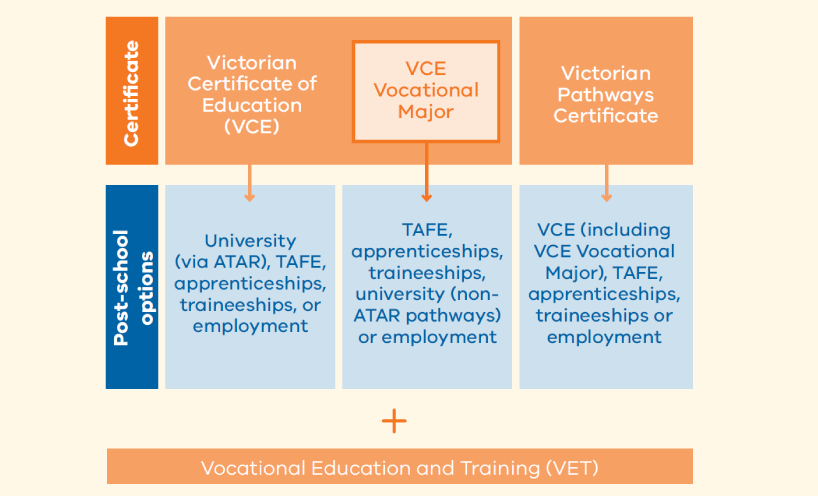
The VCE is a senior secondary certificate that can lead to an Australian Tertiary Aggregate Result (ATAR) score. It can lead to university, TAFE, apprenticeships, traineeships or employment. Students can also do VET and start progressing towards a VET qualification as part of their VCE.
The VCE Vocational Major is a program within the VCE that focuses on practical learning with a VET component. It can lead to apprenticeships, traineeships, TAFE, university (via non-ATAR entry, for example through portfolio-based entry) or employment.
The Victorian Pathways Certificate (VPC) is a flexible foundation secondary course for a limited number of students not able or ready to undertake the VCE or VCE Vocational Major.
Please speak to your school about which of these options is right for your child. All mainstream government secondary schools need to offer the VCE Vocational Major and the Victorian Pathways Certificate where there is student demand.
For more information about these options, read about study options in Year 11 and 12.
VET choices
Your child can work towards one or more VET certificates in their VCE (including the Vocational Major) or VPC program. VET is practical learning that gives students skills in a specific industry, and often includes structured learning in a workplace.
Starting VET during school can provide a pathway into a wide range of industries including health, building and construction, engineering, hospitality, community services, and early childhood education.
School-based apprenticeships and traineeships
Your child could do VET as a paid part-time apprenticeship or traineeship while completing school. These are referred to as school-based apprenticeships or traineeships (SBATs).
SBATs are apprenticeships or traineeships that students start at school, helping them get a head start on their career and earn a wage while completing their secondary school certificate. They combine paid part-time employment, vocational training, and regular school attendance.
In government schools, SBATs are supported through the Head Start program. The program provides wrap-around support to student to find a pathway and employer that’s right for them, be safe and supported in the workplace, and to transition into full-time employment or continue an apprenticeship or traineeship after finishing school.
Years 10, 11 and 12
In Years 10, 11 and 12, your child will:
- build foundational knowledge and skills related to the study and career pathway they have chosen to try
- expand their understanding of how these choices connect to the options they would like to pursue after school.
In Year 12, students actively work towards their pathway goals and prepare for their transition beyond secondary school.
Career expos and open days
Metro and regional career expos allow students to explore what’s possible after school. Some are after school or on weekends, and some can be attended as excursions during school.
TAFE and university open days are an opportunity to discover the broad range of pathways available after school, or to learn more about a specific course. You can attend these events with your child to explore the options together. Refer to this Myfuture Open Days website
Applications for further study
In Victoria, Year 12 students apply for TAFE or university place through the Victorian Tertiary Admissions Centre (VTAC). Your school may run an information night for parents and students about the VTAC course application process.
Your child can also use the Victorian Skills Gateway to find and apply directly to TAFEs or other training organisations.
You and your child can also learn about applying for a post-school apprenticeship or traineeship from the Australian Apprenticeships website.
Keep an eye on school communications for study and post-school information sessions.
Find out more
Senior secondary education is changing. To learn more about your child’s options in secondary school, visit Your world. Your VCE.
Updated 26 March 2026
About the VIC Government
- The Premier and ministers
- Find a Vic Gov department, agency or service
- Strategies and policies
- Inquiries and royal commissions
Grants and programs
Jobs and careers
Arts, culture and heritage
Business and the workplace
- Mentally Healthy Workplaces Framework
- Portable Long Service Authority
- Victoria’s racing industry
- Workforce Inspectorate Victoria
- Liquor licensing, sale and supply
Communities
- Children
- First Peoples - State Relations
- Finding records
- Gender equality & women’s leadership
- LGBTIQA+ equality
- Multicultural communities
- Seniors Online
- Veterans support and commemoration
- Volunteering in Victoria
- Youth Central
Education and training
- Victorian Early Childhood Regulatory Authority
- Early childhood education – information for professionals
- Kinder: Best Start, Best Life
- Education – information for parents
- Schools.Vic - information for schools
- Education grants, programs, awards and events
- PROTECT
- TAFE, training and universities sector
- TAFE Victoria
- Victorian Skills Authority
- Apprenticeships Victoria
- Learn Local
Environment, water and energy
Finance and economy
Health and social support
- Family violence reform
- NDIS Worker Screening Check
- NDIS and disability services and support in Victoria
- Patient Review Panel
- Transforming Trauma Victoria
Housing and property
Law and justice
- Adoption
- Births, deaths and marriages
- Honorary justices
- Machete ban
- Safeguarding Victorians against terrorism
- Stolen Generations Reparations Package
- Victims of Crime
- Victorian Racing Tribunal
Safety and emergencies
- Emergency Recovery Victoria
- Victorian Emergency Relief and Recovery Foundation
- Emergency Recovery Resource Portal
- How well do you know fire
- Fire Services Reform
- Water safety
- Marine Search and Rescue
Science and technology
- Data sharing and open data
- Data.vic - discover and access Vic Gov open data
- Developer.Vic - portal for API developers
- Go.vic URL shortener
- Vic Gov IT project dashboard
- Victoria’s free public wi-fi network
- Cyber security in the Victorian Government
Sport and recreation
Traffic and transport
- Cameras Save Lives
- Transport Fines
- Getting Around
- Transport Planning
- Transport Future
- Climate Change and transport
- Future Directions For Transport
- Transport projects
- Ports and Freight
Working in the Victorian Government
- Single Digital Presence home
- Accommodation and Library Services
- Executive employment in the Victorian public sector
- Budget, procurement and funding
- Careers in the Victorian Government
- Council and Regulator Toolkit
- Guidelines for working in government
- Join a government network
- Standards and guidelines
- VicFleet CarPool
- Victorian Government style guide