Barwon South West Regional circular economy plan
A circular economy plan by Barwon South West for Barwon South West
On this page
The Barwon South West regional circular economy plan sets out Barwon South West’s aspirations to 2030 for a sustainable and thriving circular economy
Representatives from 55 organisations contributed to the plan, including:
- local government
- businesses and business associations
- manufacturers
- social enterprise
- the waste and resource recovery industry
- research and education institutions
- and the Victorian Government.
They participated in robust discussions and workshops facilitated by the Victorian Government designed to encourage strategic thinking about their region, where they are now, where they want to be by 2030, and how they can work together to get there.
Aspirations to 2030
Barwon South West’s five circular economy aspirations to 2030 are detailed below, along with six important changes, or ‘key enablers’, that have been identified to help realise these aspirations.
By 2030, in Barwon South West
1. There is a high demand for circular economy solutions
Participation in the regional circular economy is supported and encouraged through consistent regulation, investment decisions based on evidence, and opportunities to collaborate.
2. Investment in the circular economy flows to the region
The Barwon South West region is known as a leader in circular economy through collaboration, commitment to and investment in education, infrastructure, and processing capabilities.
3. Consumers are empowered to participate in the circular economy
Consumers are informed and empowered to make environmentally conscious choices. They understand the environmental impact of their purchasing decisions and actively avoid waste.
4. Product stewardship is a priority
Products and materials are created within the Barwon South West region with an understanding of their lifecycle. They are easy to reuse, repair, repurpose or recycle. Manufacturers are supported to take up extended producer responsibilities.
5. The region’s renewable energy sector is integrated with the circular economy
The use of non-renewable energy sources is reduced.
Key enablers
Barwon South West key enablers
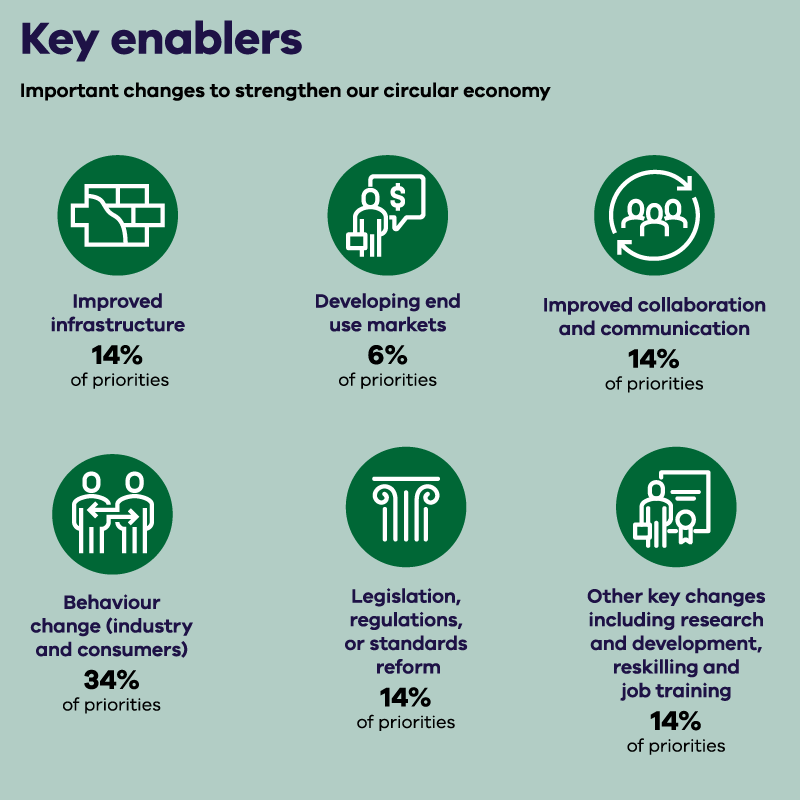
Priorities to achieve our aspirations
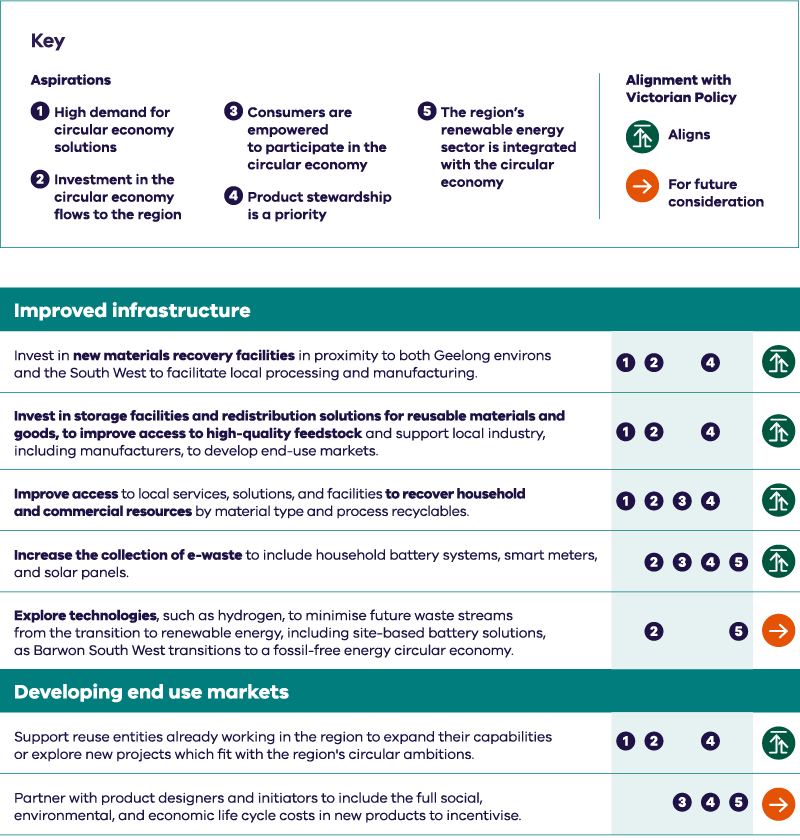
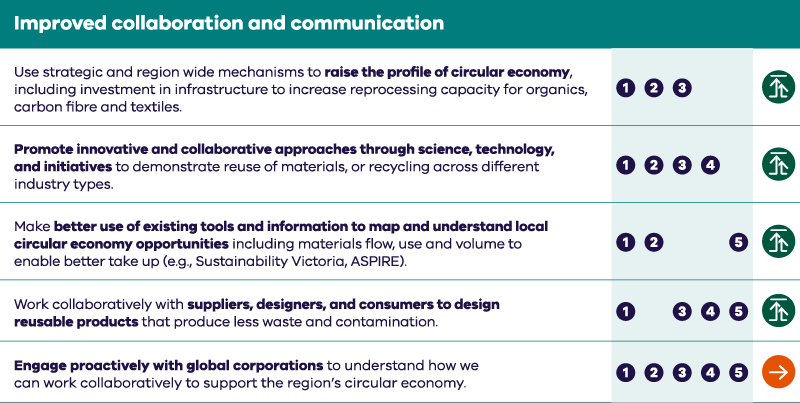
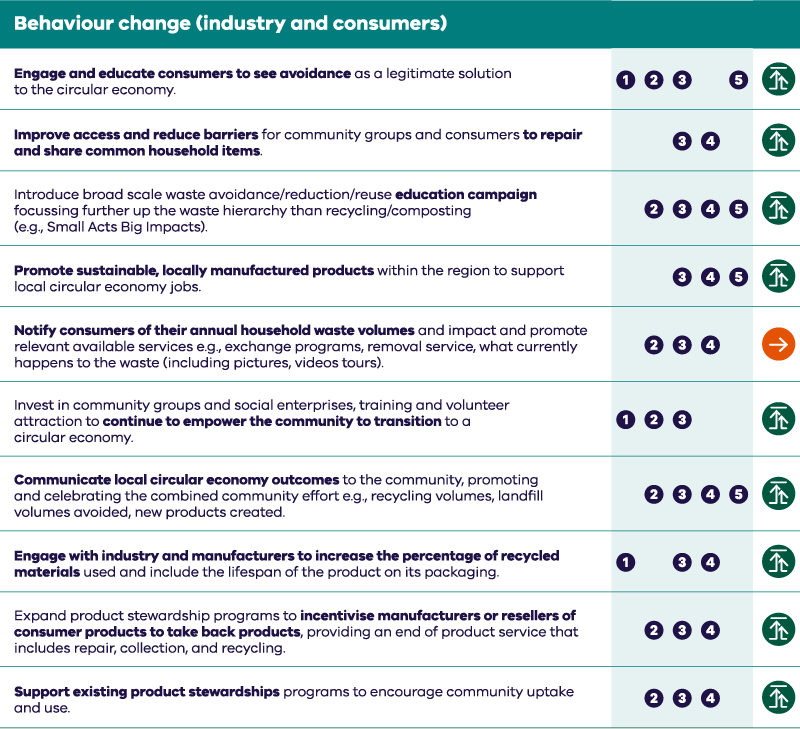
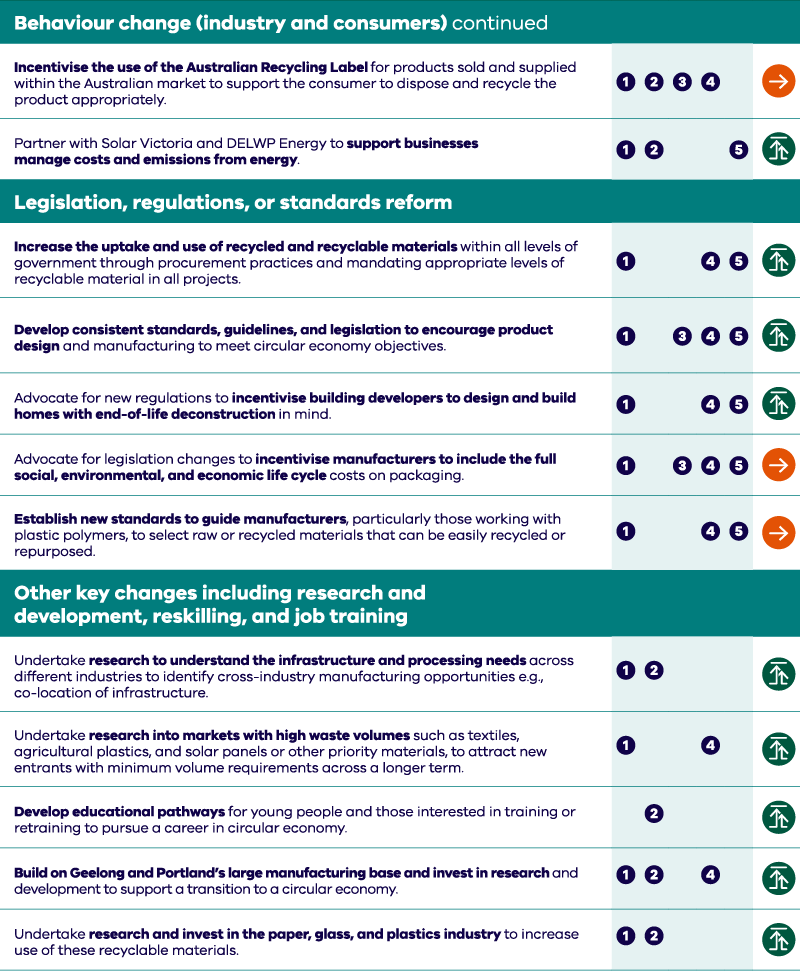
Barwon South West has developed 35 priorities to achieve their circular economy aspirations to 2030. Each priority has been identified as contributing to one or more aspiration and has been grouped by Key Enablers. Many of the priorities align with current Victorian Government policy, whilst others will be for future consideration.
Improved infrastructure, developing end use markets
Improved collaboration and communication
Behaviour change industry and consumers
Behaviour change (industry and consumers) cont’d and Legislation, regulations or standards reform and other key changes
Barwon South West Today
Barwon South West today
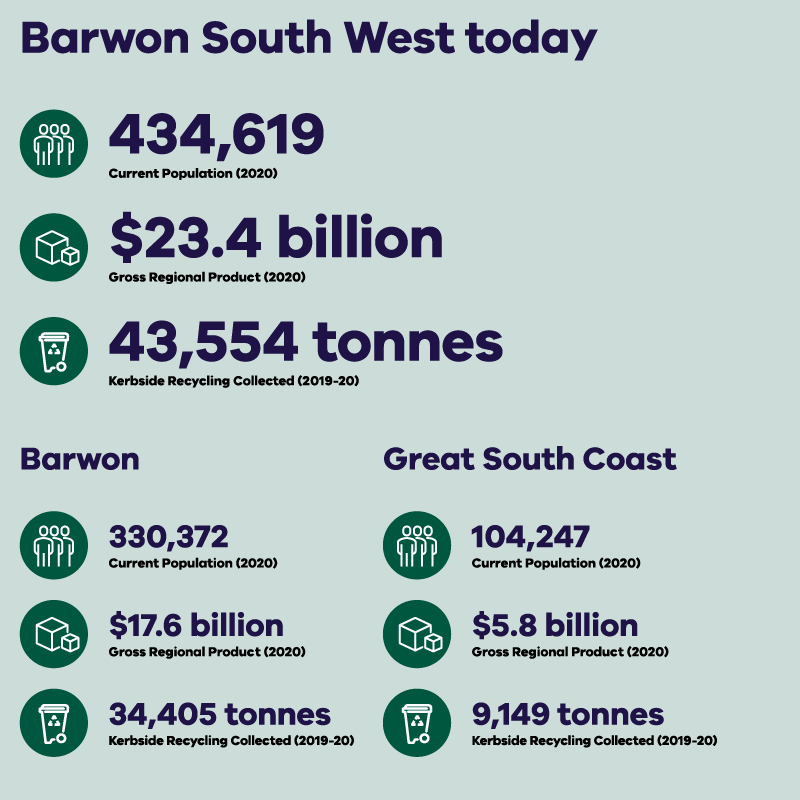
Barwon South West representatives developed the region’s circular economy aspirations and priorities. The representatives brought a local understanding of the region’s strengths and challenges. They considered ‘where we are today’ as a region, before projecting forward to ‘where we want to be’ in 2030 and beyond.
The process identified the region’s key strengths. These strengths will help the region work towards their 2030 aspirations.
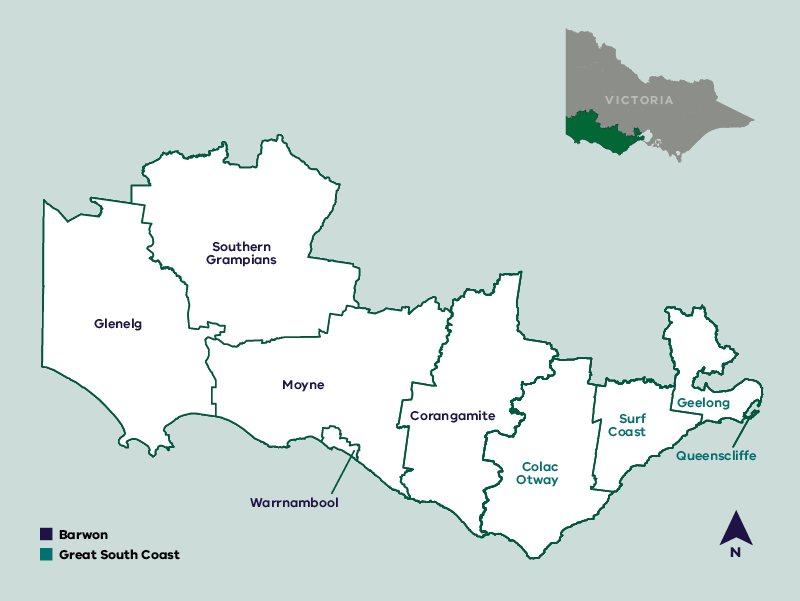
The region is large and diverse and was split into two major sub-regions: Barwon and the Great South Coast.
Barwon’s population is large, concentrated, and close to Melbourne’s metro areas. This means there is a large volume of recycled and reused material available. The sub-region has well developed transport infrastructure and strong existing regional partnerships.
The Great South Coast has a great diversity of industry. The sub-region has strong transport connections as well as space for industrial development. It also has several current circular economy projects already underway.
Refer to Victoria’s Regional Economic Development Strategies (REDS) for in-depth economic analysis.
Strengths
Barwon sub region
- Size of the population and current household mix, making it suitable for trialling projects due to the volume of waste stream availability.
- Networks and existing collaborations between local government and Deakin University; CSIRO and Deakin University and G21 Alliance and Victoria Cleantech Cluster.
- Business diversity which already generates a broad range of recoverable resources and presents an opportunity for use in recycled products and materials.
- High availability of brown-and greenfield land and transport infrastructure and connections.
- New technologies to recover waste streams that have been difficult to sort and process (plastic and e-waste included).
Great South Coast sub region
- Diversity of industry in the region: agriculture, renewable energy, food processing and education.
- Population size and land features: deep aquifer and space for industrial development.
- Current projects and the opportunity to build on these projects, e.g. BioGrow in Colac, demonstrations across the Great South Coast Group of Councils.
- Proximity to South Australia and strong transport connections. Renewable energy sector and potential to co locate collection services for solar panels and materials used.
Barwon South West in 2030
Barwon South West in 2030
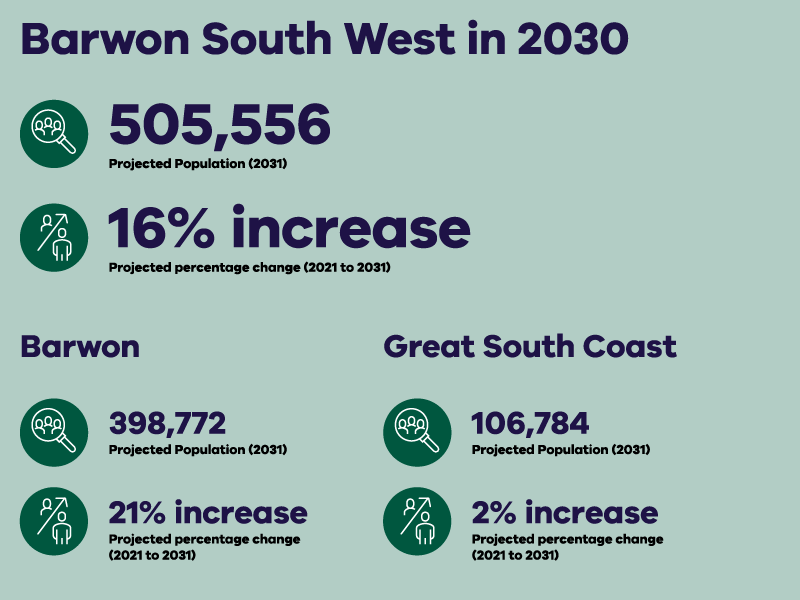
Barwon South West representatives also considered the region’s challenges.They developed the region’s circular economy priorities to mitigate these challenges.
A key challenge for Barwon will be the closure of the Drysdale landfill in 7-10 years. There is low engagement with the circular economy system and low volumes of some material streams. It also has uncertain market conditions.
The size of the Great South Coast and accessibility to infrastructure are challenges. Finding and retaining staff, including industrial workforce, is difficult. There are challenging market conditions and lack of business continuity.
By 2030, the Barwon South West region is forecast to be home to 505,000 people, increasing by 16 percent from 2021. Barwon is forecast to grow much faster than the Great South Coast, 21 percent compared to 2 percent.
Higher rates of waste and recyclable materials are likely where populations increase. This will increase demand for sorting, processing, and storage infrastructure. Increase material transport out of the region will place added pressure on regional roads.
Some areas that are not forecast to increase their populations may continue not to need household collection. This could present a challenge for local councils and industry aiming to divert materials from landfill.
Refer to Victoria’s Regional Economic Development Strategies (REDS) for in-depth economic analysis.
Challenges
Barwon sub region
- Lack of community involvement and participation in circular economy system and managing this with a growing population
- Low volumes of some waste streams
- Closure of Drysdale landfill (in seven to ten years) placing pressure on the region to recover resources from landfill
- Uncertain market conditions: competition for feedstock, instability of end markets, dominance by larger operators and waste export bans discouraging investment
- Funding cycles differ local councils, making it difficult for industry and markets to warrant commercial investment.
Great South Coast sub region
- Size of the geographical area to cover
- Limited industrial workforce and availability of staff is already challenged
- Market conditions and restrictions: lack of control over processing and location of product to commercial providers
- Lack of business continuity plans in place, existing monopolies
- Restrictive land-use planning (proximity to residential areas or environmentally sensitive areas) Climate impacts on local industries, e.g. dairy and impact on volume.
How to use the regional circular economy plans
Barwon South West regional circular economy plan
Barwon South West regional circular economy plan PDF 4.11 MB (opens in a new window)
Engagement program summary report
For more information on the Engagement Program refer to the Regional circular economy plans engagement summary report.
Regional circular economy plans engagement summary report PDF 7.44 MB (opens in a new window)
Updated 6 December 2022
About the VIC Government
- The Premier and ministers
- Find a Vic Gov department, agency or service
- Strategies and policies
- Inquiries and royal commissions
Grants and programs
Jobs and careers
Arts, culture and heritage
Business and the workplace
- Mentally Healthy Workplaces Framework
- Portable Long Service Authority
- Victoria’s racing industry
- Workforce Inspectorate Victoria
- Liquor licensing, sale and supply
Communities
- Children
- First Peoples - State Relations
- Finding records
- Gender equality & women’s leadership
- LGBTIQA+ equality
- Multicultural communities
- Seniors Online
- Veterans support and commemoration
- Volunteering in Victoria
- Youth Central
Education and training
- Victorian Early Childhood Regulatory Authority
- Early childhood education – information for professionals
- Kinder: Best Start, Best Life
- Education – information for parents
- Schools.Vic - information for schools
- Education grants, programs, awards and events
- PROTECT
- TAFE, training and universities sector
- TAFE Victoria
- Victorian Skills Authority
- Apprenticeships Victoria
- Learn Local
Environment, water and energy
Finance and economy
Health and social support
- Family violence reform
- NDIS Worker Screening Check
- NDIS and disability services and support in Victoria
- Patient Review Panel
- Transforming Trauma Victoria
Housing and property
Law and justice
- Adoption
- Births, deaths and marriages
- Honorary justices
- Machete ban
- Safeguarding Victorians against terrorism
- Stolen Generations Reparations Package
- Victims of Crime
- Victorian Racing Tribunal
Safety and emergencies
- Emergency Recovery Victoria
- Victorian Emergency Relief and Recovery Foundation
- Emergency Recovery Resource Portal
- How well do you know fire
- Fire Services Reform
- Water safety
- Marine Search and Rescue
Science and technology
- Data sharing and open data
- Data.vic - discover and access Vic Gov open data
- Developer.Vic - portal for API developers
- Go.vic URL shortener
- Vic Gov IT project dashboard
- Victoria’s free public wi-fi network
- Cyber security in the Victorian Government
Sport and recreation
Traffic and transport
- Cameras Save Lives
- Transport Fines
- Getting Around
- Transport Planning
- Transport Future
- Climate Change and transport
- Future Directions For Transport
- Transport projects
- Ports and Freight
Working in the Victorian Government
- Single Digital Presence home
- Accommodation and Library Services
- Executive employment in the Victorian public sector
- Budget, procurement and funding
- Careers in the Victorian Government
- Council and Regulator Toolkit
- Guidelines for working in government
- Join a government network
- Standards and guidelines
- VicFleet CarPool
- Victorian Government style guide