Aunty Margaret (Lilardia) Tucker MBE
Aunty Margaret Tucker MBE was an activist for Aboriginal rights. Please note this page includes the image and story of a deceased First Nations woman.
Lilardia is a 12 metre wide and 9 metre high mural celebrating one of Australia’s earliest Aboriginal activists, Aunty Margaret (Lilardia) Tucker MBE, and her dedication to creating a more equal and understanding society.
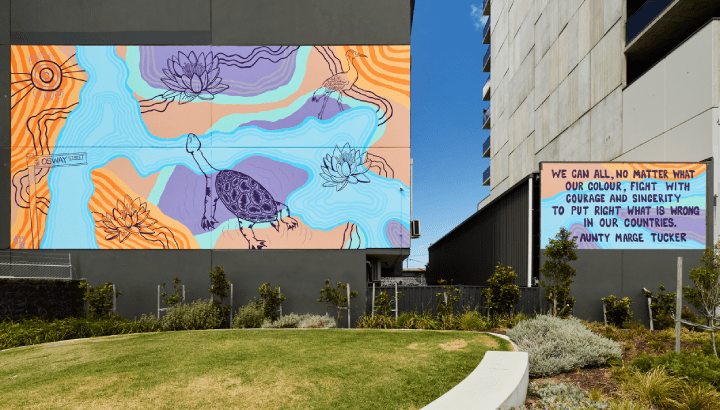
Lilardia**, 2025** Jessi Rebel (Wiradjuri) With: Grace Hasu Dlabik, Kee’ahn Bindol, Kiri Wicks, Emma Ismawi Produced by: BE.ONE.Creative Photo credit: Nicole Reed Location: Lilardia Park, 4-6 Whitehall St, Footscray, City of Maribyrnong
The artwork is located in Lilardia Park in Footscray, City of Maribyrnong, on Wurundjeri Country. Lilardia is Aunty Marge’s traditional name, meaning “water flower” and the park was named in her honour in 2023.
The mural was produced by Grace Dlabik from BE. ONE CREATIVE and brought to life by an all-women Indigenous creative team, led by Wiradjuri artist, Jessi Rebel, alongside Kee’ahn Bindol, Kiri Wicks and Emma Ismawi.
Grace Dlabik is an interdisciplinary artist, who forges artistic opportunities for underrepresented creatives through BE.ONE. Creative.
Lead artist, Jessi Rebel’s deep connection to culture, Country, and the ocean profoundly influences her artistic work, reflecting her life experiences through flowing lines and symbolic imagery.
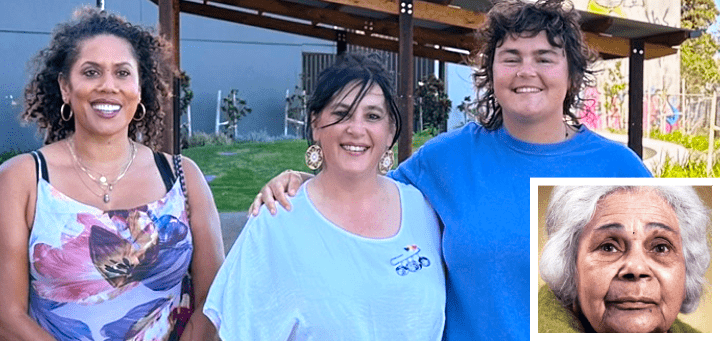
Left to right: Grace Dlabik, producer from BE. ONE Creative. Aunty Marge’s great granddaughter, Tania Rossi, Yorta Yorta/Wiradjuri, and Jessi Rebel, lead artist. Inset: Aunty Marge (Image source: Studio portrait by Dennis Mayor, State Library Victoria.)
The artistic team worked closely with Aunty Marge’s family, including Tania Rossi, who said her great grandmother would be touched by the effort to continue her legacy.
“She used to say, ‘It does not matter if you’re black, white or brindle, we all bleed the same colour and we must respect each other,’” Ms Rossi said. “She’d be very proud and she’d say just keep fighting for the good of all."
The river flowing through the artwork is the nearby Maribyrnong and the lilardia (wild flower) is a key design feature. The animals reflect Aunty Marge’s totem (Yorta Yorta - the long-neck turtle) and her two Countries (Yorta Yorta and Wiradjeri – the brolga). Aunty Marge lived and held many important community gatherings to advocate for Aboriginal rights on Osway St.
Aunty Marge’s quote featured in the artwork reads:
“We can all, no matter what our colour, fight with courage and sincerity, to put right what is wrong in our countries”.
-

-

-

-

-

-

-

-
### A closer look
View ‘A closer look’ fullscreen
-
### A closer look
View ‘A closer look’ fullscreen
-
### A closer look
View ‘A closer look’ fullscreen
-
### A closer look
View ‘A closer look’ fullscreen
-
### A closer look
View ‘A closer look’ fullscreen
-
### A closer look
View ‘A closer look’ fullscreen
-
### A closer look
View ‘A closer look’ fullscreen
-

-

-

-

-

-

-
### The making of
View ‘The making of’ fullscreen
-
### The making of
View ‘The making of’ fullscreen
-
### The making of
View ‘The making of’ fullscreen
-
### The making of
View ‘The making of’ fullscreen
-
### The making of
View ‘The making of’ fullscreen
-
### The making of
View ‘The making of’ fullscreen
Biography
Aunty Marge was committed to creating a more equal and understanding society than the one she experienced.
She was born at the Warangesda Aboriginal Mission on the Murrumbidgee River in New South Wales in 1904. She was a survivor of the Stolen Generations - one of thousands of Aboriginal children removed from the care of their parents through government policies. At age 13, she was taken from her mother and placed in the Cootamundra Domestic Training Home for Aboriginal Girls.
Aunty Marge’s experiences in the home and as a domestic servant led her to advocate for First Nations rights from the 1930s.
During the Second World War, she supported the war effort, working at a Footscray rope maker and then at a munitions factory. She was instrumental in founding the Australian Aborigines’ League to lobby state and federal governments on behalf of Aboriginal people.
Her many achievements also included becoming the first woman on the Victorian Aboriginal Welfare Board in 1964. In 1967, she became a member of the Federal Council of Aboriginal and Torres Strait Islanders which played a major role in obtaining equal voting rights for Aboriginal people through the Referendum.
In 1968 Margaret was appointed to the Ministry of Aboriginal Affairs Advisory Committee and helped create the Victorian Aboriginal Health Service in 1973.
She was also a patron of the Victorian Aboriginal Child Care Agency and in 1983 founded the Margaret Tucker Hostel for vulnerable women and children, which still operates today.
In 1968, she was made a Member of the Order of the British Empire for her contributions to a more just society.
One of the first Aboriginal women to write an autobiography, her 1977 book, ‘If Everyone Cared’ was republished in 2024 by NLA Publishing in a new edition, ‘If Everyone Cared Enough’, so more people can learn her story of courage, resilience and kindness for others.
In 2001, she was inducted to the Victorian Honour Roll of Women, among the first to receive the honour.
Arts, culture & heritage
Agnes Chambers, Agnes Doig and the Wonthaggi Miners Women’s Auxiliary
The Auxiliary founding members were a group of striking miners’ wives, led by Secretary Agnes Chambers and Agnes Doig.
Arts, culture & heritage
Aunty Dorothy Peters
Aunty Dorothy ‘Dot’ Peters AM was a widely loved and respected Yarra Yarra woman.
Arts, culture & heritage
Barbara Rae
Barbara Rae was the top scorer and winning captain of the first women’s cricket match held in Australia.
Arts, culture & heritage
Louisa Briggs
Louisa Briggs was a trailblazing Aboriginal rights leader, midwife and nurse.
Arts, culture & heritage
The women of Montsalvat
The women who were the driving force behind Montsalvat’s design, construction and culture.
The Women’s Public Art Program complements the Victorian Honour Roll of Women, which celebrates women’s outstanding leadership and contributions to life in Victoria.
Finding Her is Australia’s first interactive state-wide digital map spotlighting women’s commemorative sites. You can read about these public art projects and many more at Finding Her.
Follow along on social channels
Share the stories of inspirational Victorian women via DFFH’s social media channels.
Department of Families, Fairness and Housing
- Facebook: @VicGovDFFH
- LinkedIn: @VicGovDFFH
- Instagram @VicGovDFFH
Victorian Women’s Public Art Program
The Victorian Women’s Public Art Program aims to address the underrepresentation of women and their achievements through enduring public artworks.
Updated 25 February 2026
About the VIC Government
- The Premier and ministers
- Find a Vic Gov department, agency or service
- Strategies and policies
- Inquiries and royal commissions
Grants and programs
Jobs and careers
Arts, culture and heritage
Business and the workplace
- Mentally Healthy Workplaces Framework
- Portable Long Service Authority
- Victoria’s racing industry
- Workforce Inspectorate Victoria
- Liquor licensing, sale and supply
Communities
- Children
- First Peoples - State Relations
- Finding records
- Gender equality & women’s leadership
- LGBTIQA+ equality
- Multicultural communities
- Seniors Online
- Veterans support and commemoration
- Volunteering in Victoria
- Youth Central
Education and training
- Victorian Early Childhood Regulatory Authority
- Early childhood education – information for professionals
- Kinder: Best Start, Best Life
- Education – information for parents
- Schools.Vic - information for schools
- Education grants, programs, awards and events
- PROTECT
- TAFE, training and universities sector
- TAFE Victoria
- Victorian Skills Authority
- Apprenticeships Victoria
- Learn Local
Environment, water and energy
Finance and economy
Health and social support
- Family violence reform
- NDIS Worker Screening Check
- NDIS and disability services and support in Victoria
- Patient Review Panel
- Transforming Trauma Victoria
Housing and property
Law and justice
- Adoption
- Births, deaths and marriages
- Honorary justices
- Machete ban
- Safeguarding Victorians against terrorism
- Stolen Generations Reparations Package
- Victims of Crime
- Victorian Racing Tribunal
Safety and emergencies
- Emergency Recovery Victoria
- Victorian Emergency Relief and Recovery Foundation
- Emergency Recovery Resource Portal
- How well do you know fire
- Fire Services Reform
- Water safety
- Marine Search and Rescue
Science and technology
- Data sharing and open data
- Data.vic - discover and access Vic Gov open data
- Developer.Vic - portal for API developers
- Go.vic URL shortener
- Vic Gov IT project dashboard
- Victoria’s free public wi-fi network
- Cyber security in the Victorian Government
Sport and recreation
Traffic and transport
- Cameras Save Lives
- Transport Fines
- Getting Around
- Transport Planning
- Transport Future
- Climate Change and transport
- Future Directions For Transport
- Transport projects
- Ports and Freight
Working in the Victorian Government
- Single Digital Presence home
- Accommodation and Library Services
- Executive employment in the Victorian public sector
- Budget, procurement and funding
- Careers in the Victorian Government
- Council and Regulator Toolkit
- Guidelines for working in government
- Join a government network
- Standards and guidelines
- VicFleet CarPool
- Victorian Government style guide