Chapter 2: Collaboration
On this page
- Highlights from 2023-24
- The MARAM Child and Young Person practice guides
- Collaboration examples from the annual survey
- Plans for 2024-25
Strategic priority 2: Facilitate consistent and collaborative practice
Framework organisations work together to keep victim survivors safe and perpetrators in view. This includes through sharing information.
In 2023–24, departments and sector peaks supported consistent and collaborative family violence responses.
As a result, framework organisations made real progress in working together effectively.
This is shown by:
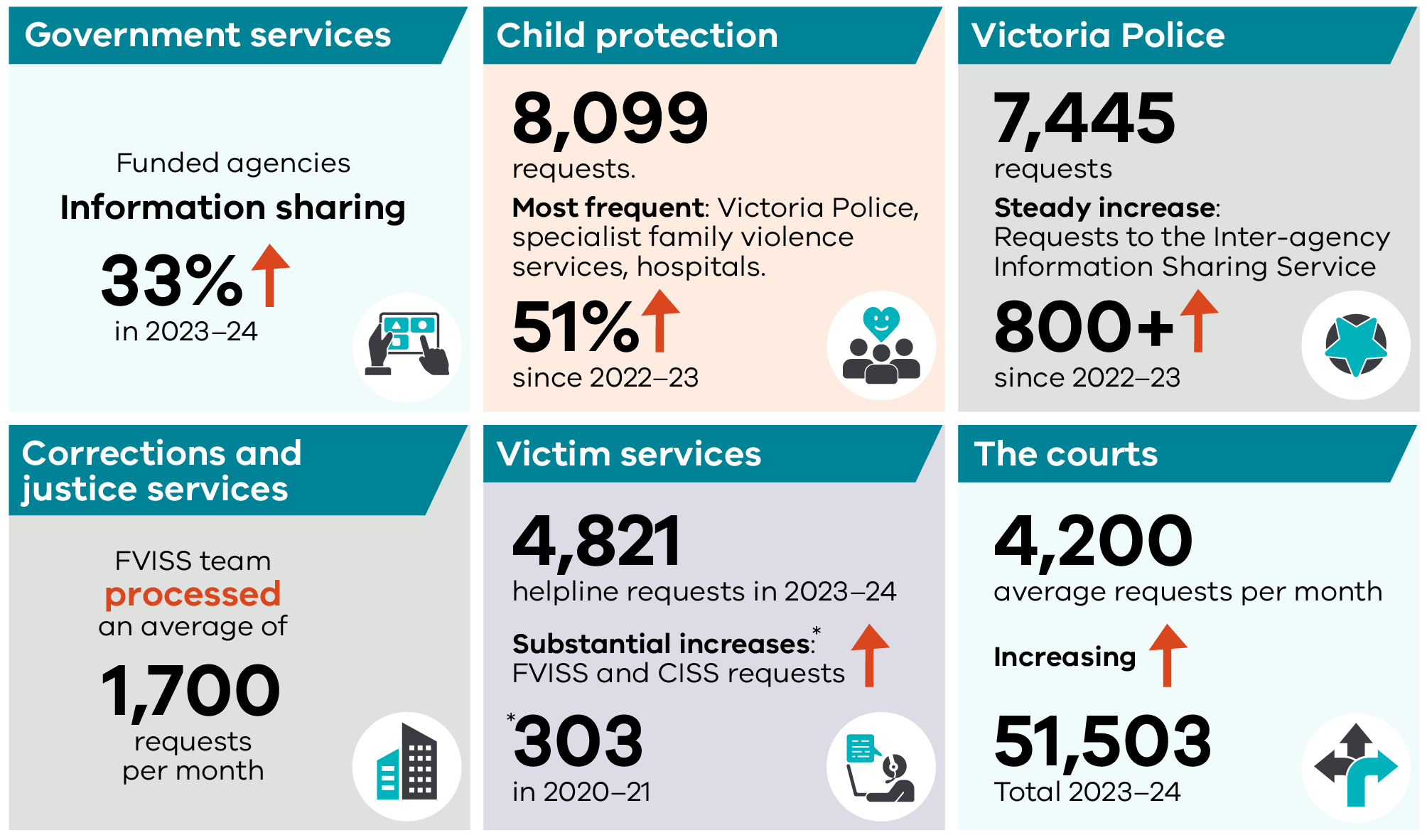
- a significant increase in information sharing requests in 2023–24. This reflects growing workforce confidence in prioritising victim survivor safety over confidentiality
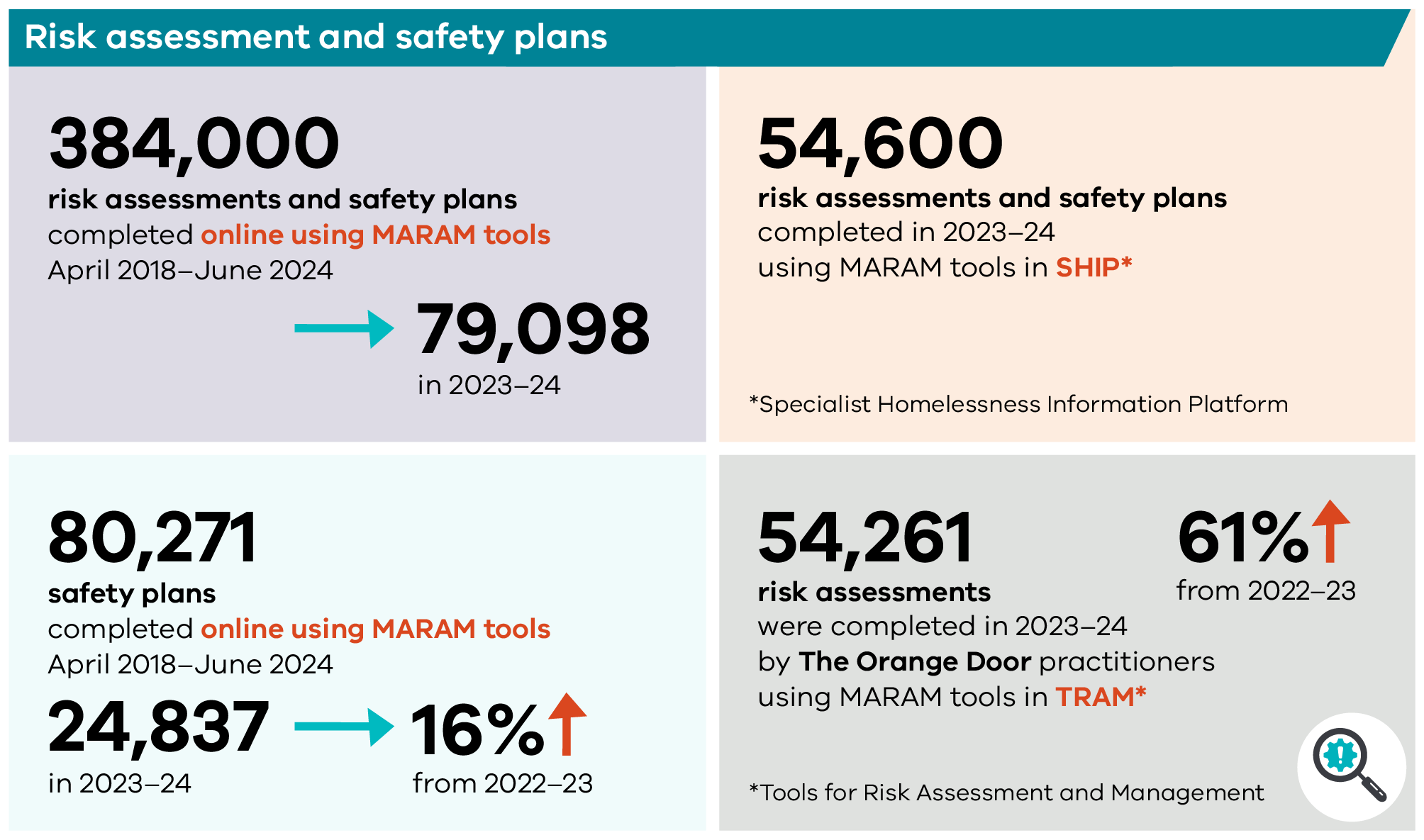
- more than 133,698 risk assessments conducted across the system using MARAM tools.
Highlights from 2023-24
- The Central Information Point introduced a brief report. This report contains a subset of critical risk information for immediate decision making. It is designed for use within 24 hours.
- The Orange Door worked closely with Victoria Police to determine how to share information about predominant aggressor identification and risk assessment.
- CAV’s Tenancy Advice and Advocacy Program worked with property managers to help victim survivors access rental properties and maintain tenancies. Child and Family Services Inc. in Ballarat delivers this program.
| Project spotlight: Updates to the TRAM platformTools for Risk Assessment and Management (TRAM) is an online platform developed by FSV.It contains risk assessment templates and safety plans. These provide a consistent approach for professionals undertaking family violence risk assessment and management.The main users of TRAM include The Orange Door network and some specialist family violence services.In 2023–24, the platform was rebuilt on a new server. This update improved the platform’s look and useability. It also reduced security-related risks.The new platform allows for better functionality in the future.The updates to TRAM support framework organisations to identify, assess and manage family violence risk. |
|---|
| Case study: The Orange Door[1]Brothers Travis (15 years) and Scott (17 years) contacted The Orange Door for help.They told the practitioner they had not slept or eaten properly for days and had been sleeping at a bus stop for the past week.Their parent had substance dependencies and forced them out of the house.Travis and Scott said they were afraid of being separated due to their ages. Travis falls under child protection, while Scott does not.The Orange Door’s work to support Travis and Scott is an example of collaborative practice in action.First, the practitioner engaged a child and young person practice leader. The practice leader arranged emergency accommodation and e-vouchers to meet the brothers’ immediate needs.The practitioner then connected Travis and Scott with a youth outreach service that could assess their longer-term accommodation and support needs.The boys engaged with the outreach services and were in safe accommodation the following morning.The practitioner also consulted with the community-based child protection service at The Orange Door to assess Travis’ risks from his parent.The information sharing schemes made this quicker and more efficient. — [1] Names have been changed. |
|---|
The MARAM Child and Young Person practice guides
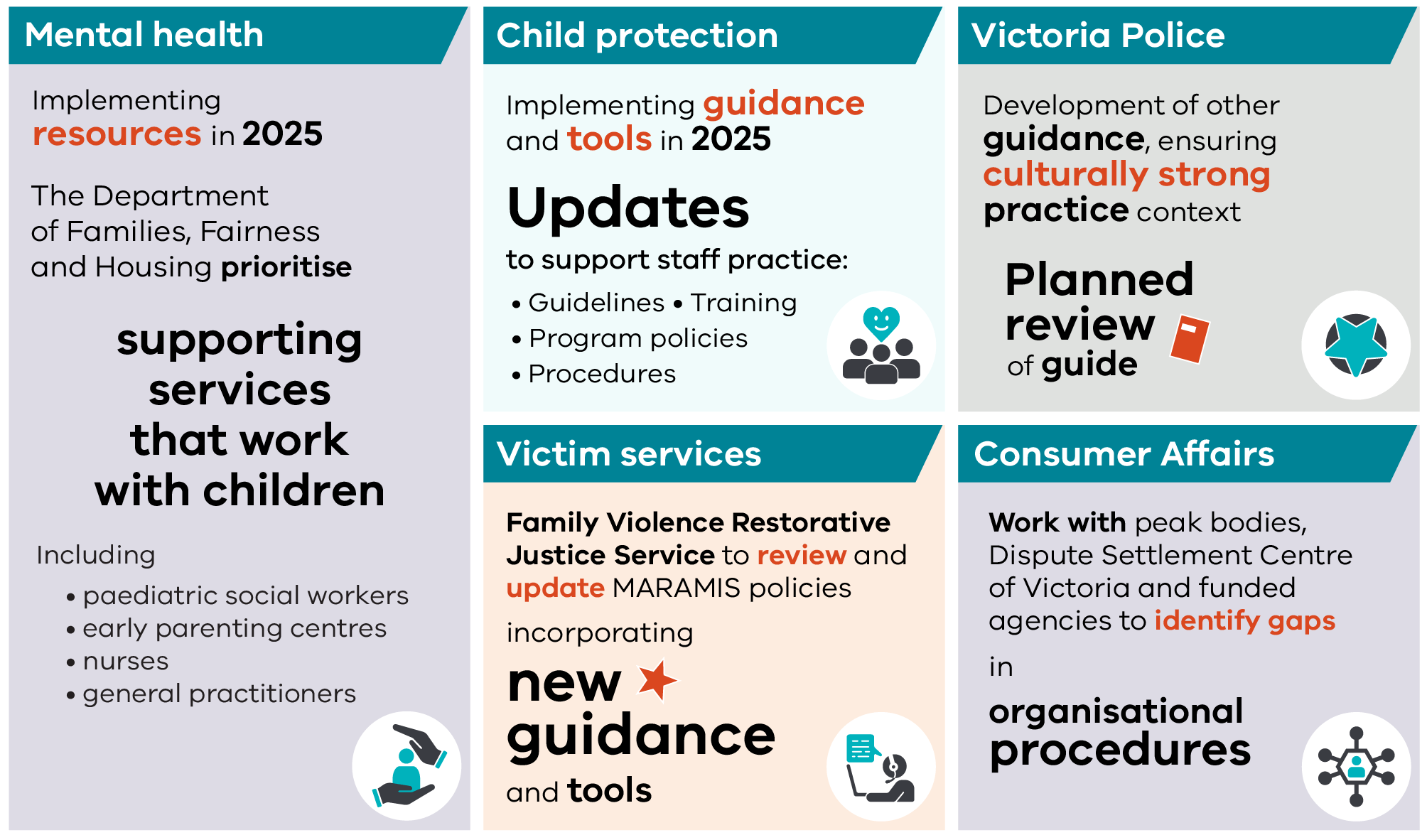
We are developing practice guides that focus on children and young people.
These will be released in 2025.
The guides support consistent and collaborative practice.
Figure 2 shows some of the ways portfolios will use the new guides.
Figure 2: Preparing for the Child and Young Person practice guides
Collaboration examples from the annual survey
The annual survey found 73% of organisational leaders agree their organisation applies consistent and collaborative practice.
This includes using MARAM tools to identify, assess and manage family violence.
Information sharing
The survey also showed increased numbers of requests for information under the Information Sharing Schemes in 2023–24. Figure 3 provides some examples.
This demonstrates that our workforces are more confident with using the schemes to support consistent and collaborative practice.
Figure 3: Information sharing by department
The annual survey shows that:
- frontline workers are confident in their understanding of the FVISS (86% of respondents) and CISS (85%)
- frontline workers shared information regularly (more than once a week) using the FVISS (27%) and the CISS (27%)
- workers shared information often (once a week to once a month) using the FVISS (31%) and the CISS (34%)
- organisational leaders believe their organisation shares information safely (84%). They understand how the information sharing schemes work (76%).
Risk assessments and safety plans
Similarly, use of MARAM risk assessments continues to grow.
Figure 4 shows an increase in 2023–24 in the number of risk assessments and safety plans undertaken by The Orange Door. (It also includes some specialist family violence services outside The Orange Door.)
Figure 4: Risk assessments and safety plans
| Case study: Child protectionChild protection received a report of siblings aged 11 and 3 who were experiencing severe family violence and coercive control by their father. Their mother’s parenting capacity was also affected by substance use issues.At the time of the report, the mother acknowledged the impact of family violence on her and the children.The children were afraid of their father and did not want to spend time with him.While they were in their mother’s care, she sought help and engaged with child protection and other services.Child protection assessed the risk to the children and their mother as ‘serious risk’.The mother accessed alcohol and other drugs services, specialist family violence services and therapeutic services for the children.The father agreed to engage with a men’s behaviour change program. He was also encouraged to seek supervised contact with the children to enable him to spend time with them safely.The mother said she was impressed that the child protection practitioners were non-judgemental. She stated they made her feel safe to disclose the family violence she and the children experienced. |
|---|
Plans for 2024-25
The Health portfolio will pilot a ‘train the trainer’ program to help public hospitals and integrated health services to use the information sharing schemes.
It will also help health services and hospitals across Victoria to access Adults Using Family Violence resources.
The courts will also implement an Adults Using Family Violence tool. They will tailor this for their workforce and update the client management database.
The Housing portfolio will publish updated Homelessness services guidelines and conditions of funding. These guidelines incorporate vital information to help homelessness services align to MARAM.
The Prevention of Family Violence portfolio will release Child and Young Person practice guides in 2025. These resources will support departments and organisations to deliver consistent practice. They also address the recommendations of the MARAM 5-year Evidence review.
Updated 14 March 2025
MARAM Consolidated Annual Report 2023-24pdf3.9 MB
About the VIC Government
- The Premier and ministers
- Find a Vic Gov department, agency or service
- Strategies and policies
- Inquiries and royal commissions
Grants and programs
Jobs and careers
Arts, culture and heritage
Business and the workplace
- Mentally Healthy Workplaces Framework
- Portable Long Service Authority
- Victoria’s racing industry
- Workforce Inspectorate Victoria
- Liquor licensing, sale and supply
Communities
- Children
- First Peoples - State Relations
- Finding records
- Gender equality & women’s leadership
- LGBTIQA+ equality
- Multicultural communities
- Seniors Online
- Veterans support and commemoration
- Volunteering in Victoria
- Youth Central
Education and training
- Victorian Early Childhood Regulatory Authority
- Early childhood education – information for professionals
- Kinder: Best Start, Best Life
- Education – information for parents
- Schools.Vic - information for schools
- Education grants, programs, awards and events
- PROTECT
- TAFE, training and universities sector
- TAFE Victoria
- Victorian Skills Authority
- Apprenticeships Victoria
- Learn Local
Environment, water and energy
Finance and economy
Health and social support
- Family violence reform
- NDIS Worker Screening Check
- NDIS and disability services and support in Victoria
- Patient Review Panel
- Transforming Trauma Victoria
Housing and property
Law and justice
- Adoption
- Births, deaths and marriages
- Honorary justices
- Machete ban
- Safeguarding Victorians against terrorism
- Stolen Generations Reparations Package
- Victims of Crime
- Victorian Racing Tribunal
Safety and emergencies
- Emergency Recovery Victoria
- Victorian Emergency Relief and Recovery Foundation
- Emergency Recovery Resource Portal
- How well do you know fire
- Fire Services Reform
- Water safety
- Marine Search and Rescue
Science and technology
- Data sharing and open data
- Data.vic - discover and access Vic Gov open data
- Developer.Vic - portal for API developers
- Go.vic URL shortener
- Vic Gov IT project dashboard
- Victoria’s free public wi-fi network
- Cyber security in the Victorian Government
Sport and recreation
Traffic and transport
- Cameras Save Lives
- Transport Fines
- Getting Around
- Transport Planning
- Transport Future
- Climate Change and transport
- Future Directions For Transport
- Transport projects
- Ports and Freight
Working in the Victorian Government
- Single Digital Presence home
- Accommodation and Library Services
- Executive employment in the Victorian public sector
- Budget, procurement and funding
- Careers in the Victorian Government
- Council and Regulator Toolkit
- Guidelines for working in government
- Join a government network
- Standards and guidelines
- VicFleet CarPool
- Victorian Government style guide