Administrative Guidelines on Engaging Professional Services in the Victorian Public Service
The purpose of these Guidelines is to provide decision making principles and practical guidance that supports public service bodies and entities to determine when the use of professional services is appropriate.
On this page
- Download the PDF
- 1. Overview
- 2. Scope
- 4. Approval requirements
- 5. Record-keeping requirements
- 6. Approval process for engaging professional services
- 7. Additional guidance
- Footnotes
- Authorisation and amendments
Download the PDF
You can download the guidelines PDF or read the full text below.
1. Overview
Professional services and labour hire play an important role in supporting the Victorian Public Service (VPS) to ensure government priorities are achieved.
The purpose of these Administrative Guidelines on Engaging Professional Services in the Victorian Public Service (Guidelines) is to provide a practical decision-making framework for the use of professional services, including approval, record-keeping and reporting requirements. This framework will support limiting professional services engagements to specific circumstances and allow departments to achieve their budget commitments. Labour Hire arrangements are covered separately under the Administrative Guidelines on Engaging Labour Hire in the Victorian Public Service (Labour Hire Guidelines).
For detailed information about the policies that govern procurement in the Victorian Government more broadly, contact the Victorian Government Purchasing Board, or visit the Victorian Government Purchasing Board website.
2. Scope
Bodies and entities in scope of the Guidelines
The Guidelines are circulated to public service bodies and entities under Section 36A of the Public Administration Act 2004 (Vic) (the Act) and apply to all government public service bodies and entities as defined in the Act that are mandated to comply with VGPB policies. The Guidelines do not apply to: • special bodies as defined by section 6 of the Act • exempt bodies as defined by section 4 of the Act • to any government body established under the Inquires Act 2014 (Vic)
Engagements in scope of the Guidelines
An engagement is in-scope when any ‘core public service functions’ are expected to form a material part of the engagement, regardless of value.
‘Core public service functions’ are a material part of an engagement when expenditure on the six types of services in Table 1 is expected to collectively:
- account for a significant proportion of the proposed engagement OR
- have a proposed value exceeding $150,000 (incl. GST), even if this will not be a significant proportion of the engagement
Worked Example
An entity is seeking to undertake an infrastructure project. The budget for the proposed work is $10,000,000, which includes preparing a substantial business case and undertaking significant stakeholder engagement.
The entity estimates that, collectively, these ‘core public service functions’ components will be valued at approximately $250,000 and will not account for a significant proportion of the proposed work. However, as the components are estimated to collectively exceed $150,000 (incl. GST), the engagement is in-scope of these Guidelines.
Core Public Service Functions
- Strategic policy/program advice, development, or implementation
- Program reviews, assurance, or evaluation
- Business strategy and organisational development and redesign
- Business case preparation and development
- External stakeholder/community engagement and facilitation
- Internal meeting and event facilitation
Exemptions
- VicGov internal service engagements (e.g. VGSO) or VicGov internal shared service providers are exempt from these Guidelines.
- Public construction services are exempt from these Guidelines. Public Construction is defined in Ministerial Directions for Public Construction Procurement and Construction Guidance 1.3b as services directly related to construction works that will impact on physical structure (e.g. architecture, engineering).
3. Valid engagement circumstances
To go-to-market for work which is considered a core public service function, as determined by the test outlined in section 2, one of the below four ‘valid engagement circumstances (VEC)’ must apply, and the conditions required for that valid engagement circumstance to apply must be met:
A. Work requiring skills or expertise that cannot be efficiently maintained within the organisation1.
To meet this condition, the following must apply:
- The necessary technical or specialist skill(s) required to deliver the work or services are not available within the organisation, AND
- Current and future demand within the organisation for the technical or specialist skill(s) does not warrant recruiting the capability into the organisation.
B. Need for genuine independence
To meet this condition, one of the following must apply:
- There is a legal obligation (legislative or contractual agreement with another level of government) for services to be performed by an entity external to government for the purpose of integrity or assurance, OR
- The services require independent assessment from a body separate from those involved in the work and a genuine effort was made to identify appropriately independent resources elsewhere in the organisation.
C. Work requiring immediate or time critical action that cannot be met within existing VPS capacity
To meet this condition, the following must apply:
- The work is urgent or time critical; such as it relates to an emergency, a legal/court deadline, or a similarly critical event; or it is a public commitment with specific deadlines that cannot be pushed out (and DPC has agreed this position), AND
- The work relates to unpredictable demands (i.e. should not be used for periods of predictable or foreseeable surge work), AND
- The ability to meet at least some of the required capacity through reprioritising existing resources or using surge functions has been considered prior to going to market and is not feasible.
D. Engagement has received explicit Cabinet approval
To meet this condition, the following must apply:
- Where a decision of Cabinet (or a Committee of Cabinet) explicitly requests a service be delivered externally.
Whether a VEC applies should be assessed and approved by the responsible senior executive prior to going to market, and the decision and VEC recorded.
Secretaries (or equivalent) may provide an exemption in exceptional circumstances to go-to market, even when one of the four VECs does not apply for which is considered a core public service function.
4. Approval requirements
Scope of approval requirements
Engagements in scope of the Guidelines are subject to these approval requirements. The definition of engagements in scope are defined in Section 2.
The approval requirements do not apply to engagements which have received explicit Cabinet approval (see Section 3 - Valid Engagement Circumstance D).
These, and other, engagements which are out of scope of these approval requirements for any reason, are subject to departments/entities’ standard procurement and approval processes and thresholds.
Approval requirements
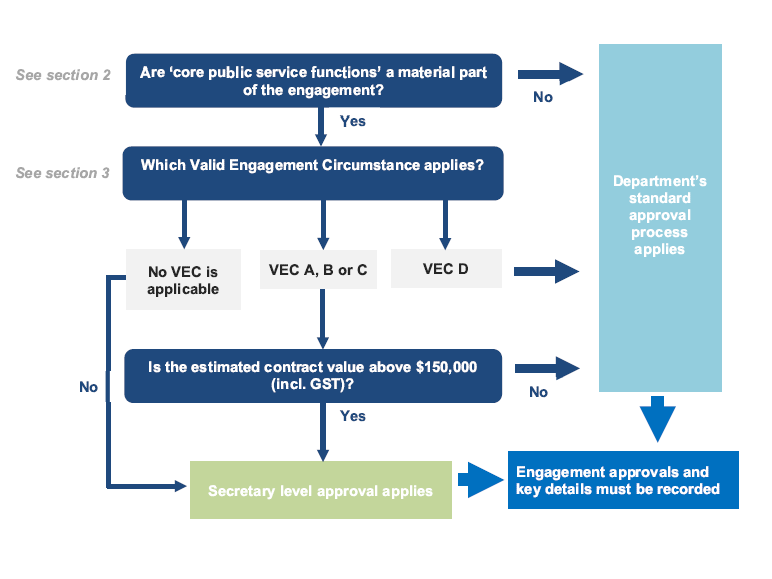
The Secretary – or equivalent Head of a public service body – must confirm the valid engagement circumstance and approve the decision to go to market for in-scope engagements, if either of the following is true:
A. The estimated engagement value is more than $150,000 (including GST) Note that as approval is required before going to market, the financial threshold applied here relates to the estimated value of the proposed engagement. B. A valid engagement circumstance does not apply (See Section 3) If no valid engagement circumstance applies, Secretary (or equivalent) approval is required before going to market regardless of the estimated value of the contract.
Department Secretaries, or equivalent Head of a public service body, are accountable for the procurement of all professional services engagements, regardless of delegation permitted under the Guidelines.
5. Record-keeping requirements
Departments and entities are expected to maintain appropriate records for all professional services engagements, including engagements in scope of these guidelines.
For engagements in scope of these Guidelines, these records should be able to demonstrate compliance with the Guidelines at the point of going to market and should include, at a minimum, the below fields in addition to fields required by the body’s internal procurement policies:
- Engagement title
- Primary ‘core public service function’ service
- Approval level
- Primary valid engagement circumstance
- Estimated engagement cost (inc. GST)
This authority may be delegated to the responsible Deputy Secretary or equivalent if a valid engagement circumstance can be demonstrated.
Please contact your Chief Procurement Officer for further information regarding the applicable approval and record keeping requirements.
6. Approval process for engaging professional services
Decision matrix
7. Additional guidance
Additional information and resources on Victorian Government State Purchase Contracts
State Purchase Contracts organised by category
Professional Advisory Services State Purchase Contract
User Guide - Professional Advisory Services State Purchase Contract
Other procurement resources
Browse State Purchase Contracts, Registers and other supplier lists
Procurement complexity and capability assessment policy
Victorian Government Financial Management and Financial Reporting Directions
Financial Reporting Directions and guidance for Departments
Standing Directions 2018 under the Financial Management Act 1994
Footnotes
- Whenever possible, engagements should include a contractual obligation and clear project strategy for transferring relevant skills and knowledge across to the VPS.
Authorisation and amendments
Authorised by the Secretary, Department of Premier and Cabinet Victoria, under section 36A(1) of the Public Administration Act 2004 (Vic).
Jeremi Moule Secretary, Department of Premier and Cabinet
Compliance
Under section 36A(3) of the Public Administration Act 2004 (Vic), if a public service body or a public entity to which guidelines have been issued operates, or intends to operate, in a manner that is inconsistent with those guidelines, the relevant public service body Head or public entity Head must provide written reasons for doing so to the Secretary, Department of Premier and Cabinet.
Number: 2024/05
Issue: 1.2
Issued by the Department of Premier and Cabinet Victoria (DPC) in July 2024.
These Guidelines are subject to periodic amendments. DPC will provide notification when an update has taken place.
Updated 15 January 2025
About the VIC Government
- The Premier and ministers
- Find a Vic Gov department, agency or service
- Strategies and policies
- Inquiries and royal commissions
Grants and programs
Jobs and careers
Arts, culture and heritage
Business and the workplace
- Mentally Healthy Workplaces Framework
- Portable Long Service Authority
- Victoria’s racing industry
- Workforce Inspectorate Victoria
- Liquor licensing, sale and supply
Communities
- Children
- First Peoples - State Relations
- Finding records
- Gender equality & women’s leadership
- LGBTIQA+ equality
- Multicultural communities
- Seniors Online
- Veterans support and commemoration
- Volunteering in Victoria
- Youth Central
Education and training
- Victorian Early Childhood Regulatory Authority
- Early childhood education – information for professionals
- Kinder: Best Start, Best Life
- Education – information for parents
- Schools.Vic - information for schools
- Education grants, programs, awards and events
- PROTECT
- TAFE, training and universities sector
- TAFE Victoria
- Victorian Skills Authority
- Apprenticeships Victoria
- Learn Local
Environment, water and energy
Finance and economy
Health and social support
- Family violence reform
- NDIS Worker Screening Check
- NDIS and disability services and support in Victoria
- Patient Review Panel
- Transforming Trauma Victoria
Housing and property
Law and justice
- Adoption
- Births, deaths and marriages
- Honorary justices
- Machete ban
- Safeguarding Victorians against terrorism
- Stolen Generations Reparations Package
- Victims of Crime
- Victorian Racing Tribunal
Safety and emergencies
- Emergency Recovery Victoria
- Victorian Emergency Relief and Recovery Foundation
- Emergency Recovery Resource Portal
- How well do you know fire
- Fire Services Reform
- Water safety
- Marine Search and Rescue
Science and technology
- Data sharing and open data
- Data.vic - discover and access Vic Gov open data
- Developer.Vic - portal for API developers
- Go.vic URL shortener
- Vic Gov IT project dashboard
- Victoria’s free public wi-fi network
- Cyber security in the Victorian Government
Sport and recreation
Traffic and transport
- Cameras Save Lives
- Transport Fines
- Getting Around
- Transport Planning
- Transport Future
- Climate Change and transport
- Future Directions For Transport
- Transport projects
- Ports and Freight
Working in the Victorian Government
- Single Digital Presence home
- Accommodation and Library Services
- Executive employment in the Victorian public sector
- Budget, procurement and funding
- Careers in the Victorian Government
- Council and Regulator Toolkit
- Guidelines for working in government
- Join a government network
- Standards and guidelines
- VicFleet CarPool
- Victorian Government style guide